Home
Class 12
CHEMISTRY
An optically active compound A with mole...

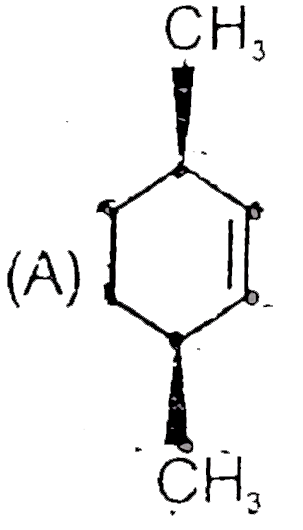
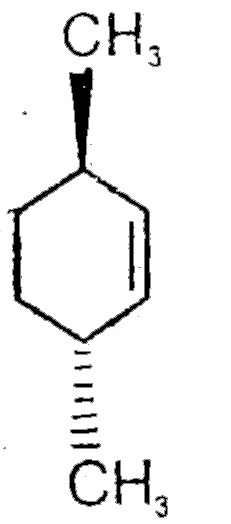
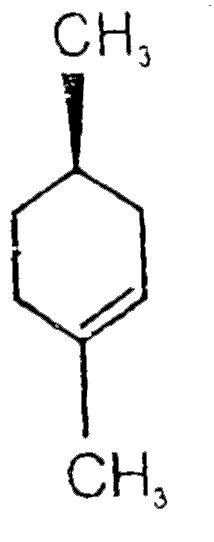
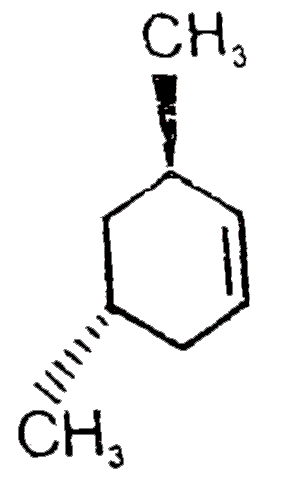
An optically active compound `A` with molecular formula `C_(8)H_(14)` undergoes catalytic hydrogenation to give an optically inactive product. Which of the following structures for A is/are consistent with all the data?

A

B

C

D

Text Solution

AI Generated Solution

The correct Answer is:

To solve the problem, we need to determine which structure of the compound A (C8H14) is optically active and can yield an optically inactive product upon catalytic hydrogenation. Here’s a step-by-step breakdown: ### Step 1: Understand the requirements - Compound A has the molecular formula C8H14. - It is optically active, meaning it must have a chiral center or a configuration that allows for optical activity. - Upon catalytic hydrogenation, it yields an optically inactive product, which means the product must have a plane of symmetry or be superimposable on its mirror image. **Hint:** Remember that optically active compounds typically have no plane of symmetry, while optically inactive compounds do. ### Step 2: Analyze the options We need to evaluate each given structure to see if it meets the criteria. 1. **Option A:** Check for optical activity. - This structure has a plane of symmetry, making it optically inactive. Thus, it cannot be compound A. **Hint:** Look for a plane of symmetry in the structure to determine optical activity. 2. **Option B:** Check for optical activity and hydrogenation. - This structure does not have a plane of symmetry, making it optically active. Upon hydrogenation, it will still be optically active as it retains chirality. **Hint:** Remember that if a compound is optically active before hydrogenation, it will likely remain so unless it loses chirality. 3. **Option C:** Check for optical activity and hydrogenation. - This structure is also optically active. However, upon hydrogenation, it can lead to a product that has a plane of symmetry (if the groups are arranged in such a way that they can cancel each other out), making the product optically inactive. **Hint:** Visualize the hydrogenation process and how the arrangement of groups might change. 4. **Option D:** Check for optical activity and hydrogenation. - This structure is optically active as well. Similar to option B, after hydrogenation, it will remain optically active. **Hint:** Again, consider the implications of chirality after the addition of hydrogen. ### Step 3: Conclusion Based on the analysis: - Option A is ruled out due to being optically inactive. - Option B is ruled out because it remains optically active after hydrogenation. - Option D is ruled out for the same reason as option B. - Option C is the only structure that can be optically active and yield an optically inactive product upon hydrogenation. Thus, the structure of compound A is **Option C**. **Final Answer:** The structure of compound A is Option C.

To solve the problem, we need to determine which structure of the compound A (C8H14) is optically active and can yield an optically inactive product upon catalytic hydrogenation. Here’s a step-by-step breakdown: ### Step 1: Understand the requirements - Compound A has the molecular formula C8H14. - It is optically active, meaning it must have a chiral center or a configuration that allows for optical activity. - Upon catalytic hydrogenation, it yields an optically inactive product, which means the product must have a plane of symmetry or be superimposable on its mirror image. **Hint:** Remember that optically active compounds typically have no plane of symmetry, while optically inactive compounds do. ...
Promotional Banner

Topper's Solved these Questions

  • TEST PAPERS

    RESONANCE ENGLISH|Exercise PT-01|30 Videos
  • TEST PAPERS

    RESONANCE ENGLISH|Exercise Pt-02|30 Videos
  • TEST PAPERS

    RESONANCE ENGLISH|Exercise PART - III CHEMISTRY|20 Videos
  • SURFACE CHEMISTRY

    RESONANCE ENGLISH|Exercise Section - 5|1 Videos
  • TEST SERIES

    RESONANCE ENGLISH|Exercise CHEMISTRY|50 Videos

Similar Questions

Explore conceptually related problems

An optically active hydrocarbon X has molecular formula C_(6)H_(12) . X on catalytic hydrogenation gives optically inactive C_(6)H_(14).X could be

A compound with molecular formula C_(7)H_(16) shows optical isomerism, the compound will be

Identify the compound that on hydrogenation produces an optically active compound from the following compounds :

A compound (A) with molecular formula C_(5) H_(10) gives one monochlorination product. Compound (A) is:

Give the structure of an optically active alkene (A) having the lowest molecular mass, which on catalytic hydrogenation gives an optically inactive compound (B) .

Which of the following is an optically inactive compound?

Number of optically active compounds out of following that can give Haloform reactions.

Which alkene will give optically inactive product with Br_2//"CCl"_4 ?

Which one of the following compounds show optical activity

RESONANCE ENGLISH-TEST PAPERS-Chemistry
  1. Find A,B and C

    Text Solution

    |

  2. is this orientation have non-zero dipole moment : Anti conformation of...

    Text Solution

    |

  3. An optically active compound A with molecular formula C(8)H(14) underg...

    Text Solution

    |

  4. Which of the following rection given secondary alcohol?

    Text Solution

    |

  5. Which of the following compounds shows geometrical isomerism ?

    Text Solution

    |

  6. Which is/are correct for given structres?

    Text Solution

    |

  7. Which set of the following compound(s) give benzene on reaction with P...

    Text Solution

    |

  8. Compare the radii of two nuclei with mass number 27 and 125 respective...

    Text Solution

    |

  9. Compare the radii of two nuclei with mass number 64 and 1 respectively...

    Text Solution

    |

  10. Which of the following reaction is/are incorrect?

    Text Solution

    |

  11. Which statement is/are correct:

    Text Solution

    |

  12. How many of the following statement/s is/are correct? (1). For isoth...

    Text Solution

    |

  13. The freezing point of 0.08 molal aq NaHSO(4) solution is -0.372. Calcu...

    Text Solution

    |

  14. Given P(C Cl(4)^(0))=100 torr, P(H(2)O)^(0)=300 torr What will be to...

    Text Solution

    |

  15. henry's law constant for CO(2) in water is 2.5xx10^(8) Pa at 298K calc...

    Text Solution

    |

  16. 0.1 litre so.ution is made by mixing 4 gram NaOH, 20 millimoles of H(2...

    Text Solution

    |

  17. 2 moles of an ideal monoatomic gas undergo a reversible process for wh...

    Text Solution

    |

  18. Conductivity of a saturated solution of a sparingly soluble salt AB at...

    Text Solution

    |

  19. In the arrangement given below 20 mole of N(2) and 5 mole of He are pr...

    Text Solution

    |

  20. An ideal monoatomic gas initially in state 1 with pressure P(1)=20 atm...

    Text Solution

    |
