Home
Class 12
PHYSICS
A ray is incident on interface of two me...


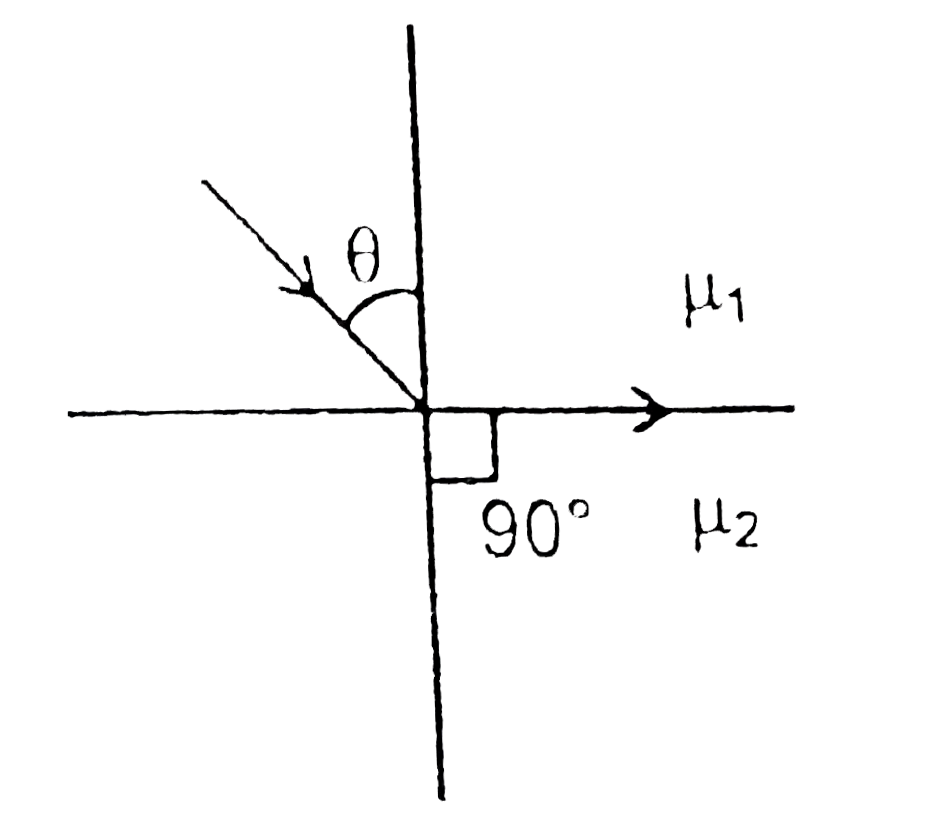
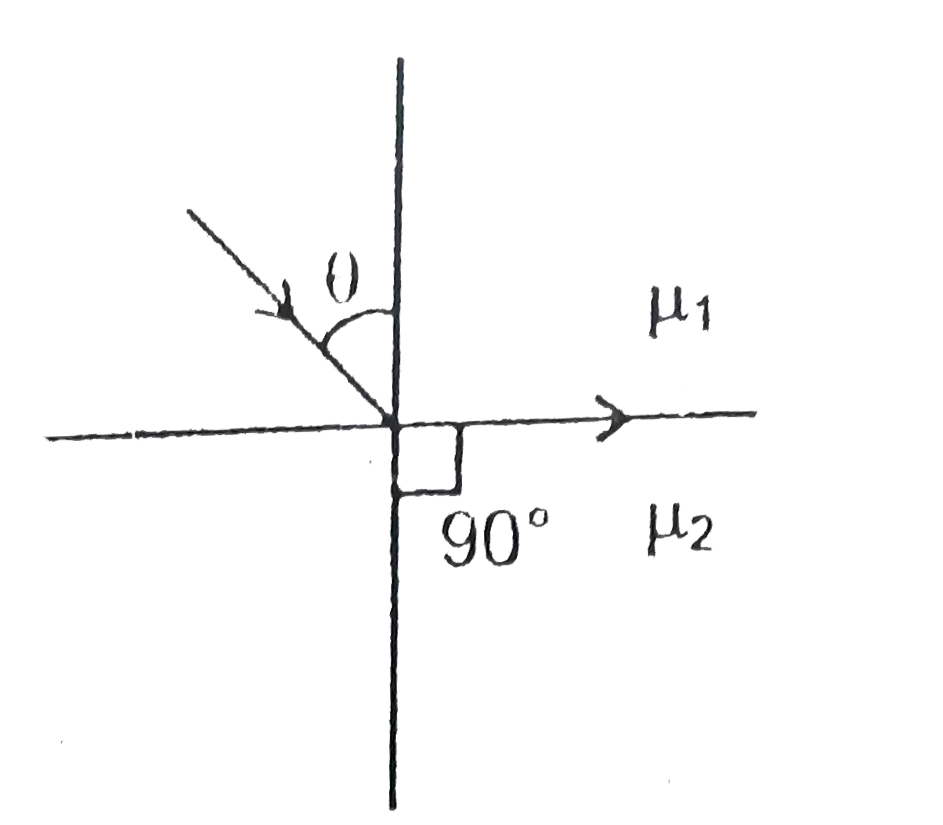
A ray is incident on interface of two media at critical angle as shown in the figure.

A

if `mu_(1)` and `mu_(2)` both are increased by same amount the ray will suffer total internal reflection.

B

if `mu_(1)` and `mu_(2)` both are increased by same amount the ray will suffer refraction and angle of refraction will be less then `90^(@)`

C

if `mu_(1)` and `mu_(2)` both are doubled ray will suffer total internal reflection.

D

if `mu_(1)` ad `mu_(2)` both are doulbed ray will suffer refraction and angle of refraction will be less te `90^(@)`

Text Solution

Verified by Experts

The correct Answer is:
B


In given case
`sintheta=(mu_(2))/(mu_(1))`
if we increase both indices by `x`
`sini_(c)=(mu_(2)+x)/(mu_(1)+x)gt(mu_(2))/(mu_(1))` (since `mu_(1)gtmu_(2))`
`i_(c)gttheta`
Ray will suffer refraction. if `mu_(1)&mu_(2)` both are doubled critical angle will remain same, so the direction of refracted ray will remain same.
Promotional Banner

Similar Questions

Explore conceptually related problems

A light ray moving in medium-I (of refractive index n_(1) ) is incident on interface of two media and it is totally internally reflected at the interface. Now, refractive index n_(2) of medium-II is decreased, then

A ray is incident on a sphere of refractive index sqrt(2) as shown in figure. Angle of refraction of the ray inside sphere is 30^(@) if total deviation suffered by the ray is 30x^(0) , then find x.

White light is incident on the interface of glass and air as shown in figure. If green ligth is just totally internally reflected then the emerging ray in air contains

White light is incident on the interface of glass and air as shown in figure. If green ligth is just totally internally reflected then the emerging ray in air contains

When a ray of ordinary light is incident on the surface of separation of two media at polarizing angle, show with the help of a labelled diagram that reflected ray and the refracted ray are mutually perpendicular to each other.

Two light rays 1 and 2 are incident on two faces AB and AC on an isosceles prism as shown in the figure. The rays emerge from the side BC. Then,

A ray of monochromatic light is incident on the refracting face of a prism (angle 75^(@)0 . It passes through the prism and is incident on the other face at the critical angle. If the refractive index of the prism is sqrt(2) , then the angle of incidence on the first of the prism is

The path of a ray of light passing through an equilateral glass prism ABC is shown in figure. The ray of light is incident on face BC at the critical angle for just total internal reflection. The total internal reflection. The total angle of deviation after the refraction at face AC is 108^@ . Calculate the refractive index of the glass.

A ray is incident on the first prism at an angle of incidence of 53^(@) as shown in the figure . The angle between side CA and B'A' for the net deviation by both the prisms to be double of the deviation produced by the first prism , will be

A rays of light is incident on a thick slab of glass of thickness t as shown in figure. The emergent ray is parallel to the incident ray but displaced sideways by a distance d. If the angles are small then d is