Home
Class 12
PHYSICS
For two different gases x and y have deg...


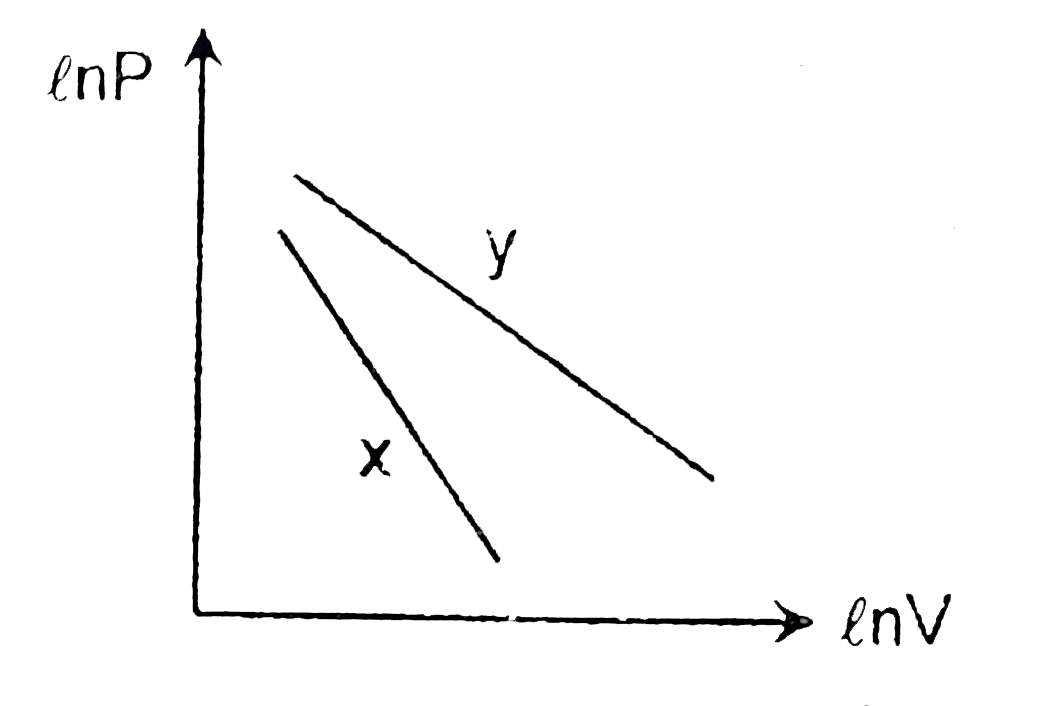
For two different gases x and y have degree of freedon `f_(1)` and `f_(2)` and molar specific heat capacities at constant volume `C_(V_(1))` and `C_(V_(2))` respectively. The lnP versus lnV graph is plotted for adiabatic process, as shown, choose the correct options.

A

`f_(2)` can be `3`

B

`f_(2)gef_(1)`

C

`C_(V_(2))geC_(V_(1))`

D

`C_(V_(1))geC_(V_(2))`

Text Solution

Verified by Experts

The correct Answer is:

B, C

`PV^(')=` constant
`lnP+gammalnV=C` where C is a constant
`lnP=-gammalnV+C` is straight line equation
`|"slope"|=gamma=1+(2)/(f)`, slope of x is greater hence `f` is smaller
`C_(V)=(R)/(gamma-1), gamma` is smaller for y hence its `C_(V)` greater
Promotional Banner

Similar Questions

Explore conceptually related problems

C_v and C_p denote the molar specific heat capacities of a gas at constant volume and constant pressure, respectively. Then

C_v and C_p denote the molar specific heat capacities of a gas at constant volume and constant pressure, respectively. Then

C_v and C_p denote the molar specific heat capacities of a gas at constant volume and constant pressure, respectively. Then

C_v and C_p denote the molar specific heat capacities of a gas at constant volume and constant pressure, respectively. Then

A gaseos mixture consists of equal number of moles of two ideal gases having adiabatic exponents gamma_(1) and gamma_(2) and molar speific heats at constant volume C_(v_(1)) and C_(v_(2)) respectively. Which of the following statements is/are correct?

Why gases have two principal specific heat capacities ? C _(P) gt C _(v), Why?

Let (C_v) and (C_p) denote the molar heat capacities of an ideal gas at constant volume and constant pressure respectively . Which of the following is a universal constant?

Molar heat capacity of gas whose molar heat capacity at constant volume is C_V , for process P = 2e^(2V) is :

Two liquids A and B have specific heat capacities 2.5 Jg^(-1)""^(@)C and 3.2 Jg^(-1)""^(@)C respectively. Which liquid is a good conductor of heat? Why?

Two liquids A and B have specific heat capacities 2.5 Jg^(-1) ""^(@)C and 3.2 Jg^(-1) ""^(@)C respectively. Which liquid is more suitable as a liquid in radiators for cooling?
