Home
Class 12
PHYSICS
Two identical glass slabs of same thickn...


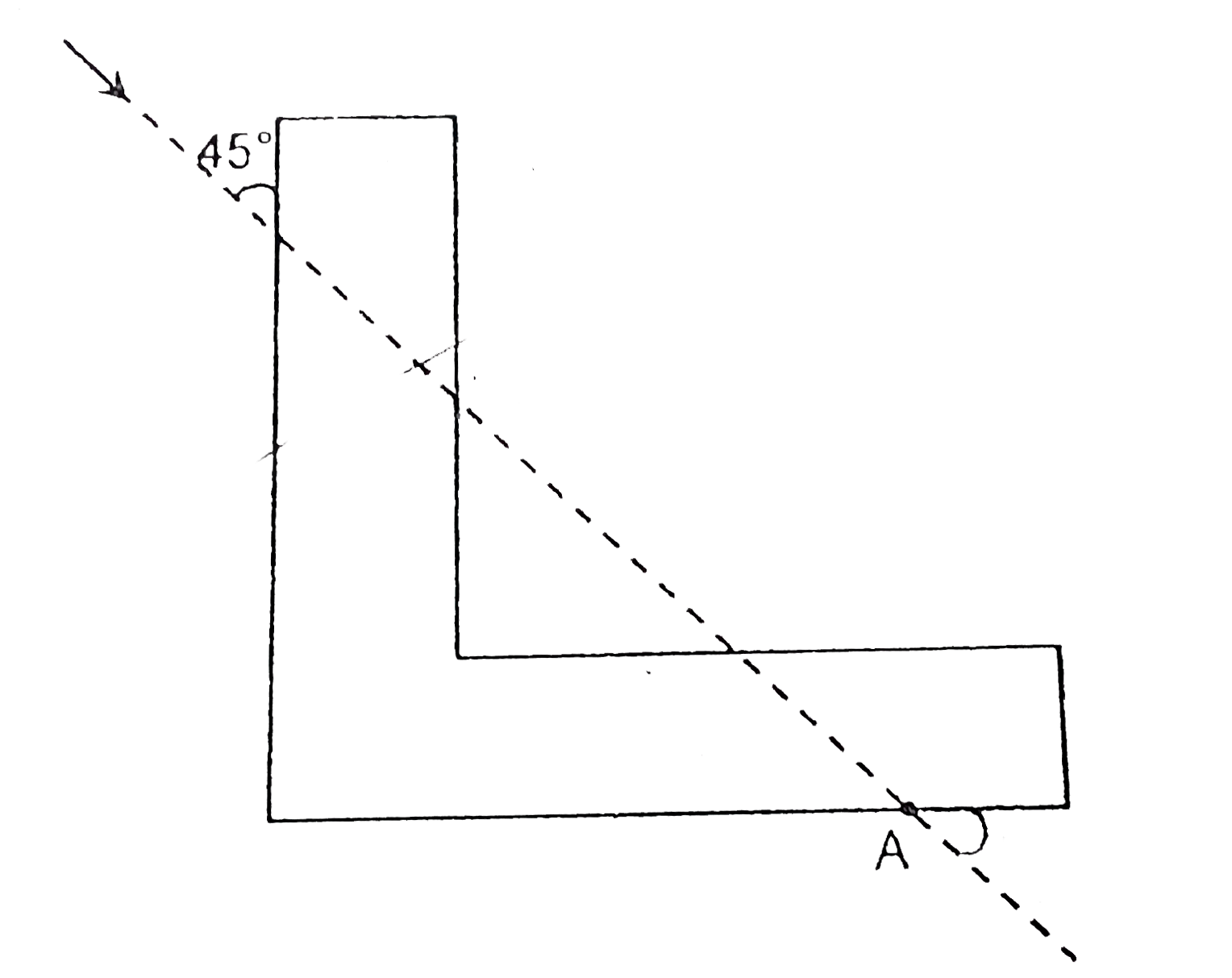
Two identical glass slabs of same thickness are joined to form an `L` shape as shown. A ray is incident on the combination as shown (in the plane of paper). The final emergent ray will choose, incorrect options(s):

A

Come out at point A in the same direction as that of original ray.

B

Come out at point A but not in the same direction as that of origional ray.

C

Does not come out at point A but is in the same direction as original ray.

D

Does not come out at point A and it is not in same direction as origional ray.

Text Solution

Verified by Experts

The correct Answer is:
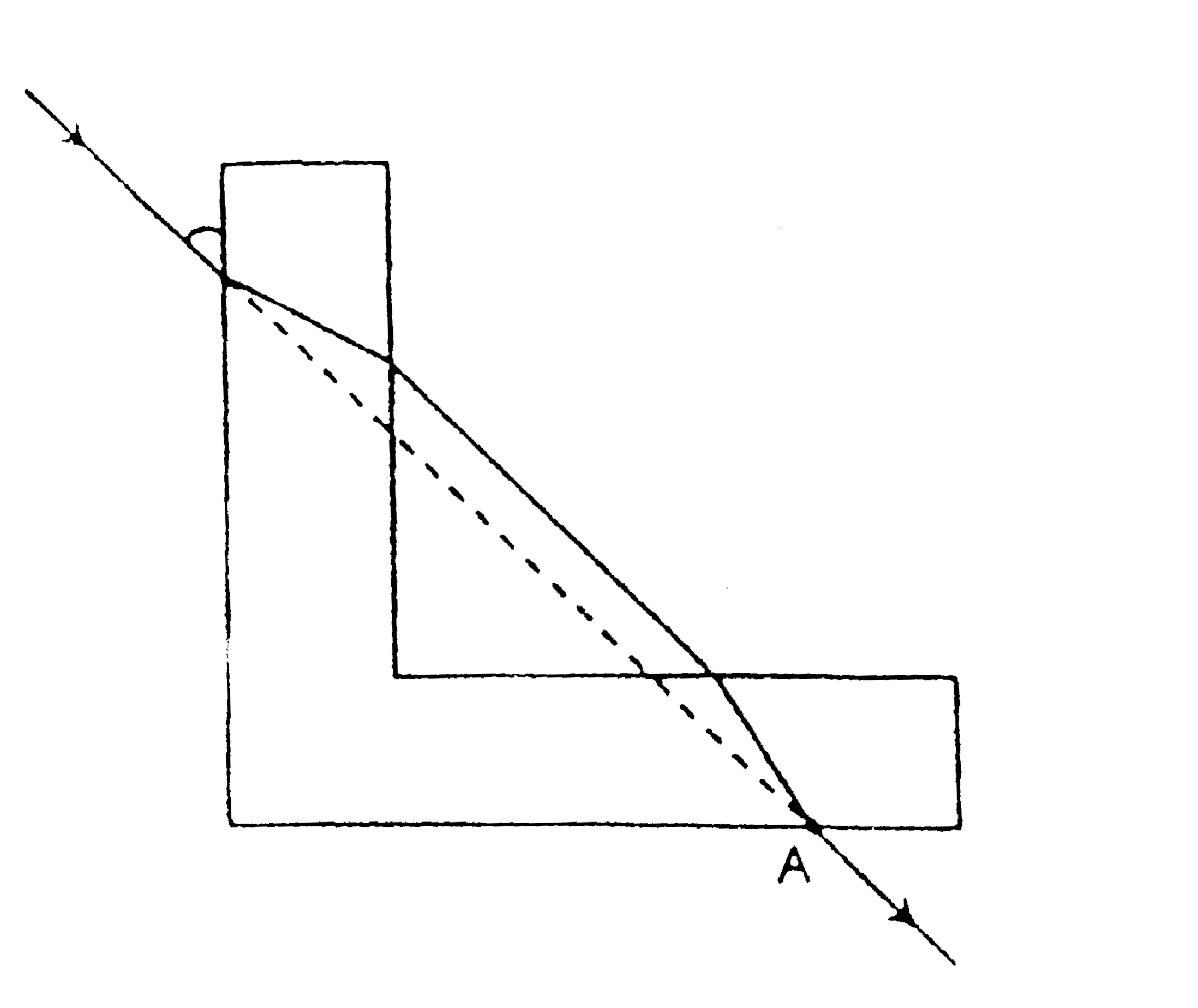
B, C, D


Option B,C,D are incorrect
An ideal monatomic
`TV^(8-1)=` constant.
`a-1=(1)/(2)`
`a=(3)/(2)` ltgbrgt `C=C_(V)-(R)/(a-1)`
`C=C_(V)-2R`
As V increase, temperature decreases hence internal energy decreases.
Promotional Banner

Similar Questions

Explore conceptually related problems

Three identical rods each of length L and mass m are joined to form a U -shape as shown in figure. The distance of centre of mass of combined system from the corner .O. is

A ray of light incident on glass slab finally emerges out of it. The ray which emerges out is called :

Two plane mirrors are arranged at right angles to each other as shown in figure.A ray of light is incident on the horizontal mirror at an angle theta . For what value of theta the ray emerges parallel to the incoming ray after reflection from the vertical mirror ?

Two identical uniform rods AB and CD, each of length L are jointed to form a T-shaped frame as shown in figure. Locate the centre of mass of the frame. The centre of mass of a uniform rod is at the middle point of the rod.

Considering normal incidence of ray, the equivalent refractive index of combination of two slabs shown in Fig. is. .

Two light rays 1 and 2 are incident on two faces AB and AC on an isosceles prism as shown in the figure. The rays emerge from the side BC. Then,

Two identical rods each of mass m and length L , are tigidly joined and then suspended in a vertical plane so as to oscillate freely about an axis normal to the plane of paper passing through 'S' (point of supension). Find the time period of such small oscillations

One side of a glass slab is silvered as shown in the figure. A ray of light is incident on the other side at angle of incidence 45^@. Refractive index of glass is given as sqrt2 . The deflection suffered by the ray when it comes out of the slab is

One side of a glass slab is silvered as shown. A ray of light is incident on the other side at angle of incidence i=45^(@) . Refractive index of glass is given as 1.5 . The deviation of the ray of light from its initial path when it comes out of the slab is

One side of a glass slab is silvered as shown. A ray of light is incident on the other side at angle of incidence i = 45^(@) . Refractive index of glass a is given as 1.5. The diviation of the ray of light from its initial path when it comes out of the slab is

