Home
Class 12
PHYSICS
An object kept near a convex lens of foc...

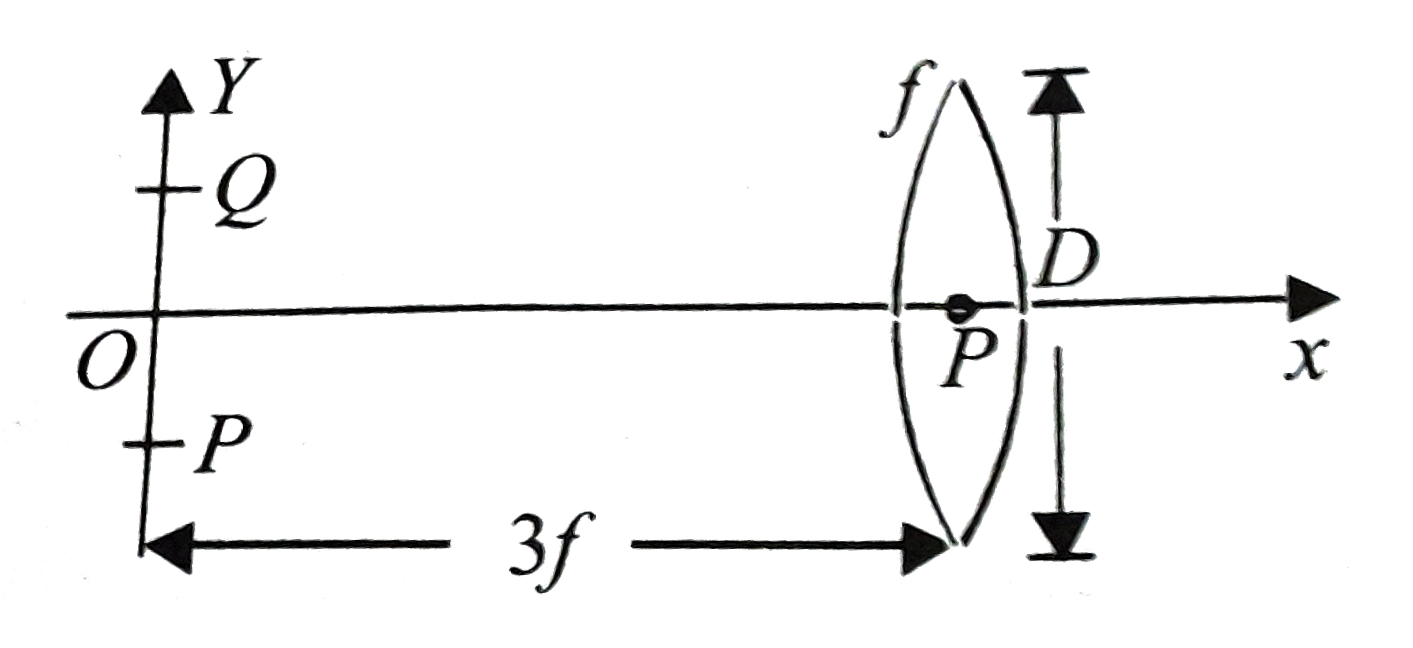
An object kept near a convex lens of focal length f, executes SHM between P and Q according to the equation `y=A sinomegat`, O being the mean position. Take x-axis as the principal axis of the lens and `A lt lt D` to answer the following questions:

Q. The amplitude of oscillation of the image is

A

Amplitude of oscillation of its image is `2A`

B

Amplitude of oscillations of its image is `(A)/(2)`

C

Phase difference between the object and its image is `pi`.

D

Phase difference between the object and its image is zero.

Text Solution

Verified by Experts

The correct Answer is:

B, C

`(1)/(v)-(1)/((-3f))=(1)/(f)`
`v=(3f)/(2)`
`(h_(i))/(h_(0))=(v)/((-3f))`
`h_(i)=-(h_(0))/(2)`
Amplitude `=(A)/(2)`
Phase differnece is `pi`.
Promotional Banner

Similar Questions

Explore conceptually related problems

An object kept near a convex lens of focal length f, executes SHM between P and Q according to the equation y=A sinomegat , O being the mean position. Take x-axis as the principal axis of the lens and A lt lt D to answer the following questions: Q. The velocity of the image when the object crosses the mean position and goes toward Q is

An object kept near a convex lens of focal length f, executes SHM between P and Q according to the equation y=A sinomegat , O being the mean position. Take x-axis as the principal axis of the lens and A lt lt D to answer the following questions: Q. The phase difference between the object and the image oscillations is

In YDSE set up (see fig.), the light sources executes SHM between P and Q according to the equation x = A sin omega t , S being the mean position. Assume d rarr 0 and A lt lt L . omega is small enough to neglect Doppler effect. If the sources were stationary at S, intenstiy at O would be I_(0) Read the paragraph carefully and answer the following questions. When the source comes toward the point Q,

In YDSE set up (see fig.), the light sources executes SHM between P and Q according to the equation x = A sin omega t , S being the mean position. Assume d rarr 0 and A lt lt L . omega is small enough to neglect Doppler effect. If the sources were stationary at S, intenstiy at O would be I_(0) Read the paragraph carefully and answer the following questions. The fractional change in intensity of the central maximum as function of time is

In YDSE set up (see fig.), the light sources executes SHM between P and Q according to the equation x = A sin omega t , S being the mean position. Assume d rarr 0 and A lt lt L . omega is small enough to neglect Doppler effect. If the sources were stationary at S, intenstiy at O would be I_(0) Read the paragraph carefully and answer the following questions. The fringe width beta can be expressed as

A thin linear object of size 1mm is kept along the principal axis of a convex lens of focal length 10cm. The object is at 15cm from the lens. The length of the image is:

A beaker containing an ideal fluid executes plane SHM in a horizontal plane according to the equation x=(sqrt(3)g)/(omega^(2))sinomegat , O being the mean position. A bob is suspended at S through a string of length L as shown in the figure. The line SO is vertical. Assuming L gtgt (sqrt(3)g)/(omega^(2)) . The magnitude of maximum buoyant force and the time with it occurs for the second time are, respectively

A beaker containing an ideal fluid executes plane SHM in a horizontal plane according to the equation x=(sqrt(3)g)/(omega^(2))sinomegat , O being the mean position. A bob is suspended at S through a string of length L as shown in the figure. The line SO is vertical. Assuming L gt gt (sqrt(3)g)/(omega^(2)) . The tension in the string is maximum at time t=

A beaker containing an ideal fluid executes plane SHM in a horizontal plane according to the equation x=(sqrt(3)g)/(omega^(2))sinomegat , O being the mean position. A bob is suspended at S through a string of length L as shown in the figure. The line SO is vertical. Assuming L gtgt (sqrt(3)g)/(omega^(2)) . The direction of buoyant force at time t=pi//2omega is best represented by

A convex lens of focal length f and a plane mirror are y distance apart. An object O is kept on the principal axis of the lens at a distance x from the lens. The values of x and y for the final image of O to fall exactly (position and size) on the object O are :
