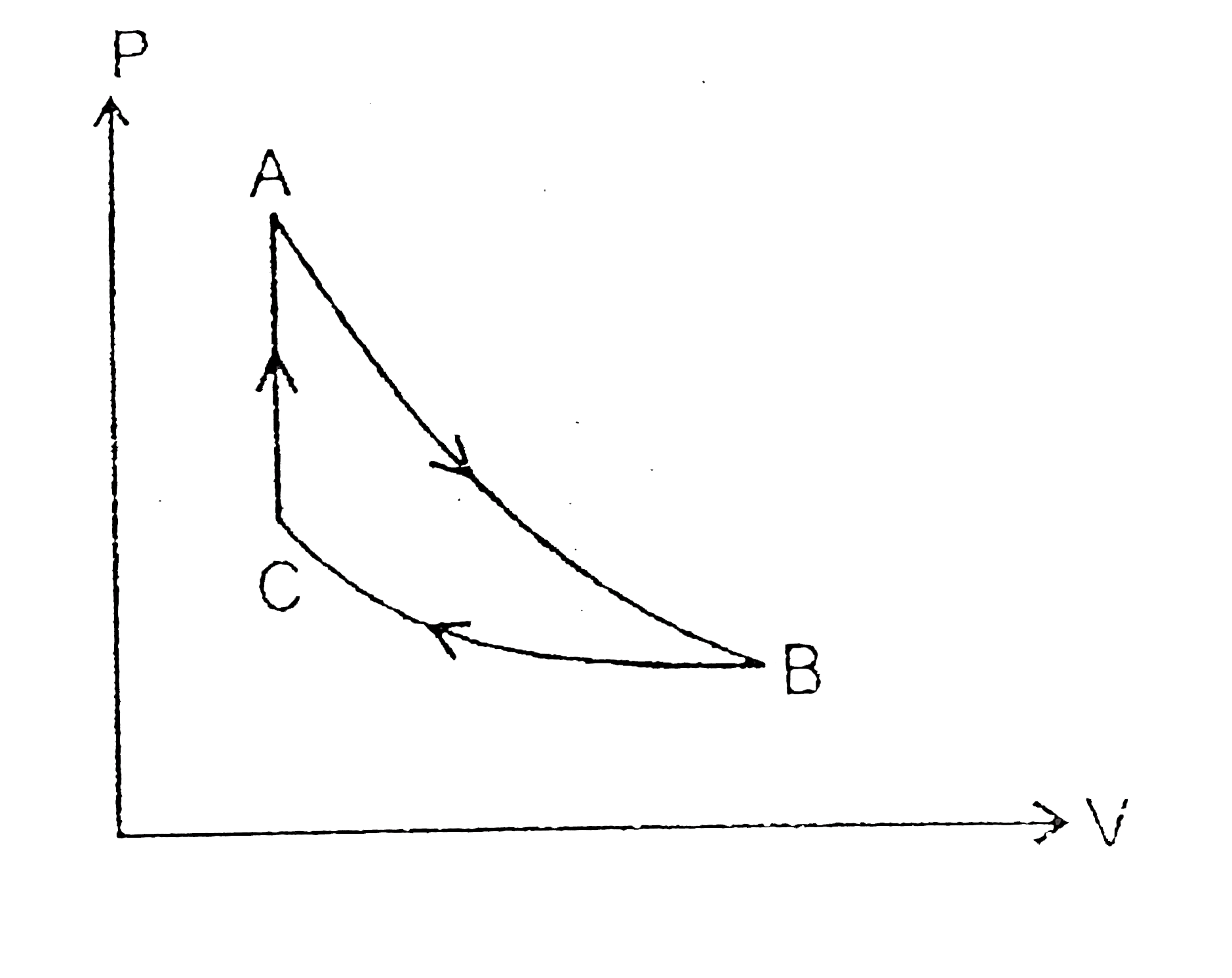
Text Solution
Verified by Experts
The correct Answer is:



Similar Questions
Explore conceptually related problems
Recommended Questions
- An ideal gas undergoes a cyclic process, in which one process is isoch...
Text Solution
|
- An ideal gas undergoes a cyclic process, in which one process is isoch...
Text Solution
|
- In the figure n mole of a monoatomic ideal gas undergo the process ABC...
Text Solution
|
- An ideal monatomic gas expands to twice its volume. If the process is ...
Text Solution
|
- An ideal gas system undergoes an isothermal process, then the work don...
Text Solution
|
- Assertion : For an isothermal process in an ideal gas, the heat obsorb...
Text Solution
|
- An ideal gas undergoes four processes: isochoric, isobaric, isothermal...
Text Solution
|
- An ideal gas undergoes four processes: isochoric, isobaric, isothermal...
Text Solution
|
- An ideal gas undergoes four processes: isochoric, isobaric, isothermal...
Text Solution
|