Home
Class 12
PHYSICS
a cavity of radius R is taken out from a...


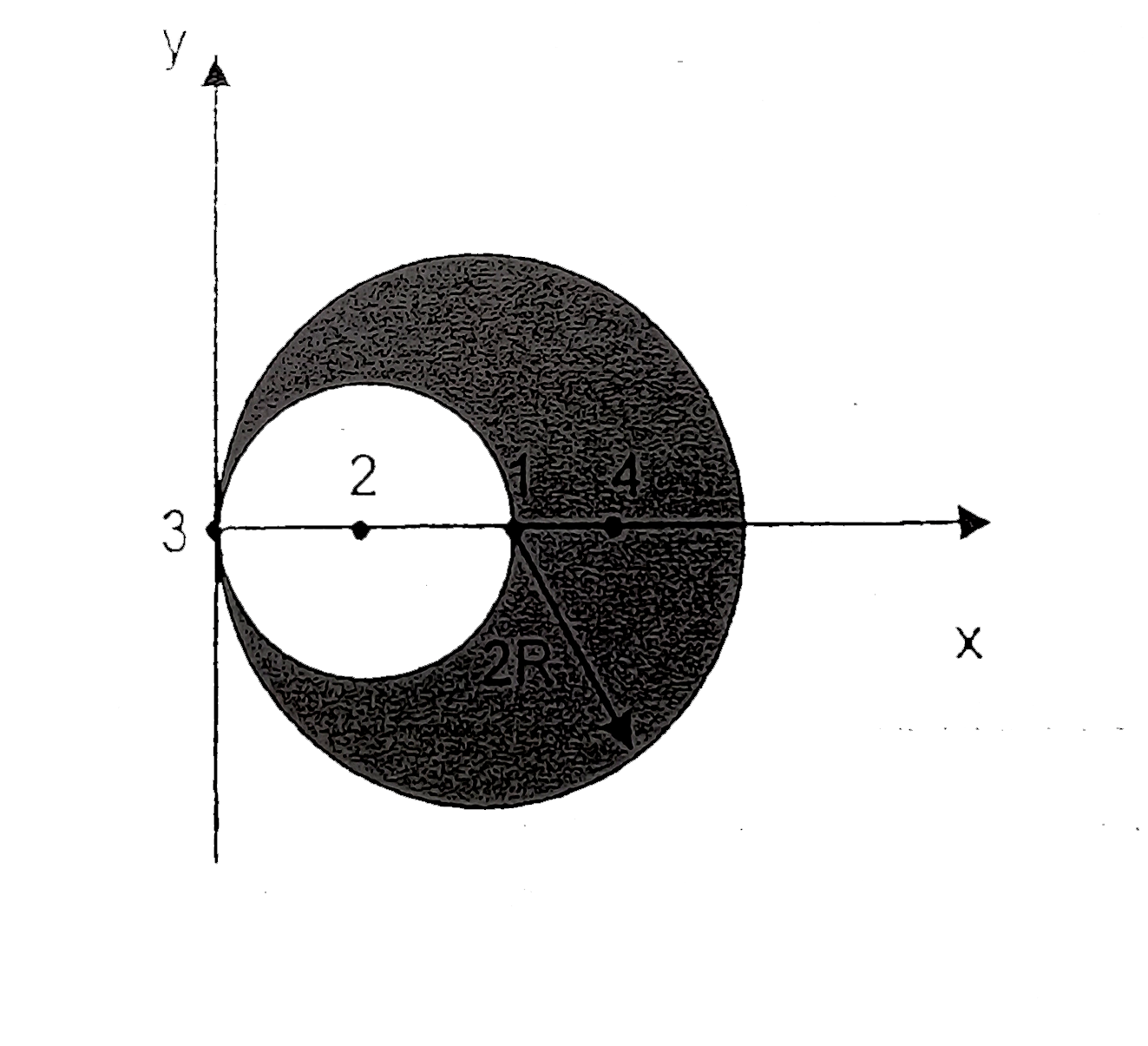
a cavity of radius `R` is taken out from a uniformly charged solid sphere with charge density `rho` and radius `2R` as shown Consider four points 1,2,3,4 at following positions,
1-`(2R,0,0)`
2- `(R,0,0)` ltbr. 3- `(0,0,0)`
4- `(3R,0,0)`
`E_(1),E_(2),E_(3),E_(4)` represents magnitude of net electric field at 1,2,3,4 respectively then the correct option (s) are:

A

a.`(E_(1))/(E_(2))=(E_(2))/(E_(3))`

B

b.`(E_(4))/(E_(2))=(4)/(3)`

C

c.`(E_(4))/(E_(1))=(3)/(4)`

D

d.`(E_(4))/(E_(2))=(3)/(4)`

Text Solution

Verified by Experts

The correct Answer is:

A, B, C

`E=(rhor)/(3epsilon_(0))` [for inside cavity points] &
`((rhoR^(3))/(3epsilon_(0)r^(2))` for out side cavity points)
`E_(1)=E_(2)=E_(3)=(rhoR)/(3epsilon_(0))`
`E_(4)=(rhoR)/(3epsilon_(0))-(rho(R)^(3))/(3epsilon_(0)(2R)^(2))`
`=(rhoR)/(3epsilon_(0))-(rhoR)/(3epsilon_(0)xx4)=(rhoR)/(4epsilon_(0))`
Promotional Banner

Similar Questions

Explore conceptually related problems

A solid sphere having radius R and uniform charge density rho has a cavity of radius R/2 as shown in figure.Find the value of |E_A /E_B|

A solid non conducting sphere of radius R and uniform volume density rho has centre at origin. Find out electric field intensity in vector form at following positions : (i) (R, 0, 0) (ii) (0, 0, R/2) (iii) (R, R, R)

A non-conducting solid sphere has volume charge density that varies as rho=rho_(0) r, where rho_(0) is a constant and r is distance from centre. Find out electric field intensities at following positions. (i) r lt R" " (ii) r ge R

Charge density of a sphere of radius R is rho = rho_0/r where r is distance from centre of sphere.Total charge of sphere will be

A positively charge sphere of radius r_0 carries a volume charge density rho . A spherical cavity of radius r_0//2 is then scooped out and left empty. C_1 is the center of the sphere and C_2 that of the cavity. What is the direction and magnitude of the electric field at point B?

A uniformly charged solid sphere of radius R has potential V_(0) (measured with respect to oo ) on its surface. For this sphere the equipotential surfaces with potentials (3V_(0))/(2) , (5 V_(0))/(4), (3V_(0))/(4) and (V_(0))/(4) have radius R_(1), R_(2), R_(3) and R_(4) respecatively. Then

In the circuit shown, E_(1)= 7 V, E_(2) = 7 V, R_(1) = R_(2) = 1Omega and R_(3) = 3 Omega respectively. The current through the resistance R_(3)

In the circuit shown, E_(1)= 7 V, E_(2) = 7 V, R_(1) = R_(2) = 1Omega and R_(3) = 3 Omega respectively. The current through the resistance R_(3)

Consider a solid sphere of density rho and radius 4R . Centre of the sphere is at origin. Two spherical cavities centred at (2R,0) and (-2R,0) are created in sphere. Radii of both cavities is R . In left cavity material of density 2rho is filled while second cavity is kept empty. What is gravitational field at origin.

The maximum electric field at a point on the axis of a uniformly charged ring is E_(0) . At how many points on the axis will the magnitude of the electric field be E_(0)//2 .
