Home
Class 12
PHYSICS
The figure shows a constant deviation pr...


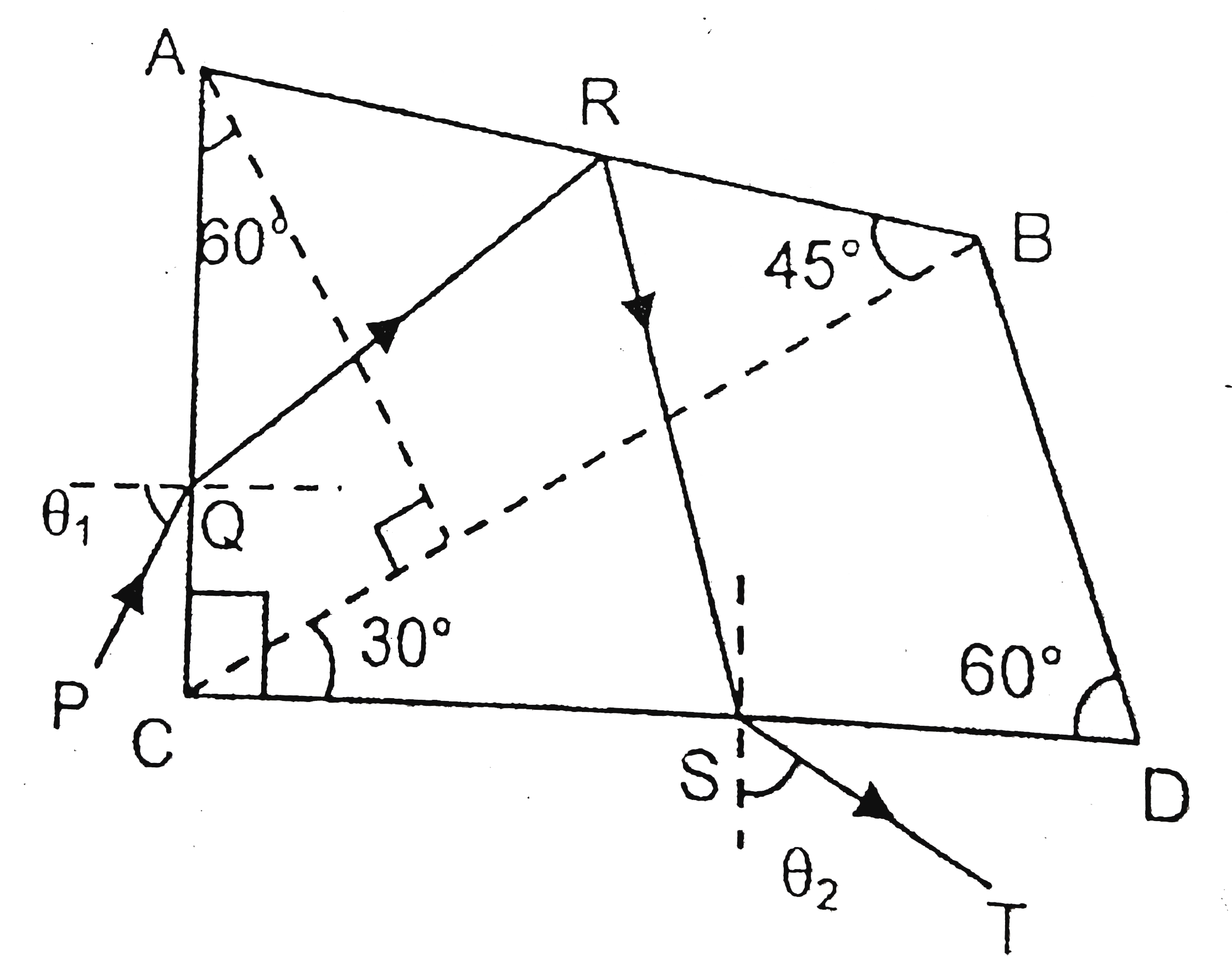
The figure shows a constant deviation prism ABCD. The incident ray is PQ and the emergent ray is ST. Although it is made up of one piece of glass, but it is equivalent to two `30^(@)-60^(@)-90^(@)` prism and one `45^(@)-45^(@)90^(@)` prism.The angle `theta_(1)` is the angle of incidence on face AB. The path of the ray inside the prism is indicated in the figure. for this prism `mu=2sintheta_(1)`.
Q. The total deviation of incident ray when it emerges out of the prism is

A

`60^(@)`

B

`30^(@)`

C

`45^(@)`

D

`90^(@)`

Text Solution

Verified by Experts

The correct Answer is:

A

let `r` be angle of refraction at `theta_(1)`
`mu=(sintheta_(1))/(sinr),sintheta_(1)=(mu)/(2)impliessinr=(1)/(2),r=30^(@)`
considering ABC as a triangular prism `r+r^(')=A`
`30^(@)+r^(')=75^(@)impliesr^(')=45^(@)`
Thus ray is incident on AB at `45^(@)` it is reflected at the same angle on to CD.
From the figure `angleRSD=360^(@)-(45^(@)+135^(@)+60^(@))=120^(@)`
(considering the quadrilateral)
`because` angle of incidence at `CD=120^(@)-90^(@)=30^(@)`
`impliestheta_(1)=theta_(2)`
`because` total deviation of ray `=(theta_(1)-30^(@))+(180^(@)-90^(@))-(theta_(2)-30^(@))=90^(@)`
Promotional Banner

Similar Questions

Explore conceptually related problems

The figure shows a constant deviation prism ABCD. The incident ray is PQ and the emergent ray is ST. Although it is made up of one piece of glass, but it is equivalent to two 30^(@)-60^(@)-90^(@) prism and one 45^(@)-45^(@)90^(@) prism.The angle theta_(1) is the angle of incidence on face AB. The path of the ray inside the prism is indicated in the figure. for this prism mu=2sintheta_(1) . Q. The ratio (theta_(1))/(theta_(2)) is

Figure shows graph of deviation delta versus angle of incidence for a light ray striking a prism. Angle of prism is

Refractive index of a prism is sqrt(7//3) and the angle of prism is 60^(@) . The minimum angle of incidence of a ray that will be transmitted through the prism is

The angle between the incident ray and the emergent ray in case of a prism is called angle of prism. _________

The angle between the incident ray and the refracted ray of a prism is called angle of deviation.

Two light rays 1 and 2 are incident on two faces AB and AC on an isosceles prism as shown in the figure. The rays emerge from the side BC. Then,

Light ray is incident on a prism of angle A=60^(@) are refractive index mu=sqrt(2) . The angle of incidence which the emergent rays grazes the surface is given

A ray of light incident on one of the face of a prism as shown. After refraction through this surface ray is incident on base of the prism. The refractive index of the prism is sqrt(3) . The net deviation of the ray due to prism is

The refractive index of material of a prism of angles 45^(@) , -45^(@) , and -90^(@) is 1.5. The path of the ray of light incident normally on the hypotenuse side shown in

If the critical angle for the material of a prism is C, and the angle of the prism is A, then there will be no emergent ray when
