Home
Class 12
PHYSICS
Consider a transparent homogenous hemisp...


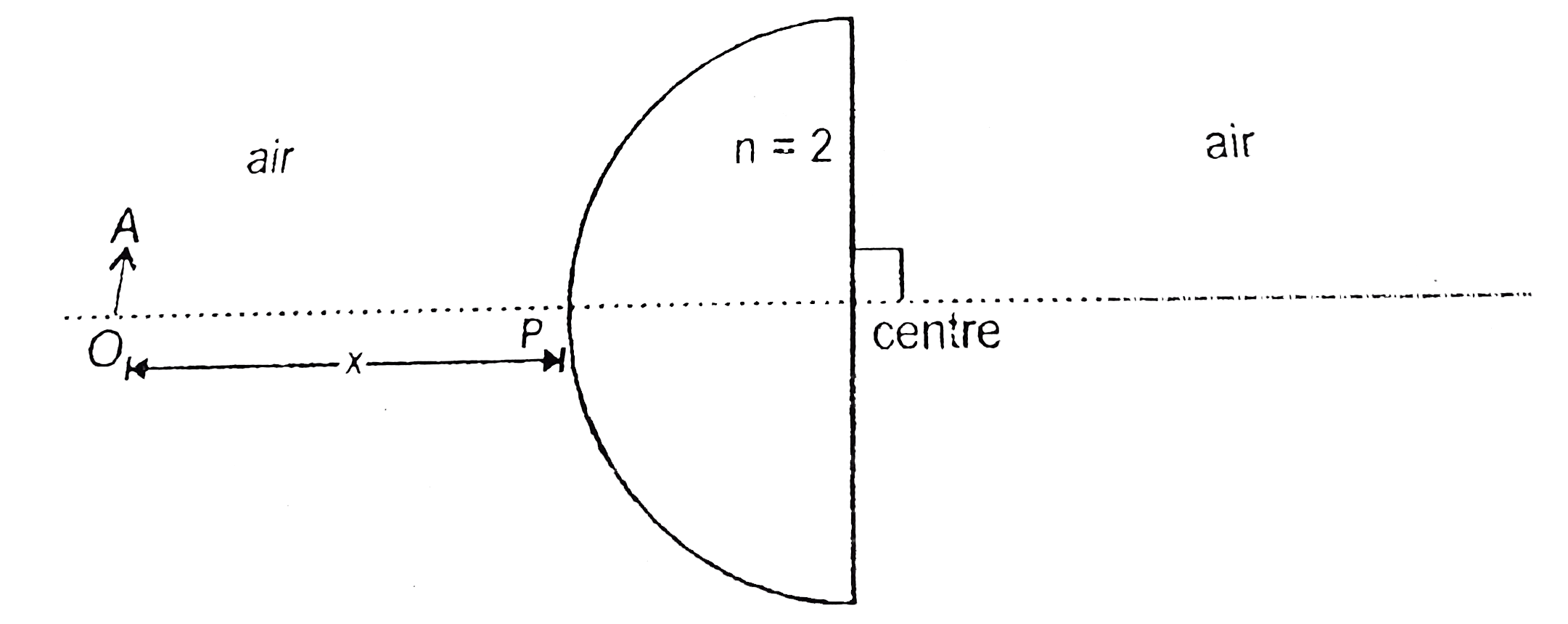
Consider a transparent homogenous hemisphere of refractive index `n=2` in front of which a small object is placed in air as shown in figure.

A

if value of `x=3R` then the final image of the small object OA will be real & inverted.

B

If value of `x=2R` then the final image of the small object OA will be inverted and magnified.

C

consider a ray starting from O which strikes the spherical surface at grazing incidence `(i~=90^(@))` taking `x=R` the angle (from normal) at which the ray will emerge from the plane surface is `30^(@)`

D

consider a ray starting from O which strikes the spherical surface at grazing incidence `(i~=90^(@))`. Takin `x=R` the angle (from normal) at which the ray will emerge from the plane surface is `90^(@)`.

Text Solution

Verified by Experts

The correct Answer is:
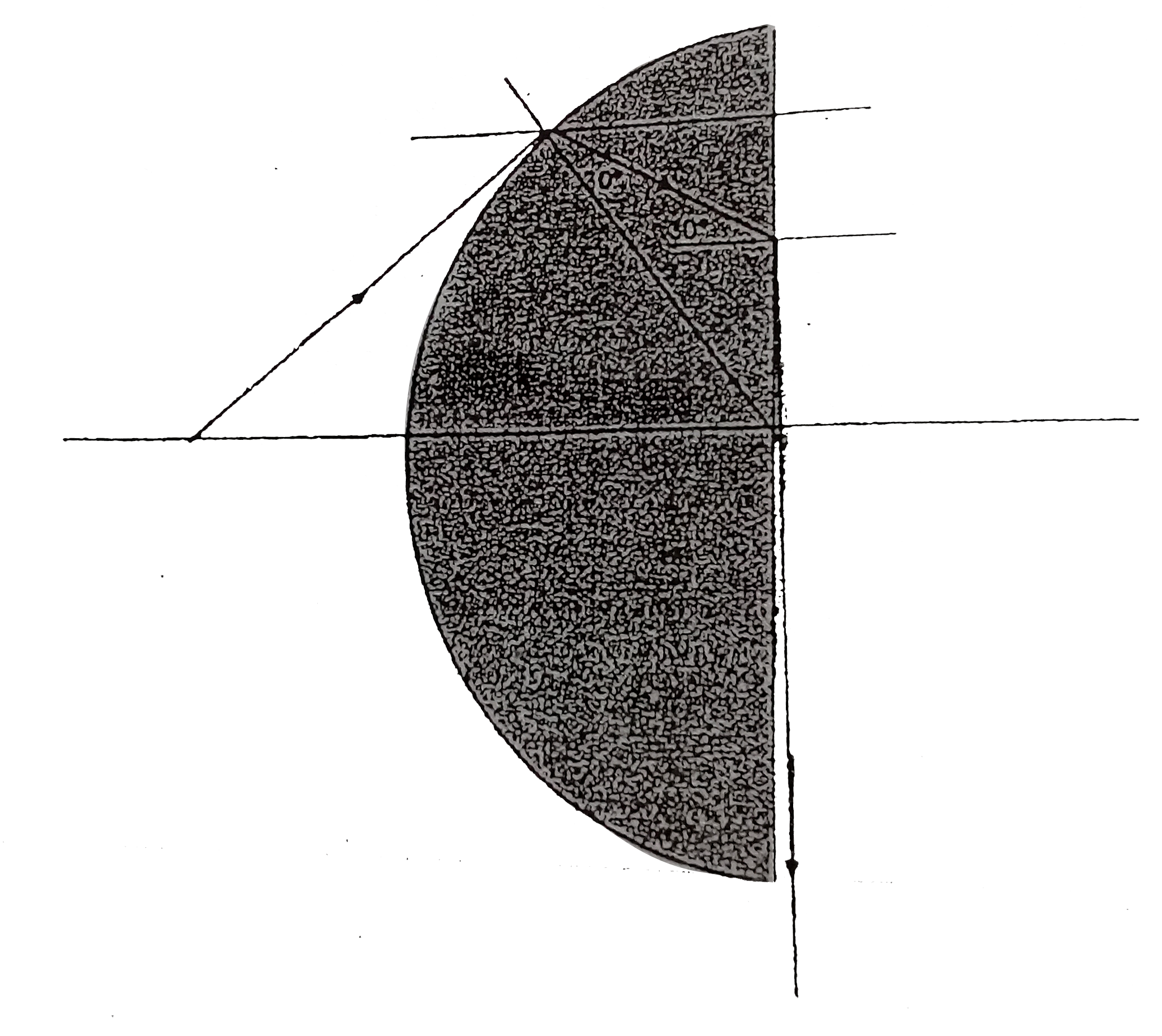
A, D

For first surface
`(2)/(V)-(1)/(-3R)=(2-1)/(R)implies(2)/(V)=(1)/(R)-(1)/(3R)`
`(2)/(V)=(2)/(3R)impliesV=3R`
for second surface `u=2R`
`(1)/(V)=(2)/(2R)impliesV=R` Real & inverted.
(B) for first surface
`(2)/(V)-(1)/(-2R)=(2-1)/(R)implies(2)/(V)=(1)/(R)-(1)/(2R)`
`impliesV=4Rimpliesm_(1)=-1`
for second surface `u=3R`
`(1)/(V)=(2)/(3R)impliesV=(3R)/(2)` real & inverted and same size.
Promotional Banner

Similar Questions

Explore conceptually related problems

Consider a transparent hemispher (n=2) in front of which a small object is placed in air (n=1) as shown in figure. Q. For which value of x, of the following , will the final image of the object O be virtual?

Consider a transparent hemispher (n=2) in front of which a small object is placed in air (n=1) as shown in figure. Q. What is the nature of final image of the object when x=2R ?

Consider a transparent hemispher (n=2) in front of which a small object is placed in air (n=1) as shown in figure. Q. Consider a ray starting from O which strikes the spherical surface at grazing incident (i=90^(@)) . Takin x=R , what will be the angle (from normal) at which the ray may emerge from the plane surface.

A person is looking at the flat surface of a transparent hemisphere of refractive index mu=sqrt(2) . Half of the flat surface is coloured black and half of curved surface is coloured in six equally spaced strips as shown in Figure. Then

In front of an earthed conductor a point charge +q is placed a shown in figure

A parallel beam of light is incident normally on the flat surface of a hemisphere of radius 6 cm and refractive index 1.5 , placed in air as shown in figure (i). Assume paraxial ray approxiamtion. .

The diagram shows a spherical surface which separates two media of refractive index, mu_(1) and mu_(2) . Respectively. Now, a point object is placed on the principal axis as shown in the figure. Then

A parallel narrow beam of light is incident on the surface of a transparent hemisphere of radius R and refractive index mu=1.5 as shown. The position of the image formed by refraction at the image formed by refraction at the spherical surface only as

A small angled prism of apex angle A=4^@ and refractive index mu=1.5 is placed in front of a vertical plane mirror as shown in figure. If the mirror is rotated through an angle theta, then the light ray becomes horizontal either after the mirror or after second time passing from the prism in opposite direction. The value theta is

A prism having an apex angle of 4^@ and refractive index of 1.50 is located in front of a vertical plane mirror as shown in the figure. A horizontal ray of light is incident on the prism. The total angle through which the ray is deviated is:

