Home
Class 12
PHYSICS
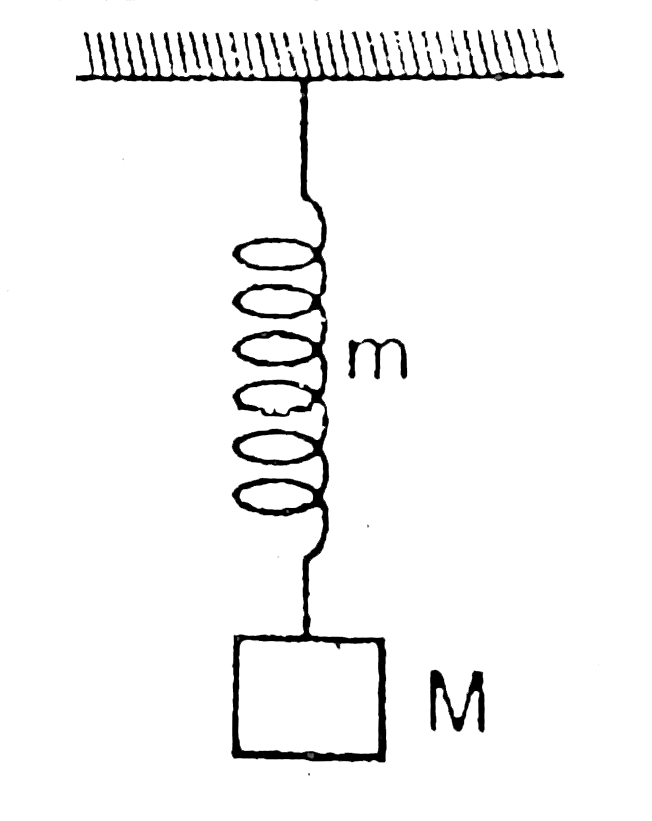
A block of M is suspended from a vertica...


A block of `M` is suspended from a vertical spring of mass `m` as shown in the figure. When block is pulled down and released the mass oscillates with maximum velocity `v`.

A

Max kinetic energy of spring system is `(1)/(2)(M+m)v^(2)`

B

Max kinetic energy of spring block system is `(1)/(2)(M+(m)/(3))v^(2)`

C

Max kinetic energy of spring is `(mv^(2))/(6)`

D

Max kinetic energy of spring is `(mv^(2))/(2)`

Text Solution

Verified by Experts

Promotional Banner

Similar Questions

Explore conceptually related problems

A block of mass m is suspended by different springs of force constant shown in figure.

A block of mass m suspended from a spring of spring constant k . Find the amplitude of S.H.M.

A block of mass m is released from a wedge of mass m as shown in figure . Find the time taken by the block to reach the end of the wedge.

A block of mass m as shown in figure is pulled by a force 40N. The tension at the middle of the block is

A body of mass m is suspended from three springs as shown in figure. If mass m is displaced slightly then time period of oscillation is

If the mass attached to a vertical spring is pulled down and left, it oscillates. why ?

A block of mass m is placed on the top of another block of mass M as shown in the figure. The coefficient of friction between them is mu . The maximum acceleration with which the block M may move so that m also moves along with it is

A mass M is suspended from a spring of negiliglible mass the spring is pulled a little and then released so that the mass executes simple harmonic oscillation with a time period T If the mass is increases by m the time period because ((5)/(4)T) ,The ratio of (m)/(M) is

A block of mass 'm' is released on the top of a frictionless incline as shown in the figure. The time period of the oscillation of the block is

A block A of mass 2m is hanging from a vertical massless spring of spring constant k and is in equilibrium. Another block B of mass m strikes the block A with velocity u and sticks to it as shown in the figure. The magnitude of the acceleration of the combined system of the blocks just after the collision is

