

Home
Class 12
PHYSICS
A cart of mass 3 kg is pulled by a 5 kg ...


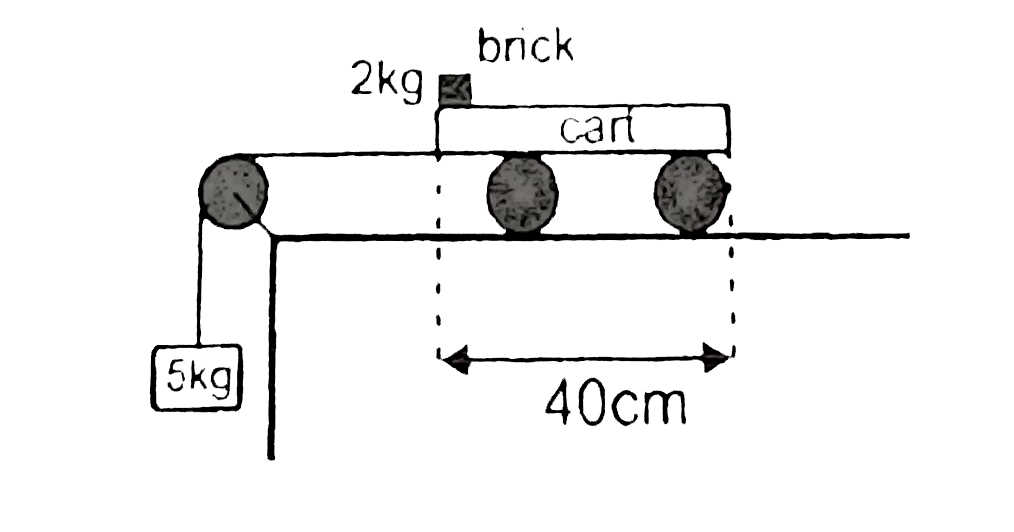
A cart of mass 3 kg is pulled by a 5 kg object as shown in figure. Length of cart is 40 cm moves on frictionless table. There is a small brick of mass 2 kg on the cart which falls at 0.8 sec. after the start of motion. if the coefficient of friction between cart and brick is `(x)/(10)`. then value of x is `:(g=10m//s^(2))`

Promotional Banner

Similar Questions

Explore conceptually related problems

The velocity - time (V - t) graph of an object of mass 2 kg is as shown in figure while it is moving on a rough horizontal surface. The coefficient of friction between object and the surface is (g = 10 m/s^2)

Two block A and B of mass 50 kg and 300 kg respectively are placed as shown in figure. Coefficient of friction between all surface is (1)/(2) Then (take g = 10 m//s )

A toy cart of mass sqrt(3) kg is pulled by a force of 20N at an angle of 30^(@) with the frictionless horizontal surface on which the cart is placed. The cart shall move on the surface with an acceleration .

A block of mass m=5kg is resting on a rough horizontal surface for which the coefficient of friction is 0.2 . When a force F=40N is applied, the acceleration of the block will be (g=10m//s^(2)) .

A force F is applied on a block of mass 5 kg as shown in figure. Co-efficient of friction between the wall and clock is (sqrt(3))/(2). (g = 10m//s^(2)) Select correct option(s)

A cart of mass M has a block of mass m in contact with it as shown in the figure-2.133. The coefficient of friction between the block and the cart is mu . What is the minimum acceleration of the cart so that the block m does not fall ?

If coeffiecient of friction between the block of mass 2kg and table is 0.4 then out acceleration of the system and tension in the string. (g=10m//s^(2))

A body of mass 20kg is moving on a rough horizontal plane. A block of mass 3kg is connected to the 20 kg mass by a string of negligible mass through a smooth pulley as shown in the figure. The tension in the string is 27 N. The coefficient of kinetic friction between the heavier mass and the surface is (g = 10m/ s^2 )

Two particles A and B of mass 3kg and 2kg moving with speed 10m//s and 5m//s as shown in figure. Find the maximum momentum that particles A can have after collision with B .

Two particles A and B of mass 3kg and 2kg moving with speed 10m//s and 5m//s as shown in figure. Find the maximum momentum that particle B can have after collision with A