Home
Class 12
PHYSICS
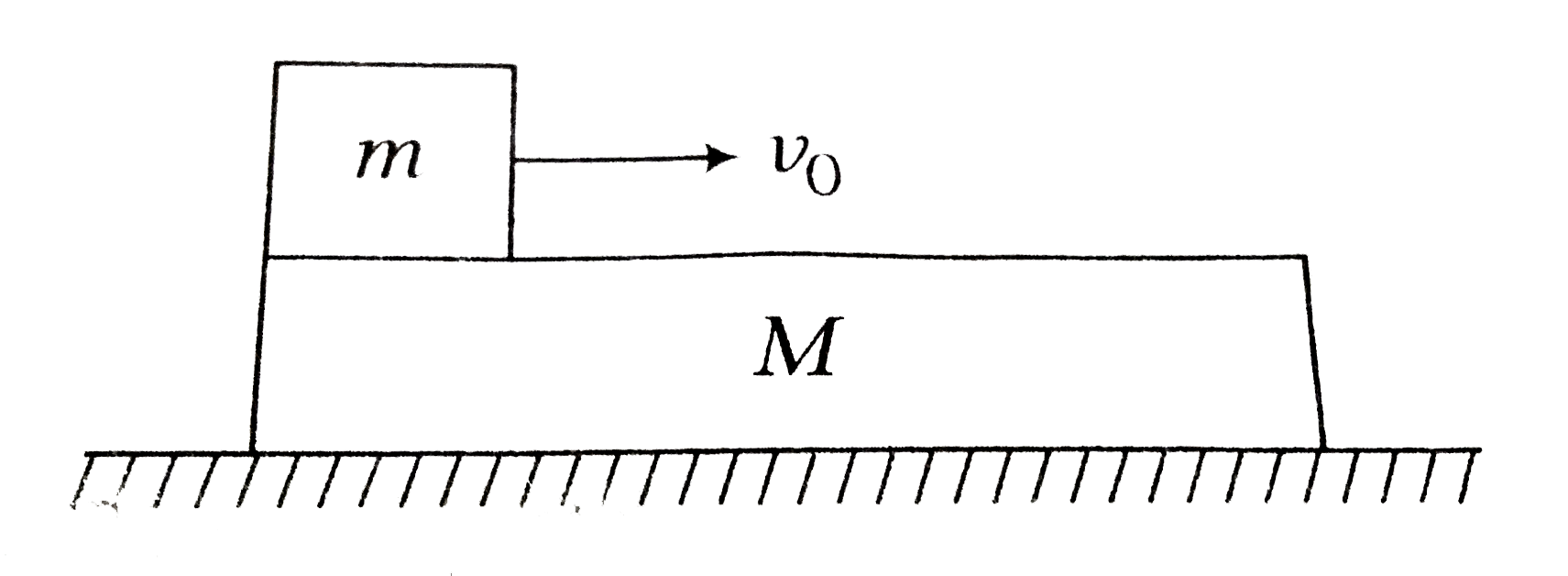
The coefficient of friction between the ...

The coefficient of friction between the block and plank is `mu` and its value is such that block becomes stationary with respect to plank before it reaches the other end. Then which of the following is not correct.

A

The work done b friction on the block is negative

B

the work done by friction on the plank is positive

C

the net work done by friction is negative

D

net work done by the friction is zero.

Text Solution

Verified by Experts

The correct Answer is:

A, B, C
Promotional Banner

Similar Questions

Explore conceptually related problems

The block of mass m is kept on plank of mass M. The block is given velocity V_(0) as shown. The coefficient of friction between the block of mass m and plank of mass M is mu and its value is such that block becomes stationary with respect to plank before it reaches the other end. Then:

A plank of mass M and length L is placed at rest on a smooth horizontal surface. A small block of mass m is projected with a velocity v_0 from the left end of it as shown in figure. The coefficient of friction between the block and the plank is m, and its value is such that the block becomes stationary with respect to the plank before it reaches the other end. a. Find the time and common velocity when relative sliding between the block and the plank stops. b. Find the work done by the friction force on the block during the period it slides on the plank. Is the work positive or negative? c. Calculate the work done on the plank during the same period. Is the work positive or negative? d. Also, determine the net work done by friction, Is it positive or negative?

Block A of mass m rests on the plank B of mass 3m which is free to slide on a frictionless horizo-ntal surface. The coefficient of friction between the block and plank is 0.2. If a horizontal force of magnitude 2 mg is applied to the plank B, the acceleration of A relative to the plank and relative to the ground respectively, are:

A block is placed over a plank. The coefficient of friction between the block and the plank is mu= 0.2. Initially both are at rest, suddenly the plank starts moving with acceleration a_(0) = 4m//s^(2). The displacement of the block in 1 is (g=10m//s^(2))

A block of mass m=2kg of shown dimensions is placed on a plank of mass M = 6Kg which is placed on smooth horizontal plane. The coefficient of friction between the block and the plank is mu=1/3 . If a horizontal froce F is applied on the plank, then find the maximum value of F (in N) for which the block and the plank move together

A small block of mass 1kg is placed over a plank of mass 2kg. The length of the plank is 2 m. coefficient of friction between the block and the plnak is 0.5 and the ground over which plank in placed is smooth. A constant force F=30N is applied on the plank in horizontal direction. the time after which the block will separte from the plank is (g=10m//s^(2))

A bolck of mass m =2 kg is placed on a plank of mass M = 10 kg, which is placed on a smooth horizontal plane as shown in the figure. The coefficient of friction between the block and the plank is mu=(1)/(3) . If a horizontal force F is applied on the plank, then the maximum value of F for which the block and the plank move together is (g=10m//s^(2))

A block is kept on a rough horizontal plank. The coefficient of friction between the block and the plank is 1/2 . The plank is undergoing SHM of angular frequency 10 rad/s. The maximum amplitude of plank in which the block does not slip over the plank is (g= 10 m/ s^(2) )

A plank of mass 2 kg and length 1 m is placed on horizontal floor.A small block of mass 1 kg is placed on top of the plank , at its right extreme end .The coefficient of friction between plank and floor is 0.5 and that between plank and block is 0.2 . If a horizontal force = 30 N starts acting on the plank to the right ,the time after which the block will fall off the plank is (g = 10 ms^(-2))

A small block of mass 'm' is placed on a plank of mass 'M'. The block is connected to plank with the help of a light string passing over a light smooth pulley as shown in figure. The co-efficient of static friction between the block and plank is mu . The co-efficient of friction between the plank and the horizontal surface is zero. What maximum horizontal force F applied on the block of mass m can make the block and plank not to slide relatively?
