Home
Class 12
PHYSICS
A block of mass m = 2 kg is connected to...

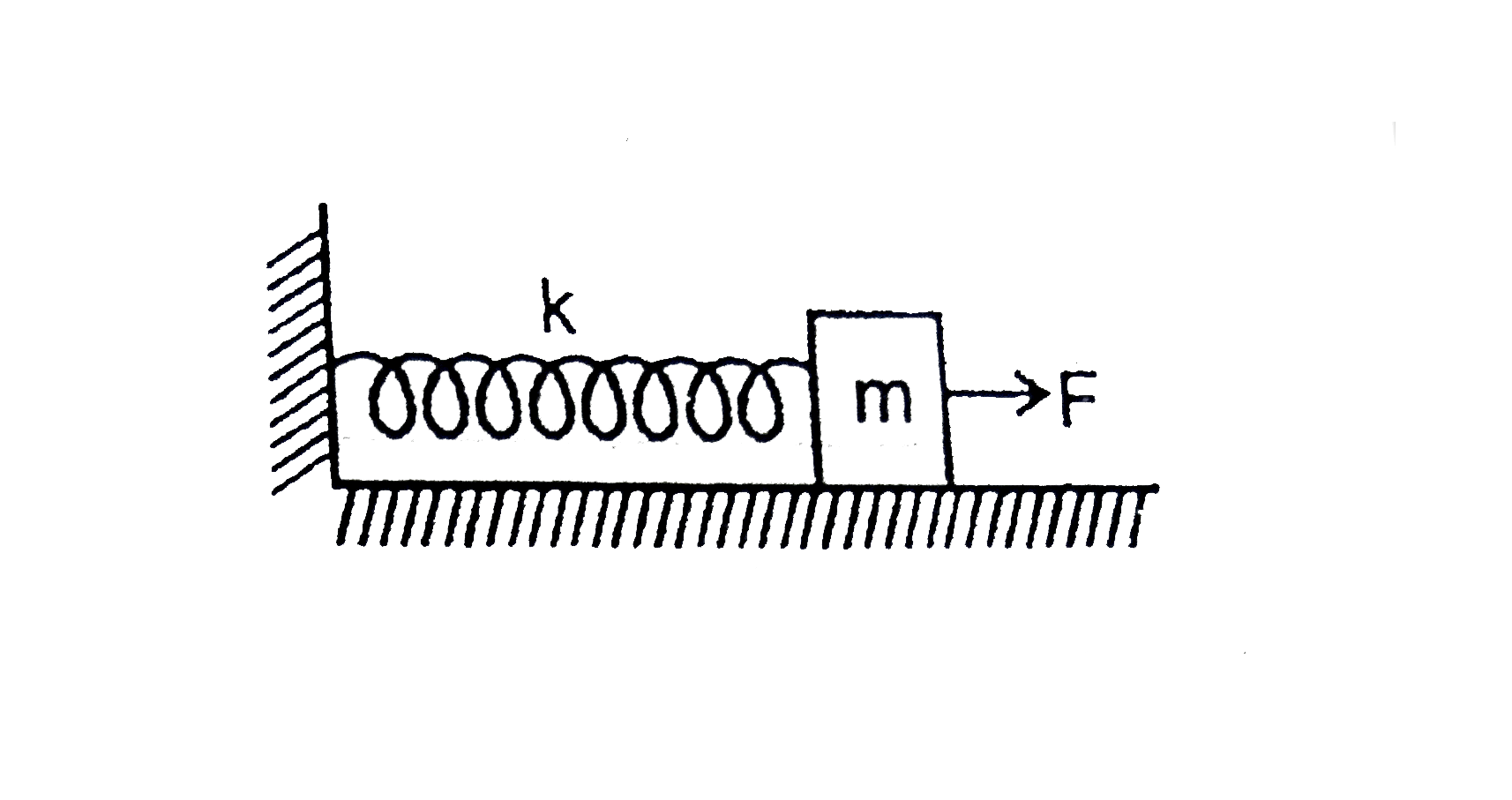
A block of mass `m = 2 kg` is connected to a a spring of force constant `k = 50 N//m`. Initially the block is at rest and tlhe spring has natural length. A constant force `F = 60 N` is applied horizontally towards, the maximum speed of the block (in `m//s`) will be (negelect friction).

Text Solution

Verified by Experts

The correct Answer is:

6

For maximum speed.
`(dv)/(dt)=0impliesa=0`
if at maximum speed elongation is x, then
`f=kximpliesx=(F)/(k)` now by WET,
`-(1)/(2)kx^(2)+Fx=(1)/(2)mv^(2)`
`V=(F)/(sqrt(mk))=6(m)/(s)`
Promotional Banner

Similar Questions

Explore conceptually related problems

A block of mass m is connected to a spring of force constant k. Initially the block is at rest and the spring has natural length. A constant force F is applied hrizontally towards right. The maximum speed of the block will be (there is no friction between block and the surface)

A block of mass m is connected to a spring (spring constant k ). Initially the block is at rest and the spring is in its natural length. Now the system is released in gravitational field and a variable force F is applied on the upper end of the spring such that the downward acceleration of the block is given as a=g-alphat , where t is time elapses and alpha=1m//s^(2) , the velocity of the point of application of the force is:

A block of mass m is suspended by different springs of force constant shown in figure.

The block of mass m is released when the spring was in its natrual length. Spring constant is k. Find the maximum elongation of the spring.

A block of mass 0.2 kg is attached to a mass less spring of force constant 80 N/m as shown in figure. Find the period of oscillation. Take g=10 m//s^(2) . Neglect friction

A block of mass 0.2 kg is attached to a mass less spring of force constant 80 N/m as shown in figure. Find the period of oscillation. Take g=10 m//s^(2) . Neglect friction

A block of mass m is connect to another block of mass M by a massless spring of spring constant k. The blocks are kept on a smooth horizontal plane. Initially the blocks are at rest and the spring is upstretched when a constant force F starts acting on the block of mass M to pull it. Find the maximum extension of the spring.

A block of mass m is connect to another block of mass M by a massless spring of spring constant k. The blocks are kept on a smooth horizontal plane. Initially the blocks are at rest and the spring is unsrtretched when a constnt force F starts acting on the block of mass M to pull it. Find the maximum extension of the spring.

A block of mass 'm' is connected to another block of mass 'M' by a spring (massless) of spring constant 'k' The blocks are kept on a smooth horizontal plane. Initially the blocks are at rest and the spring is unstretched Then a constant force 'F' starts acting on the block of mass 'M' to pull it. Find the force on the block of mass 'm' :

A block of mass m = 2 kg is attached to two unstretched spring of force constant k_(1)=100 N//m and k_(2)=125 N//m The block is displaced towards left through a distance of 10 cm and released. Find the speed of the block as it passes through the mean position.
