Home
Class 12
CHEMISTRY
Which is (are) correct out of the follow...

Which is (are) correct out of the following:

A

`CH_(2)=CH_(2)ltH-C-=C-h` (rate of electrophilic addition)

B

`ltH_(3)C-C-=C-CH_(3)` (rate of catalytic hydrogenation)

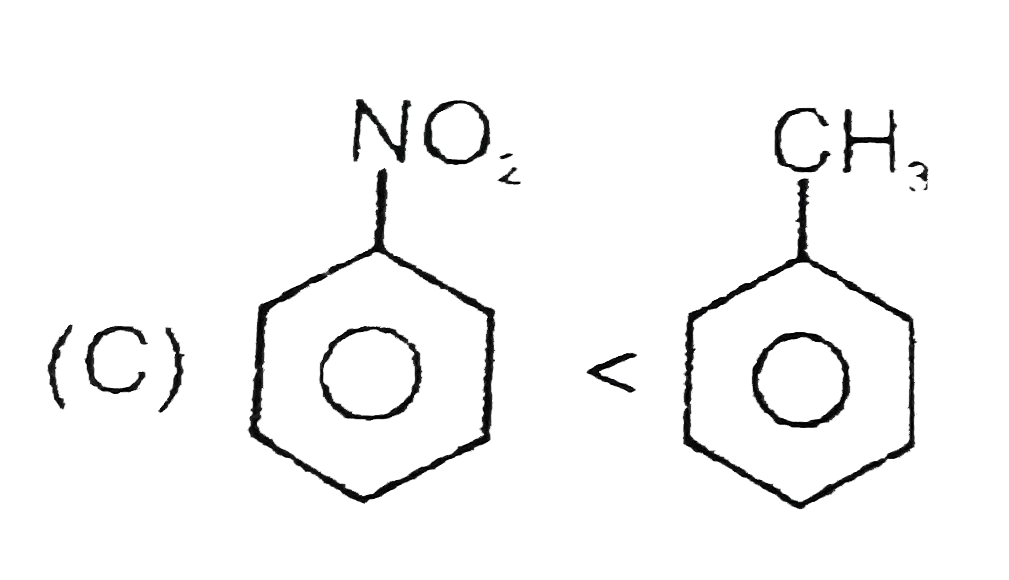
C

(rate of electrphilic substitution reaction)

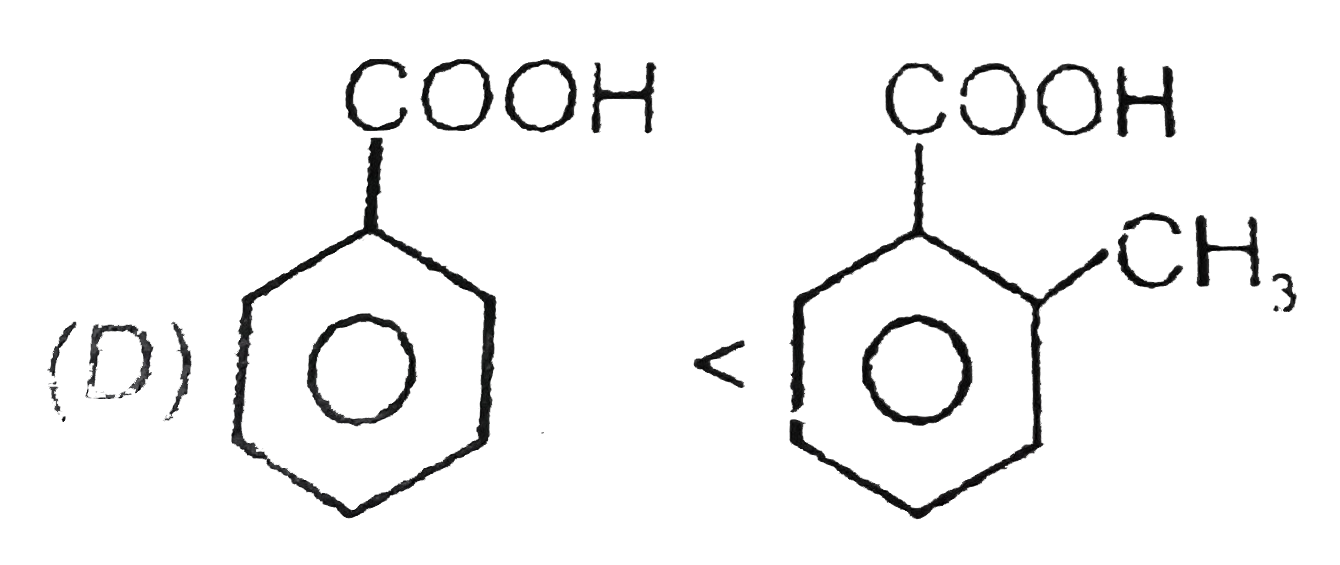
D

(order of acidic strength)

Text Solution

AI Generated Solution

The correct Answer is:

To determine which statements are correct, let's analyze each one step by step. ### Step 1: Evaluate the first statement **Statement:** Ethylene is less reactive than ethyne towards electrophilic addition reactions. **Analysis:** - Alkenes (like ethylene) are generally more reactive than alkynes (like ethyne) in electrophilic addition reactions. This is because alkenes form a more stable intermediate during the reaction compared to alkynes, which form a highly strained and unstable intermediate. - **Conclusion:** This statement is **false**. ### Step 2: Evaluate the second statement **Statement:** Cis-but-2-ene is less reactive than but-2-yne towards the rate of catalytic hydrogenation. **Analysis:** - In catalytic hydrogenation, alkynes are indeed more reactive than alkenes due to two main factors: lower steric hindrance and higher pi electron density in alkynes. - Therefore, cis-but-2-ene (an alkene) is less reactive than but-2-yne (an alkyne) in this context. - **Conclusion:** This statement is **true**. ### Step 3: Evaluate the third statement **Statement:** Nitrobenzene is less reactive than toluene for electrophilic substitution reactions. **Analysis:** - In electrophilic substitution reactions, the presence of electron-donating groups (like the methyl group in toluene) increases the electron density of the benzene ring, making it more reactive towards electrophiles. - Conversely, the nitro group in nitrobenzene is an electron-withdrawing group, which decreases the electron density, making it less reactive than toluene. - **Conclusion:** This statement is **true**. ### Step 4: Evaluate the fourth statement **Statement:** The ortho effect increases the acidity of benzoic acid when an ortho substituent is present. **Analysis:** - The ortho effect refers to the increased acidity of a carboxylic acid when an electron-donating group is present at the ortho position. This occurs because the substituent can stabilize the negative charge of the conjugate base through steric effects, making the acid more acidic. - **Conclusion:** This statement is **true**. ### Final Conclusion The correct statements are **B, C, and D**.
Promotional Banner

Topper's Solved these Questions

  • TEST PAPERS

    RESONANCE ENGLISH|Exercise PT-01|30 Videos
  • TEST PAPERS

    RESONANCE ENGLISH|Exercise Pt-02|30 Videos
  • TEST PAPERS

    RESONANCE ENGLISH|Exercise PART - III CHEMISTRY|20 Videos
  • SURFACE CHEMISTRY

    RESONANCE ENGLISH|Exercise Section - 5|1 Videos
  • TEST SERIES

    RESONANCE ENGLISH|Exercise CHEMISTRY|50 Videos

Similar Questions

Explore conceptually related problems

Which of the following statements is/are correct about the following is/are correct about the following reactions ?

Select the correct pair out of the following

Mark the correct statements out of the following:

Mark the correct statements out of the following:

Mark the correct option(s) out of the following:

The correct statement out of the following is :

Choose the correct statement out of the following.

Select the correct statement out of the following.

Choose the correct statement out of the following.

Select the correct statement out of the following

RESONANCE ENGLISH-TEST PAPERS-Chemistry
  1. Identify the option which represents the correct products of the follo...

    Text Solution

    |

  2. can be reduced to by the reagents.

    Text Solution

    |

  3. Which is (are) correct out of the following:

    Text Solution

    |

  4. Identify the correct options related with the physical properties of ...

    Text Solution

    |

  5. Choose the incorrect option (s):

    Text Solution

    |

  6. In which of the following reactions correct major product has be menti...

    Text Solution

    |

  7. Which of the following are correct regarding the given reaction?

    Text Solution

    |

  8. The K(a) of monobasic acid P, Q and R are 10^(-6),10^(-8) and 10^(-10)...

    Text Solution

    |

  9. The K(a) of monobasic acid P, Q and R are 10^(-6),10^(-8) and 10^(-10)...

    Text Solution

    |

  10. At infinite dilution, the equivalent conductances of CH(3)COOHa, HCl a...

    Text Solution

    |

  11. At infinite dilution, the equivalent conductances of CH(3)COOHa, HCl a...

    Text Solution

    |

  12. Synthesis of propellane takes placed by the following route. Q. Prod...

    Text Solution

    |

  13. Synthesis of propellane takes placed by the following route. Q. The ...

    Text Solution

    |

  14. How many electron in Ca (Z =20) have n = 2, l = 0 ?

    Text Solution

    |

  15. What is pH of pure water whose is degree of dissociation 18xx10^(-9)?

    Text Solution

    |

  16. For a cell reaction DeltaG^(@)=-1930(kJ)/(mol) and the cell e.m.f (E^(...

    Text Solution

    |

  17. How many of the following pairs are conjugate acid/base pairs? HCl,C...

    Text Solution

    |

  18. What is sum of oxidation number and coordination number of Al in Cryol...

    Text Solution

    |

  19. What is atomicity of gaseous compound formed in the Mond's process whe...

    Text Solution

    |

  20. How many monocarboxylic acids (indluding stereo) would give Methylcycl...

    Text Solution

    |