Home
Class 12
PHYSICS
A ray of light travelling in air is inc...

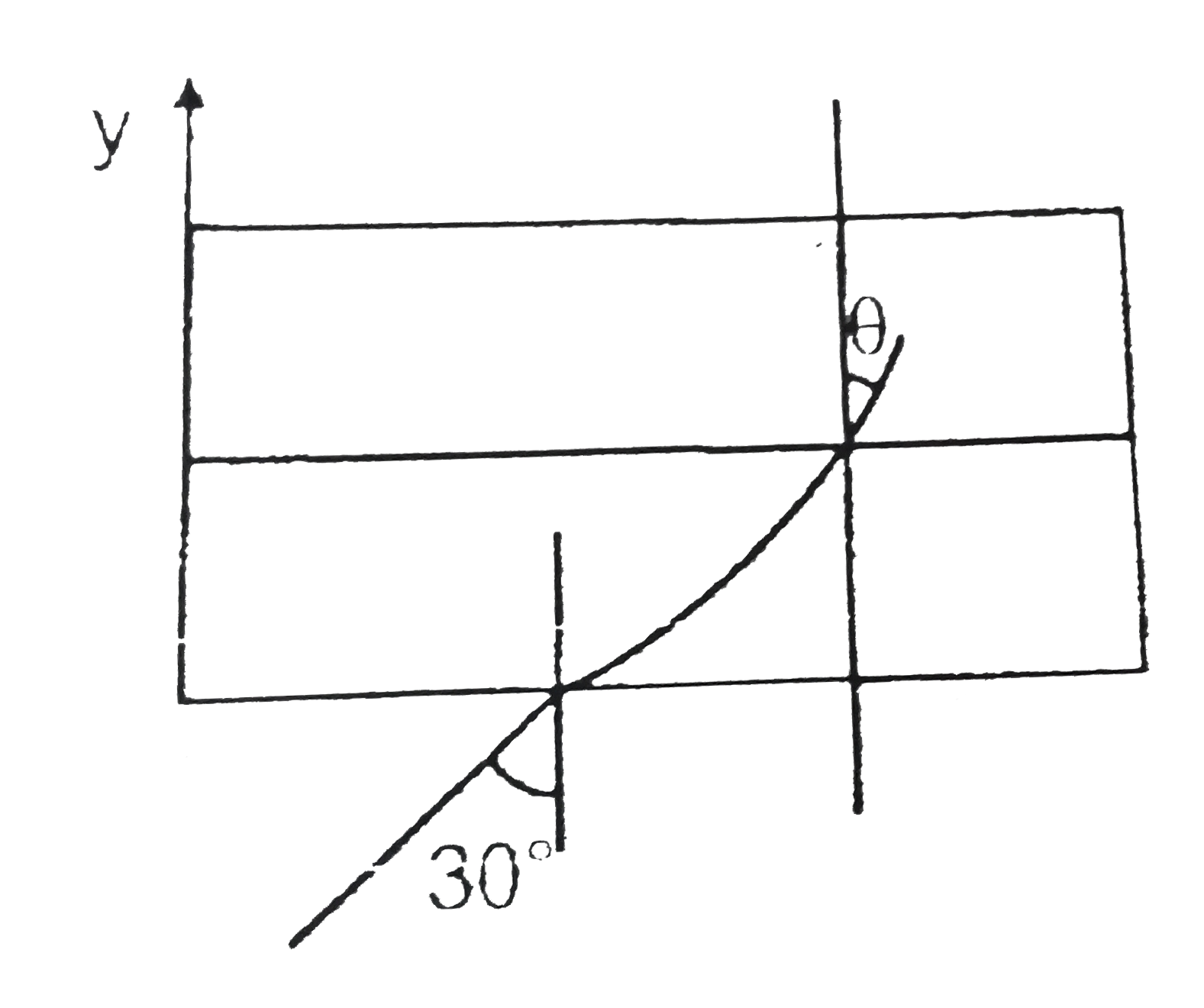
A ray of light travelling in air is inciden at angle of inciden `30^@` on one surface of slab in which refractive index varies with y. The light travels along the curve `y =4x^(2)` ( y and x are in meter) in the slab. Find out the refractive index of the slab at `y=1//2m` in the slab.

Text Solution

Verified by Experts

The correct Answer is:
3

`1xxsin30^(@)=musintheta` .(1)
`tan((pi)/(2)-theta)="slope"=(dy)/(dx)impliescottheta=8x=8((y)/(4))^((1)/(2))`

`cottheta=4sqrt(4)` ltbtgt at `y=(1)/(2)impliescottheta=(4)/(sqrt(2))=2sqrt(2)impliesintheta=(1)/(3)`
from (1) `implies1xx(1)/(2)=muxx(1)/(3)impliesmu=(3)/(2)`
`alpha=3`
Promotional Banner

Similar Questions

Explore conceptually related problems

A ray of light is icncident at anangle of 60^@ on one face of a ractangular glass slab of thickness 2sqrt(3) mm refractive index sqrt(3) , Calculate the lateral shift produced in mm.

A ray of light travelling in air is incident at angle of incidence I~~90^(@) on a long rectangular slab of a transparent medium of thickness y_(0) . The medium has a variable refractive index of mu(x)=sqrt(1+ke^(2x//a),xge0 wher a is a positive constant

A ray of light travelling through rarer medium is incident at very small angle i on a glass slab and after refraction its velocity is reduced by 20%. The angle of deviation

A ray of light travelling in air is incident at grazing incidence on a slab with variable refractive index, n (y) = [ky^(3//2) + 1 ]^(1//2) where k=1 m^(-3//2) and follows path as shown in the figure. What is the total deviation produced by slab when the ray comes out.

A ray of light is incident on one face of a transparent slab of thickness 15 cm. The angle of incidence is 60^(@) . If the lateral displacement of the ray on emerging from the parallel plane is 5sqrt(3) cm, the refractive index of the material of the slab is

A ray of light travelling in air is incident at grazing angle (incident angle= 90^(@)) on a long rectangular slab of a transparent medium of thickness t=1.0 (see figure). The point of incidence is the origin A(O,O) .The medium has a variable index of refraction n(y) given by : n(y)=[ky^(3//2)+1]^(1//2) ,where k= 1.0m^(-3//2) .the refractive index of air is 1.0 (i) Obtain a relation between the slope of the trajectory of the ray at a point B(x,y) in the medium and the incident angle at that point (ii) obtain an equation for the trajectory y(x) of the ray in the medium. (ii) Determine the coordinates ( x_(1),y_(1)) of the point P .where the ray the ray intersects upper surface of the slab -air boundary. Indicate the path of the ray subsequently.

A long rectangular slab of transparent medium of thickness d placed on a table with its length parallel to the x-axis and width parallel to the axis. A ray of light travelling inair makes a near normal incidence on the slab as shown. Taking the point of incidence as orign (0,0,0). The refraction index mu of the medium varies as mu=(mu_(0))/(1-(x/r) where mu_(1) and r(gtd) are constants. The refractive index of air is mu_(0) The x-coordinate of the point A where the ray intersects the upper surface of the slab air boundary is

A ray of light, travelling in a medium of refractive index 'mu_, is incident at an angle i on a composite transparent plate consisting of three plates of refractive indices mu_1,mu_2 and mu_3. The ray emerges from the composite plate into a medium of refractive index mu_4, at angle x. Then,

A ray of light is incident on a glass slab at grazing incidence. The refractive index of the material of the slab is given by mu=sqrt((1+y) . If the thickness of the slab is d=2m , determing the equation of the trajectory of the ray inside the slab and the coordinates of the point where the ray exits from the slab. Take the origin to be at the point of entry of the ray.

A light ray is incident at 45^(@) on a glass slab. The slab is 3cm thick, and the refractive index of the glass is 1.5 . What will the displacement of the ray be as a result of its passage through the slab? At what angle will the ray emerge formn the slab?

