Home
Class 12
PHYSICS
A true balance is one whose pans are of ...


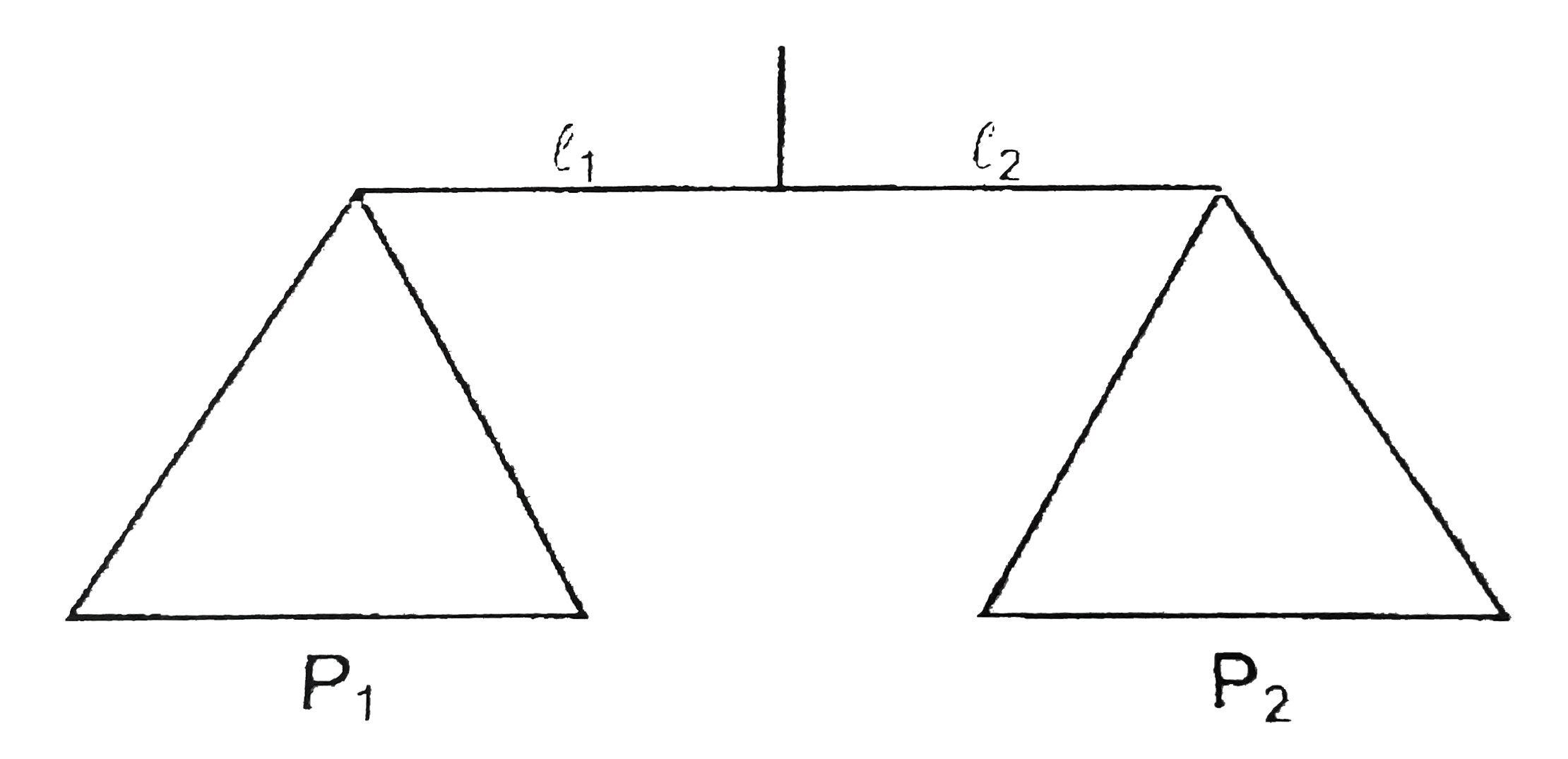
A true balance is one whose pans are of equal masses and arms are of equal lengths. When this happens, the net moment of forces about point of suspension is zero and beam remains horizontal without any weight i.e., for the true balance `P_(1)=P_(2)` and `l_(1)=l_(2)` also `P_(1)l_(1)=P_(2)l_(2)` (mass of beam is neglibigle). A shopkeeper uses a false balance to weigh articles. Both arms and pans of this false balance are different, but beam become horizontal without any weight. `(P_(1)neP_(2)` and `l_(1)nel_(2)` but `P_(1)l_(1)=P_(2)l_(2))`.
Q. Shopkeeper use a weight W to weigh and article by false balance. in two weighing by using alternating pans let `W_(1)` and `W_(2)` are the weights of the article given to the customer i.e., customer gets `(W_(1)+W_(2))` weight of article. Loss of gain to the shopkeeper is:

A

`(W(l_(2)-l_(1))^(2))/(l_(1)l_(2))` gain

B

`(W(l_(2)-l_(1))^(2))/(l_(1)l_(2))` loss

C

No gain, no loss

D

Data insufficient

Text Solution

Verified by Experts

The correct Answer is:

B

Since `P_(1)l_(1)=P_(2)l_(2)` and `P_(2)ltP_(1)impliesl_(2)gtl_(1)`
`Wl_(1)=W_(2)l_(2)impliesW_(2)=(Wl_(1))/(l_(2))` since `(l_(1))/(l_(2))lt1impliesW_(2)ltW`
`implies` there will be gain for shopkeeper
`DeltaW_(2)=W-W_(2)=W((l_(2)-l_(1))/(l_(2)))`
`W_(1)` be the weight of article when article put in `P_(1)`
`W_(1)l_(1)=Wl_(2)impliesW_(1)=(Wl_(2))/(l_(1))` since `(l_(1))/(l_(2))lt`
`impliesW_(1)gtW`
`implies` there will be loss for shopkeeper
`DeltaW_(1)=W_(1)-W=W((l_(2)-l_(1))/(l_(1)))`
Since weight loss is more so net loss
`=W((l_(2)l_(1))/(l_(1)))-W((l_(2)-l_(1))/(l_(2)))=W((l_(2)-l_(1))^(2))/(l_(1)l_(2))`
Promotional Banner

Similar Questions

Explore conceptually related problems

A true balance is one whose pans are of equal masses and arms are of equal lengths. When this happens, the net moment of forces about point of suspension is zero and beam remains horizontal without any weight i.e., for the true balance P_(1)=P_(2) and l_(1)=l_(2) also P_(1)l_(1)=P_(2)l_(2) (mass of beam is neglibigle). A shopkeeper uses a false balance to weigh articles. Both arms and pans of this false balance are different, but beam become horizontal without any weight. (P_(1)neP_(2) and l_(1)nel_(2) but P_(1)l_(1)=P_(2)l_(2)) . Q. Choose the correct options(s)

A body weighs 6gms when placed in one pan and 24gms when placed on the other pan of a false balance. If the beam is horizontal when both the pans are empty, the true weight of the body is :

The two arms of a balanced are of unequal length. An object when placed in the left pan of the balance weighs 4 kg. The same object when placed in the right pan of the balance weighs 9 kg. The actual (or) true mass of the object is

In a beam balance, when the beam is balanced in horizontal position, it is in __________ equilibrium.

The length of a steel wire is l_(1) when the stretching force is T_(1) and l_(2) when the stretching force is T_(2) . The natural length of the wire is

Two objects of equal mass rest on the opposite pans of an arm balance. Does the scale remain balance when it is accelerated up or down in a life ?

A physical balance has its arms of length 60cm and 40cm. What weight kept on the pan of the longer arm will balance an object of weight 100 gf kept on the other pan?

Two equal masses each in are hung from a balance whose scale pans differ in vertical height by h . The error in weighing in terms of density of the earth rho is

Two equal masses each in are hung from a balance whose scale pans differ in vertical height by h . The error in weighing in terms of density of the earth rho is

Two identical blocks of mass m are suspended from a beam balance whose scale pans differ in vertical height by h(h
