Home
Class 12
PHYSICS
A person throws a ball in vertical plane...

A person throws a ball in vertical plane such that velocity of ball along horizontal is `V_(x)` and along vertical is `v_(gamma)`. Coefficinet of friction between man and gound is `mu`. Necessary condition so that man always remains at rest will be (Note: the process is done in time `Deltatto0)`

A

`v_(x)gtmuv_(gamma)`

B

`v_(x)lemuv_(gamma)`

C

`v_(y)lemuv_(x)`

D

`muv_(x)lev_(y)`

Text Solution

Verified by Experts

The correct Answer is:
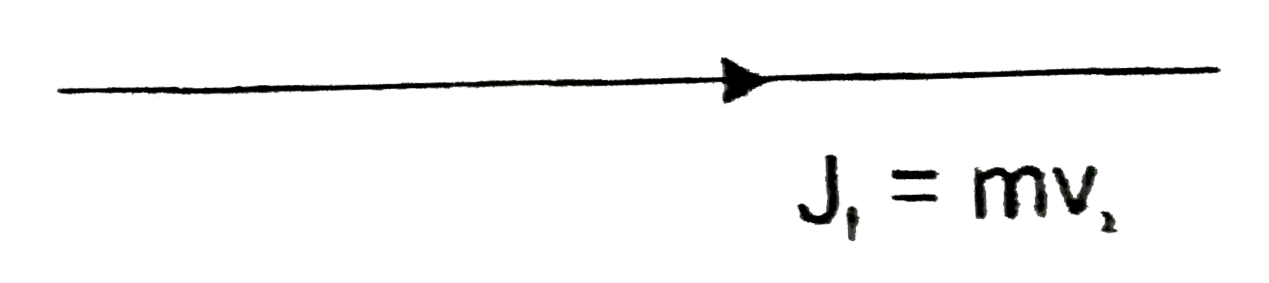
B


`J_(N)=mv_(y)`
`J_(f)lemuJ_(N)`
`mv_(x)lemumv_(y)implies(v_(y))/(v_(x))ge(1)/(mu)`
`muv_(y)gev_(x)`
Promotional Banner

Similar Questions

Explore conceptually related problems

A block is resting on a horizontal plate in the xy plane and the coefficient of friction between block and plate is mu . The plate begins to move with velocity v=bt^(2) in x direction At what time will the block start sliding on the plate?

A disc of the radius R is spun to an angular speed omega_0 about its axis and then imparted a horizontal velocity of magnitude (at t = 0) with its plane remaining vertical. The coefficient of friction between the disc and the plane is mu . The sense of rotation and direction of its linear speed are shown in the figure . Choose the correct statement.

A rod AB of length 2m is hinging at point A and its other end B is atteched to a platform on which a point of mass m is kept. Rod rotates about point A maintaing angle theta = 30^(@) with the vertical in such a way that platform remain horizontal and revolves on the horizontal circular path.If the coeffiicent of staic friction between the block and platform is mu = 0.1 then find the maximum angular velocity in rad s^(-1) of rod so that the block does not slip on the plateform (g = 10 ms^(-2))

A rod AB of length 2m is hinging at point A and its other end B is atteched to a platform on which a point of mass m is kept. Rod rotates about point A maintaing angle theta = 30^(@) with the vertical in such a way that platform remain horizontal and revolves on the horizontal circular path.If the coeffiicent of staic friction between the block and platform is mu = 0.1 then find the maximum angular velocity in rad s^(-1) of rod so that the block does not slip on the plateform (g = 10 ms^(-2))

A ball rolls without sliding over a rough horizontal floor with velocity v_(0)=7m//s towards a smooth vertical wall. If coefficient of restitution between the wall and the ball is e=0.7 . Calculate velocity v of the ball after the collision.

A disc of radius R is spun to an angular speed omega_(0) about its axis and then imparted a horizontal velocity of magnitude (omega_(0)R)/(4) (at t=0 ) with its plane remaining vertical. The coefficient of friction between the disc and the plane is mu . The sense of rotation and direction of its linear speed are shown in the figure. The disc returns to its initial point in time T=(25)/(6k mug)omega_(0)R . Find the value of k .

A block B is pushed momentarily along a horizontal surface with an initial velocity v . If mu is the coefficient of sliding friction between B and the surface, block B will come to rest after a time:

A block B is pushed momentarily along a horizontal surface with an initial velocity v . If mu is the coefficient of sliding friction between B and the surface, block B will come to rest after a time:

In the position shown in figure, the spring is at its natural length. The block of mass m is given a velocity v_0 towards the vertical support at t=0 . The coefficient of friction between the block and the surface is given by mu=alphax , where alpha is a positive constant and x is the position of the block from its starting position. The block comes to rest for the first time at x, which is

A plank of mass M and length L is placed at rest on a smooth horizontal surface. A small block of mass m is projected with a velocity v_0 from the left end of it as shown in figure. The coefficient of friction between the block and the plank is m, and its value is such that the block becomes stationary with respect to the plank before it reaches the other end. a. Find the time and common velocity when relative sliding between the block and the plank stops. b. Find the work done by the friction force on the block during the period it slides on the plank. Is the work positive or negative? c. Calculate the work done on the plank during the same period. Is the work positive or negative? d. Also, determine the net work done by friction, Is it positive or negative?

