Home
Class 12
PHYSICS
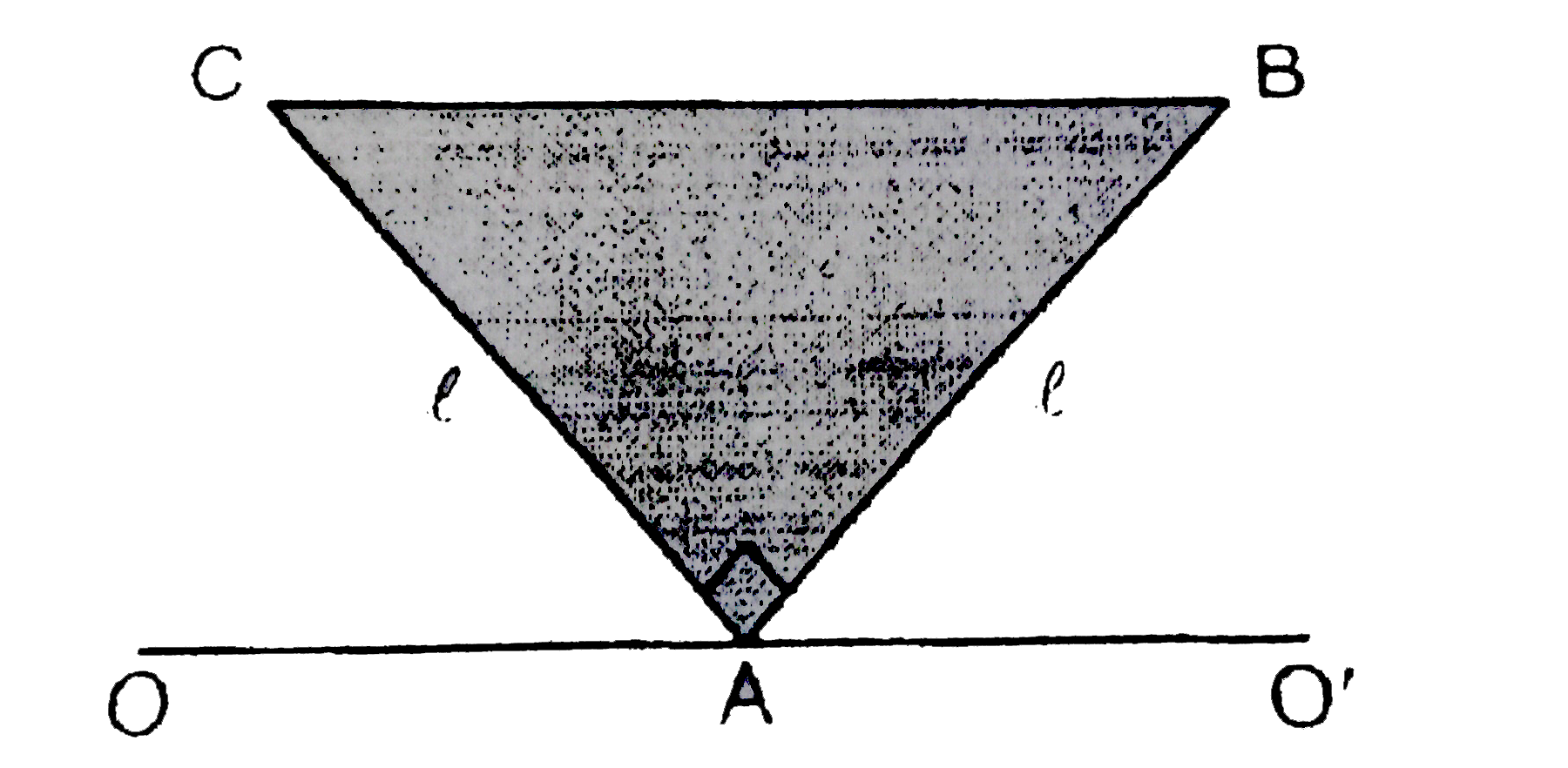
In the adjacent figure ABC is a uniform ...


In the adjacent figure ABC is a uniform isosceles triangular lamina of mass m and `AB=AC=l` the lamina is free to rotate about a fixed horizontal axis `OAO^(')` which is in the plane of the lamina. Initially the lamina is in static equilibrium with maximum gravitational potential energy. due to slight disturbance, lamina starts rotating. Now choose the correct option(s)

A

a. The maximum angular speed acquried by lamina is `4sqrt((sqrt(2)g)/(3l))`

B

b. The maximum vertical force on the axis by the lamina is `(41)/(9)mg`

C

c. Angular momentum of the lamina about `OAO^(')` is conserved

D

d. When the lamina acquire maximum angular speed acceleration of centre of mass is zero.

Text Solution

Verified by Experts

The correct Answer is:

A, B

`because-DeltaU=DeltaK`
`(2sqrt(2)mgl)/(3)=(1)/(2).(ml^(2)omega^(2))/(4)`
(moment of inertial about `OAO^(')=(ml^(2))/(4))`
`impliesomega=sqrt((16sqrt(2))/(3).(g)/(l))=4sqrt((sqrt(2)g)/(3l))`
`becauseF-mg=momega^(2)R=mxx(16sqrt(2)g)/(3l).(sqrt(2)l)/(3)`
`impliesF=mg+(32mg)/(9)=(41mg)/(9)`
Promotional Banner

Similar Questions

Explore conceptually related problems

A uniform equilateral triangular lamina of side a has mass m. Its moment of inertia about the axis passing through the centroid and prependicular to the plane of the lamina is :-

Find MI of a triangular lamina of mass M about the axis of rotation AB shown in Fig.

A right triangular plate ABC of mass m is free to rotate in the verticle plane about a fixed horizontal axis through A. It is supported by a string such that the side AB is horizontal. The reaction at the support A is

A uniform rod of mass m and length L is free to rotate in the vertical plane about a horizontal axis passing through its end. The rod initially in horizontal position is released. The initial angular acceleration of the rod is:

ABC is a triangular framwork of three uniform rods each of mass m and length 2l . It is free to rotate in its own plane about a smooth horizontal axis through A which is perpendicular to ABC. If it is released from rest when AB is horizontal and C is above AB. Find the maximum velocity of C in the subsequent motion.

In the figure shown one end of a light spring of natural length l_(0)=sqrt(5/8)m(~~0.8m) is fixed at point D and other end is attached to the centre B of a uniform rod AF of length l_(0)//sqrt(3) and mass 10kg. The rod is free to rotate in a vertical plane about a fixed horizontal axis passing through the end A of the rod. The rod is held at rest in horizontal position and the spring is in relaxed state. It is found that, when the rod is released to move it makes an angle of 60^(@) with the horizontal when it comes to rest for the first time. Find the (a) the maximum elogation in the spring . (Approximately) (b) the spring constant. (Approximately)

A uniform rod of mass M and length L, which is free to rotate about a fixed vertical axis through O, is lying on a frictionless horizontal table. A particle of equal mass strikes the rod with a velocity V_(0) and sticks to it. The angular velocity of the combination immediately after the collision is:

A thin rod of mass m and length l is free to rotate on a smooth horizontal plane about its one fixed end. When it is at rest, it receives a horizontal impulse J at its other end, at angle of 37^(@) with the length. Choose incorrect option immediately after impact:

Figure shows a solid uniform cylinder of radius R and mass M , which is free to rotate about a fixed horizontal axis O and passes through centre of the cylinder. One end of an ideal spring of force constant k is fixed and the other end is higed to the cylinder at A . Distance OA is equal to (R)/(2) . An inextensible thread is wrapped round the cylinder and passes over a smooth, small pulley. A block of equal mass M and having cross sectional area A is suspended from free end of the thread. The block is partially immersed in a non-viscous liquid of density rho . If in equilibrium, spring is horizontal and line OA is vertical, calculate frequency of small oscillations of the system.

A uniform rod of length l , mass m , cross-sectional area A and Young's modulus Y is rotated in horizontal plane about a fixed vertical axis passing through one end, with a constant angular velocity omega . Find the total extension in the rod due to the tension produced in the rod.
