Home
Class 12
CHEMISTRY
An ideal gas is taken around the cycle A...

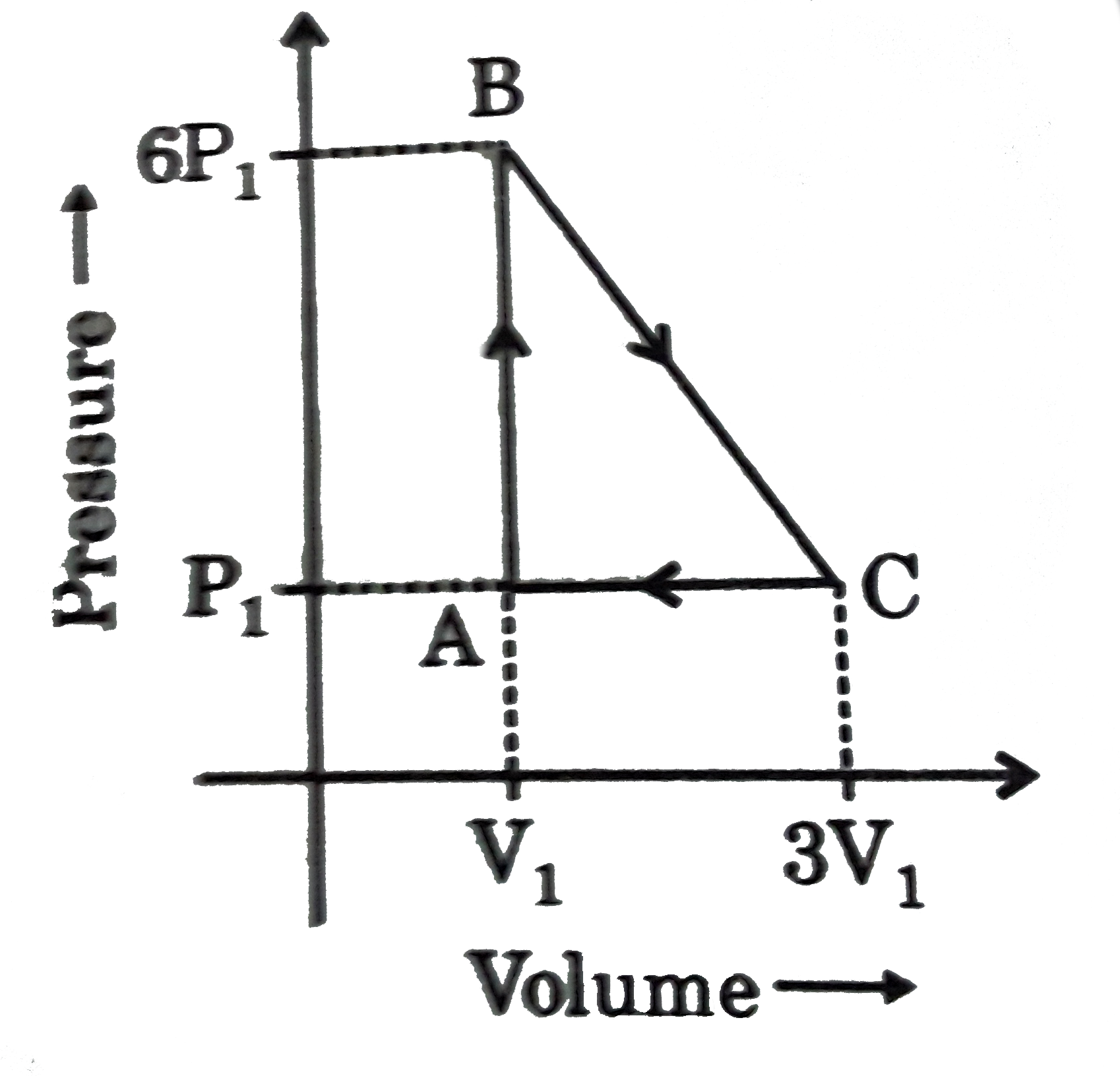
An ideal gas is taken around the cycle ABCA as shown in P-V diagram. The net work done by the gas during the cycle is equal to :

A

`12P_(1)V_(1)`

B

`6P_(1)V_(1)`

C

`5P_(1)V_(1)`

D

`P_(1)V_(1)`

Text Solution

Verified by Experts

The correct Answer is:

3

Work done by the gas in the cyclic process `=` Area bounded `(`ABCA`)=5P_(1)V_(1)`
Promotional Banner

Topper's Solved these Questions

  • TEST PAPERS

    RESONANCE ENGLISH|Exercise Pt-02|30 Videos
  • TEST PAPERS

    RESONANCE ENGLISH|Exercise PT-03|28 Videos
  • TEST PAPERS

    RESONANCE ENGLISH|Exercise Chemistry|701 Videos
  • SURFACE CHEMISTRY

    RESONANCE ENGLISH|Exercise Section - 5|1 Videos
  • TEST SERIES

    RESONANCE ENGLISH|Exercise CHEMISTRY|50 Videos

Similar Questions

Explore conceptually related problems

An ideal gas is taken around the cycle ABCA shown in P - V diagram. The net work done by the gas during the cycle is equal to

An ideal gas is taken around the cycle ABCA shown in P - V diagram. The net work done by the gas during the cycle is equal to

An ideal gas is taken around the cycle ABCA as shown in the P-V diagram. The total work done by the gas during the cycle is

An ideal gas is taken around the cycle ABCD shown in the P_V diagram below. The net work done by the gas during the cycle is equal to

An ideal monoatomic gas is taken round the cycle ABCDA as shown in the P-V diagram. The work done during the cycle is

An ideal monoatomic gas is taken round the cycle ABCDA as shown in the P-V diagram. The work done during the cycle is

An ideal monoatomic gas is taken round the cycle ABCDA as shown in the P-V diagram. The work done during the cycle is

One mole of a monatomic ideal gas is taken along the cycle ABCA as shown in the diagram. The net heat absorbed by the gas in the given cycle is

Two moles of helium gas are taken over the cycle ABCDA, as shown in the P-T diagram The net work done on the gas in the cycle ABCDA is :

Two moles of helium gas are taken over the cycle ABCDA, as shown in the P-T diagram The net work done on the gas in the cycle ABCDA is :

RESONANCE ENGLISH-TEST PAPERS-PT-01
  1. For the reactions, AhArrB, K(c)=1,BhArrC,K(c)=3,ChArrD,K(c)=5. K(c) ...

    Text Solution

    |

  2. The conversion of sugar C(12)H(22)O(11) to CO(2) is :

    Text Solution

    |

  3. If standard heat of dissociation of PCl(5) is 230 cal than slope of ...

    Text Solution

    |

  4. For a certain gas P(c) and T(c) are 80atm and -33^(@)C respectively th...

    Text Solution

    |

  5. Which of the following statement (s) is true I- Slpe of isotherm at...

    Text Solution

    |

  6. A mixture contain 61.2% BaO, 28% CaO and 10.8 % ( silica ) impurities...

    Text Solution

    |

  7. Consider the reactions (i) PCl(5)(g) hArr PCl(3)(g)+Cl(2)(g) (ii) ...

    Text Solution

    |

  8. Two glass bulbs A and B at same temperature are connected by a very sm...

    Text Solution

    |

  9. Determine enthalpy of formation for H(2)O(2)(l), using listed enthalpi...

    Text Solution

    |

  10. The rate of diffusion of two gases X and Y is in the ration of 1:5 and...

    Text Solution

    |

  11. Which one is the correct ground state electronic configuration :

    Text Solution

    |

  12. At constant temperature , the equilibrium constant (KP) for the deco...

    Text Solution

    |

  13. An ideal gas is taken around the cycle ABCA as shown in P-V diagram. T...

    Text Solution

    |

  14. In a chemical reaction, K(2)Cr(2)O(7)+xH(2)SO(4)+ySO(2) to K(2)SO(4)+ ...

    Text Solution

    |

  15. For the gas phase reaction, PCI (5)(g)Leftrightarrow OCI(3)(g) + CI(...

    Text Solution

    |

  16. The enthalpy of neutralization of a week monoprotic acid (HA) in 1 M s...

    Text Solution

    |

  17. Benzene burns according to the following equation at 300K (R=8.314J mo...

    Text Solution

    |

  18. X and Y are two elements which form X(2)Y(3) and X(3)Y(4). If 0.20 mol...

    Text Solution

    |

  19. In the reaction 4A + 2B + 3C to A(4)B(2) C(3), what will be the numb...

    Text Solution

    |

  20. The correct figure representing isothermal and adiabatic expansions of...

    Text Solution

    |
