Home
Class 12
CHEMISTRY
For the decomposition of HI the followin...

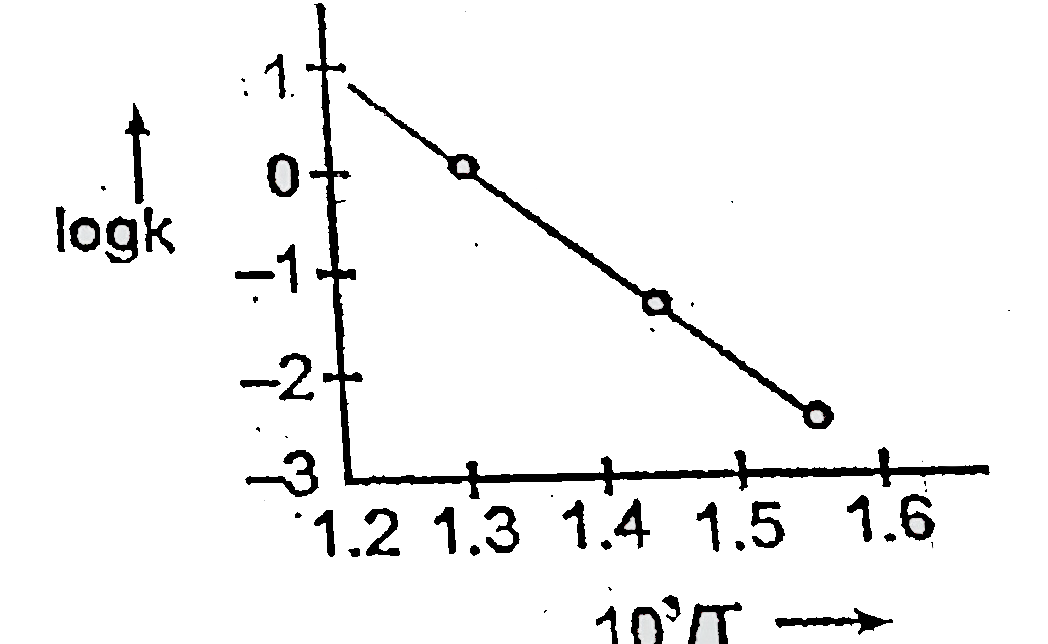
For the decomposition of `HI` the following logarithmic plot is
shown `: [R=1.98 cal// mol - K]`

The activation energy of the reaction is about

A

`45600 cal`

B

`13500 cal`

C

`24600 cal`

D

`32300 cal`

Text Solution

Verified by Experts

The correct Answer is:

1

`logk=-(E_(a))/(2.303R)(1)/(T)+"constant"=-(E_(a))/(2.303R)xx10^(-3)xx(10^(3))/(T)+"constant"`
Thus slope of graph will be `-(E_(a)xx10^(-3))/(2.303R)= -(4)/(0.4)`
`implies" "E_(a)=2.303xx1.98xx10^(4)=45600cal`
Promotional Banner

Topper's Solved these Questions

  • TEST PAPERS

    RESONANCE ENGLISH|Exercise Pt-05|30 Videos
  • TEST PAPERS

    RESONANCE ENGLISH|Exercise PT-06|30 Videos
  • TEST PAPERS

    RESONANCE ENGLISH|Exercise PT-03|28 Videos
  • SURFACE CHEMISTRY

    RESONANCE ENGLISH|Exercise Section - 5|1 Videos
  • TEST SERIES

    RESONANCE ENGLISH|Exercise CHEMISTRY|50 Videos

Similar Questions

Explore conceptually related problems

In an exothermic reaction X rarr Y , the activation energy is 100 kJ mol^(-1) of X . The enthalphy of the reaction is -140 kJ mol^(-1) . The activation energy of the reverse reaction Y rarr X is

Consider the following plots of rate constant versus (1)/(T) for four different reactions. Which of the following orders is correct for the activation energies of these reactions ?

Consider the following plots of rate constant versus (1)/(T) for four different reactions. Which of the following orders is correct for the activation energies of these reactions?

The activation energy for the forward reaction X rarr Y is 60 kJ mol^(-1) and Delta H is -20 kJ mol^(-1) . The activation energy for the reverse reaction is

The activation energy of exothermic reaction ArarrB is 80 kJ "mol"^(-1) . The heat of reaction is 200 kJ "mol"^(-1) . The activation energy for the reaction Brarra ( in kJ/mol) will be :

The rate constant for a first order reaction becomes six times when the temperature is raised from 350 K to 400 K. Calculate the activation energy for the reaction [R=8.314JK^(-1)mol^(-1)]

In the decomposition of H_2O_2 at 300 K, the energy of activation was found to be 18 kcal//"mol" white it decreases to 6 kcal//"mol" when the decomposition was carried out in the presence of a catalyst at 300 K. The number of times the catalysed reaction faster than uncatalysed one is (Give you answer by multiplying 10^7 )

If a reaction A+BrarrC is exothermic to the extent of 30 KJ mol^(-1) , the the forward reaction has an activation energy , 70KJ mol^(-1) , the activation energy for the reverse reaction is

A colliison between reactant molecules must occur with a certain minimum energy before it is effective in yielding Product molecules. This minimum energy is called activation energy E_(a) Large the value of activation energy, smaller the value of rate constant k . Larger is the value of activation energy, greater is the effect of temperature rise on rate constant k . E_(f) = Activation energy of forward reaction E_(b) = Activation energy of backward reaction Delta H = E_(f) - E_(b) E_(f) = threshold energy If a reaction A + B rarr C is exothermic to the extent 30 kJ mol^(-1) and the forward reaction has an activation energy of 249 kJ mol^(-1) the activation energy for reverse reaction in kJ mol^(-1) is

The activation energy of a non–catalysed reaction at 37^@C is 200 kcal/mol and the activation energy of the same reaction when catalysed decreases to only 60.0 kcal/mol. Calculate the ratio of rate constants of the two reactions.

RESONANCE ENGLISH-TEST PAPERS-PT-04
  1. The figure below shows a unit cell of the mineral Perovskite ( the tit...

    Text Solution

    |

  2. The rate constant of a first order reaction is 10^(-3) m i n^(-1) at 3...

    Text Solution

    |

  3. Barium ion , CN^(-) and Co^(2+) form an ionic complex . If that comple...

    Text Solution

    |

  4. Given the standard electrode potentials , K^(+)//K = - 2.93 V , Ag^(...

    Text Solution

    |

  5. What happens when freshly precipitated Fe(OH)3 is shaken with small am...

    Text Solution

    |

  6. To obeserve the effect of concentration on the conductivity, electrol...

    Text Solution

    |

  7. For different aqueous solutions of 0.1M urea, 0.1M NaCl, 0.1M Na(2)SO(...

    Text Solution

    |

  8. An ideal mixture of liquids A and B with 2 moles of A and 2 moles of B...

    Text Solution

    |

  9. Equivalent conductance of 1M CH(3)COOH is 10ohm^(-1) cm^(2) "equiv"^(-...

    Text Solution

    |

  10. A solution of Na(2)CO(3) is added drop by drop to litre of a solution ...

    Text Solution

    |

  11. A very thin copper plate is electro- plated with gold using gold chlor...

    Text Solution

    |

  12. For the decomposition of HI the following logarithmic plot is shown ...

    Text Solution

    |

  13. Position of non-polar and polar parts in micelle is

    Text Solution

    |

  14. Under the influemce of an electric field, the particles in a sol migra...

    Text Solution

    |

  15. What is the time required for 75 percent completion of a first-order r...

    Text Solution

    |

  16. The edge length of a face-centred cubic unit cell is 508 p m. If the r...

    Text Solution

    |

  17. Calculate the perimeter of given in HCP unit cell ( Given that radius ...

    Text Solution

    |

  18. Insulin is dissolved in a suitable solvent and the ostonic pressure (p...

    Text Solution

    |

  19. Which of these is a correct statement for the case of milk?

    Text Solution

    |

  20. Following are the values of E(a) and DeltaH for three reactions carrie...

    Text Solution

    |
