Home
Class 12
PHYSICS
Given system is in equilibrium. All surf...


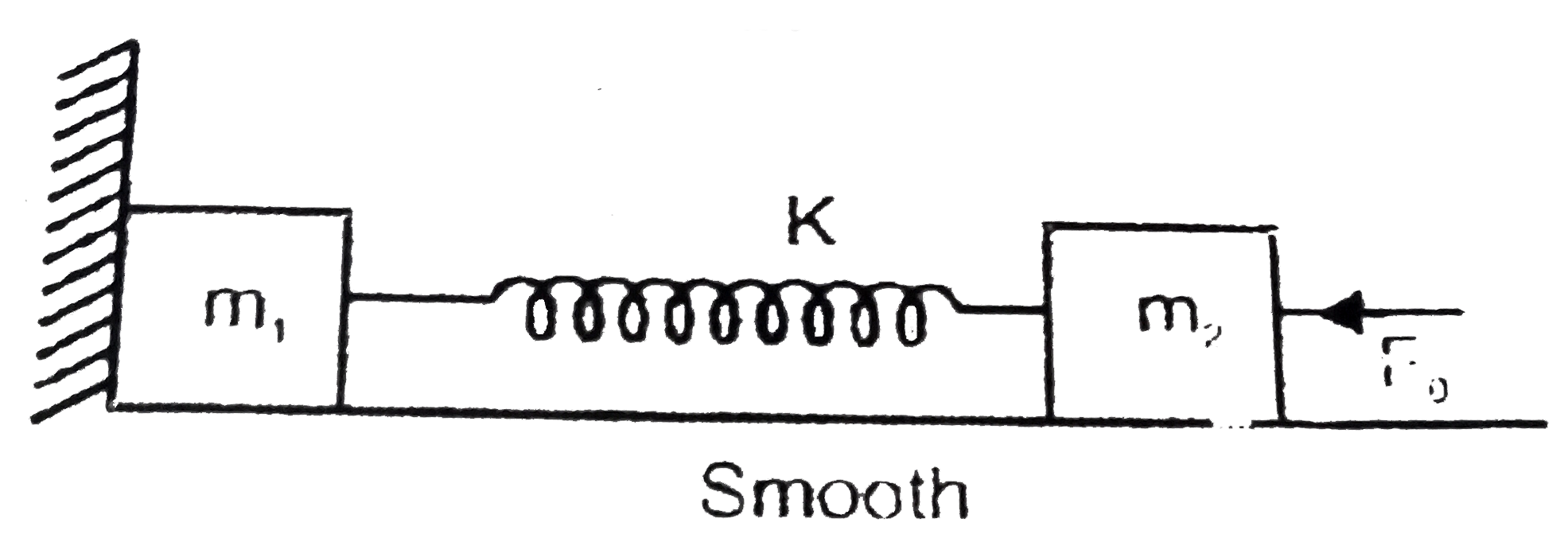
Given system is in equilibrium. All surfaces are smooth. Spring is ideal and blocks are sticked at the ends of spring Now `F_(0)` is removed Average normal contact force between wall and mass `m_(1)` upto the time spring attains its natural length for the first time in newton is (given that `F_(0)=2pi` Newton)

Text Solution

Verified by Experts

NA
Promotional Banner

Topper's Solved these Questions

  • TEST PAPERS

    RESONANCE ENGLISH|Exercise PHYSICS|784 Videos
  • TRAVELLING WAVES

    RESONANCE ENGLISH|Exercise Exercise- 3 PART I|19 Videos

Similar Questions

Explore conceptually related problems

A spring having a spring constant k is fixed to a vertical wall as shown in Fig. A block of mass m moves with velocity v torards the spring from a parallel wall opposite to this wall. The mass hits the free end of the spring compressing it and is decelerated by the spring force and comes to rest and then turns the spring is decelerated by the spring force and comes to rest and then turns back till the spring acquires its natural length and contact with the spring is broken. In this process, it regains its angular speed in the opposite direction and makes a perfect elastice collision on the opposite left wall and starts moving with same speed as before towards right. The above processes are repeated and there is periodic oscillation. Q. What is the time period of oscillation ?

The system is in equilibrium and at rest. Now mass m_(1) is removed from m_(2) . Find the time period and amplituded of resultant motion. Spring constant is K .

A block of mass m is attached to a spring of force constant k whose other end is fixed to a horizontal surface. Initially the spring is in its natural length and the block is released from rest. The average force acting on the surface by the spring till the instant when the block has zero acceleration for the first time is

In the situation shown in figure all contact surfaces are smooth. The force constant of the spring is K. Two forces F are applied as shown. The maximum elongation produced in the spring is how many times of F//K (initially the spring is relaxed)?

A spring is attached with a block of mass m and a fixed horizontal roof as shown. The block is lying on a smooth horizontal table and initially the spring is vertical and unstretched. Natural length of spring is 3l_(0) . A constant horizontal force F is applied on the block so that block moves in the direction of force. When length of the spring becomes 5l_(0) , block leaves contact with the table. Find the constant force F, if initial and final velocity of block is zero.

In the system as shown in figure, the blocks have masses m_(1) and m_(2) , the spring constant is k, coefficient of friction between the block of mass m_(1) and the surface is mu . The system is released with zero initial speed from the position where the spring is in its natural length.

A block of mass m, attacted to a string of spring constant k, oscillates on a smooth horizontal table. The other end of the spring is fixed to a wall. The block has a speed v when the spring is at its natural length. Before coming to an instantaneous rest. If the block moves a distance x from the mean position, then

In the figure, a block of mass m is rigidly attached to two identical springs of stiffness k each. The other ends of the springs are connected to the fixed wall. When the block is in equilibrium, length of each spring is b, which is greater than the natural length of the spring. The time period of the oscillation of the block if it is displaced by small distance perpendicular to the length of the springs and released. Space is gravity free.

A block of mass m is connected to a spring (spring constant k ). Initially the block is at rest and the spring is in its natural length. Now the system is released in gravitational field and a variable force F is applied on the upper end of the spring such that the downward acceleration of the block is given as a=g-alphat , where t is time elapses and alpha=1m//s^(2) , the velocity of the point of application of the force is:

In the figure shown, a spring mass system is placed on a horizontal smooth surface in between two vertical rigid walls W_(1) and W_(2) . One end of spring is fixed with wall W_(1) and other end is attached with mass m which is free to move. Initially, spring is tension free and having natural length l_(0) . Mass m is compressed through a distance a and released. Taking the collision between wall W_(2) and mass m as elastic and K as spring constant, the average force exerted by mass m on wall W_(2) in one oscillation of block is

RESONANCE ENGLISH-TEST SERIES-PHYSICS
  1. Consider a long solenoid of radius R which has n turns per unit length...

    Text Solution

    |

  2. A particle with mass m and charge q moving with a velocity v, enters a...

    Text Solution

    |

  3. Given system is in equilibrium. All surfaces are smooth. Spring is ide...

    Text Solution

    |

  4. A cubical block of side 10sqrt(10) cm is connected to a smooth and uni...

    Text Solution

    |

  5. A masonary column of density rho has height h top cross sectional area...

    Text Solution

    |

  6. In a carburator of an engine, aire is drawn from atmosphere through se...

    Text Solution

    |

  7. A rod of length l and total charge 'q' which is uniformly distributed ...

    Text Solution

    |

  8. A uniform magnetic field vecB=0.25hatkT exists in a circular region of...

    Text Solution

    |

  9. A small block of mass m=2kg is at rest point P of the stationary wedge...

    Text Solution

    |

  10. Two particles of different masses projected from a tower with same spe...

    Text Solution

    |

  11. Two soap bubbles with radius 2r and 3r come in contact. Their common ...

    Text Solution

    |

  12. Consider a uniform magnetic field B perpendicular to the plane. The co...

    Text Solution

    |

  13. P is the centre of mass of four points masses A, B, C and D which are ...

    Text Solution

    |

  14. In Young's double slit experiment the ratio of intensitities of bright...

    Text Solution

    |

  15. A Young's double slit experiment is performed with white light.

    Text Solution

    |

  16. A particle is acted upon by a force of constant magnitude which is alw...

    Text Solution

    |

  17. A heavy particle is tied to the end A of a string of the length1.6 m. ...

    Text Solution

    |

  18. An object follows a curved path. The following quantities may remain c...

    Text Solution

    |

  19. In Young's double slit experiment, white light is used. The separation...

    Text Solution

    |

  20. A cylinder rests in a supporting carriage as shown. The side AB of car...

    Text Solution

    |
