Home
Class 11
PHYSICS
Hanger is mass less a ball of mass m dro...


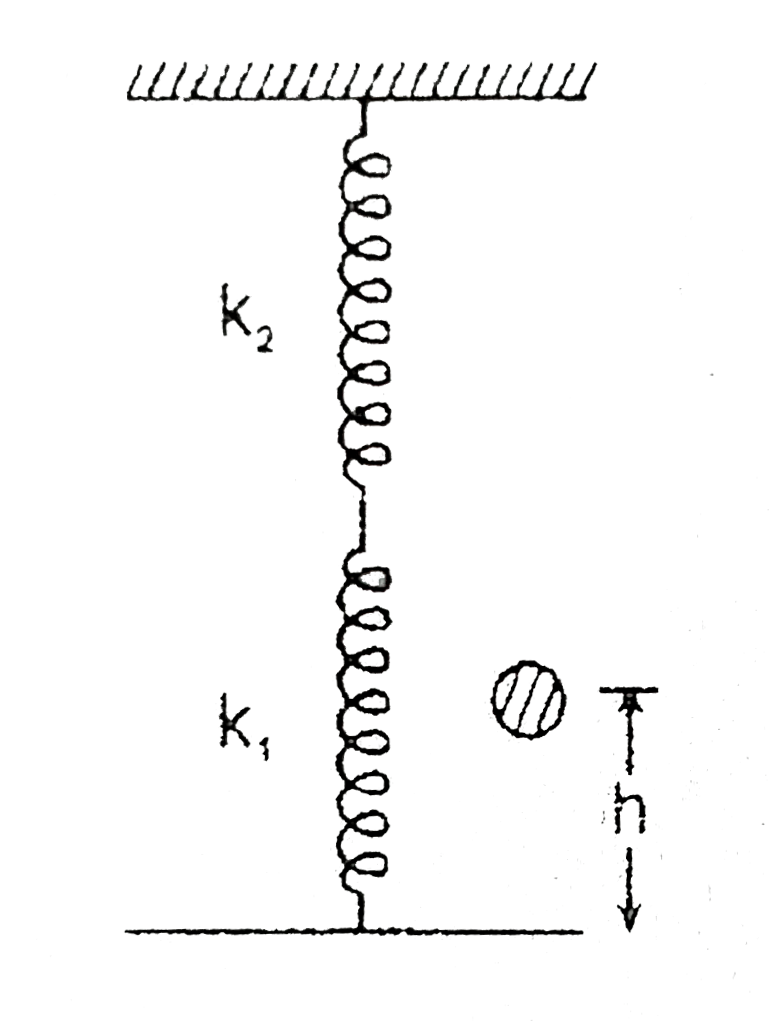
Hanger is mass less a ball of mass `m` drops a height `h` which sticks to hanger after striking. Neglect over turning find out the maximum extension in rod. Assuming or id massless let maximum extension be `x_(max)`.

Text Solution

Verified by Experts

Applying energy conservation
`mg(h + x) = (1)/(2) (k_(1)k_(2))/(k_(1) + k_(2))x^(2)`
where `k_(1) = (A_(1)Y_(1))/(l_(1)) , k_(1) = (A_(2)Y_(2))/(l_(2))`
& `k_(eq.)=(A_(1)A_(2)Y_(1)Y_(2))/(A_(1)Y_(1)l_(2)+A_(2)Y_(2)l_(1))`
`k_(eq)x^(2) - 2mgx - mgh = 0`
`x = (2mg+- sqrt(4m^(2)g^(2) + 8mghk_(eq)))/(2k_(eq)), x_(mass) = (mg)/(k_(eq)) + sqrt((m^(2)g^(2))/(k_(eq)^(2)) + (2mgh)/(k_(eq)))`
Promotional Banner

Topper's Solved these Questions

  • ELASTICITY AND VISCOCITY

    RESONANCE ENGLISH|Exercise Exercise- 1 PART - I|8 Videos
  • ELASTICITY AND VISCOCITY

    RESONANCE ENGLISH|Exercise Exercise- 1 PART - II|14 Videos
  • DAILY PRACTICE PROBLEMS

    RESONANCE ENGLISH|Exercise dpp 92 illustration|2 Videos
  • ELECTROMAGNETIC INDUCTION

    RESONANCE ENGLISH|Exercise Exercise|43 Videos

Similar Questions

Explore conceptually related problems

A ball of mass 'm' drops from a height which sticks to a massless hanger after striking it. Neglecting overturning. Find out the maximum extension in rod, assuming that the rod is massless.

A ball of mass 'm' drops from a height which sticks to a mass-less hanger after striking it. Neglecting overturning, Find out the maximum extension in rod, assuming that the rod is mass-less.

A block of mass m strikes a light pan fitted with a vertical spring after falling through a distance h. If the stiffness of the spring is k, find the maximum compression of the spring.

In the figure shown, mass 2m connected with a spring of force constant k is at rest and in equilibrium. A partical of mass m is released from height 4.5 mg//k from 2m . The partical stick to the block. Neglecting the duration of collision find time from the release of m to the moment when the spring has maximum compression.

In the figure shown, mass 2m connected with a spring of force constant k is at rest and in equilibrium. A particle of mass m is released from height 4.5 mg//k from 2m . The particle stick to the block. Neglecting the duration of collision find time from the release of m to the moment when the spring has maximum compression.

A mass M is in static equilibrium on a massless vertical spring as shown in the figure. A ball of mass m dropped from certain height sticks to the mass M after colliding with it. The oscillations they perform reach to height'a' above the original level of scales & depth 'b' below it. (a) Find the constant of force of the spring., (b) Find the oscillation frequency. (c ) What is the height above the initial level from which the mass m was dropped?

A mass M is in static equilibrium on a massless vertical spring as shown in the figure. A ball of mass m dropped from certain height sticks to the mass M after colliding with it. The oscillations they perform reach to height'a' above the original level of scales & depth 'b' below it. (a) Find the constant of force of the spring., (b) Find the oscillation frequency. (c ) What is the height above the initial level from which the mass m was dropped?

A block of mass m is attached to one end of a mass less spring of spring constant k. the other end of spring is fixed to a wall the block can move on a horizontal rough surface. The coefficient of friction between the block and the surface is mu then the compession of the spring for which maximum extension of the spring becomes half of maximum compression is .

When a tensile or compressive load 'P' is applied to rod or cable, its length changes. The change length x which, for an elastic material is proportional to the force Hook' law). P alpha x or P = kx The above equation is similar to the equation of spring. For a rod of length L , area A and young modulue Y . the extension x can be expressed as. x = (PL)/(AY) or P = (AY)/(x) , hence K = (AY)/(L) Thus rod or cables attached to lift can be treated as springs. The energy stored in rod is called strain energy & equal to (1)/(2)Px . The loads placed or dropped on the floor of lift cause stresses in the cable and can be evaluted by spring analogy. If the cable of lift cause stresses and load is placed dropped, then maximum extension in cable can be calculated by energy conservation. In above problem if mass of 10 kg falls on the massless collar attached to rod from the height of 99cm then maximum extension in the rod is equal (rod of length 4m, area 4cm^(2) and young modules 2 xx 10^(10)N//m^(2) g = 10m//sec^(2) )-

Consider the situation shown in figure. Mass of block A is m and that of blcok B is 2m. The force constant of string is k. Friction is absent everywhere. System is released from rest with the spring unstretched. Find (a) The maximum extension of the spring x_(m) (b) The speed of block A when the extension in the springt is x=(x_(m))/(2) (c ) The net acceleration of block B when extension in the spring is x=(x_(m))/(4).