Home
Class 11
PHYSICS
A bar of cross section A is subjected to...

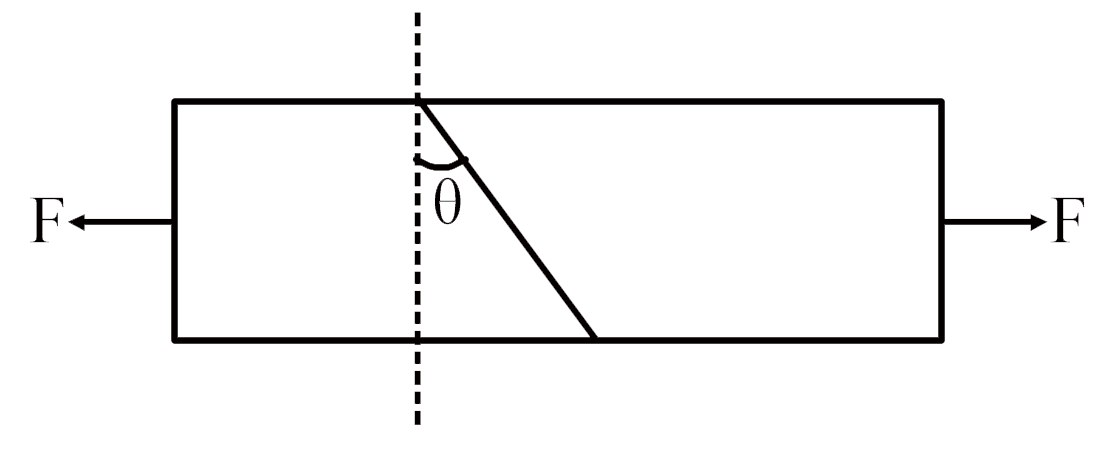
A bar of cross section A is subjected to equal and opposite tensile forces F at its ends. Consider a plane through the bar making an angle `theta` with a plane at right angles to the bar as shown in figure.

The tensile stress at this plane in terms of F, A and `theta` is

A

What is the tensile stress at this plane in terms of `F, A` and `theta` ?

B

What is the sherating stress at the plane, in terms of `F, A` and `theta` ?

C

For what value of `theta` is the tensile stress a maximum ?

D

For what valule of `theta` is shearing stress a maximum?

Text Solution

Verified by Experts

The correct Answer is:
A, B, C, D

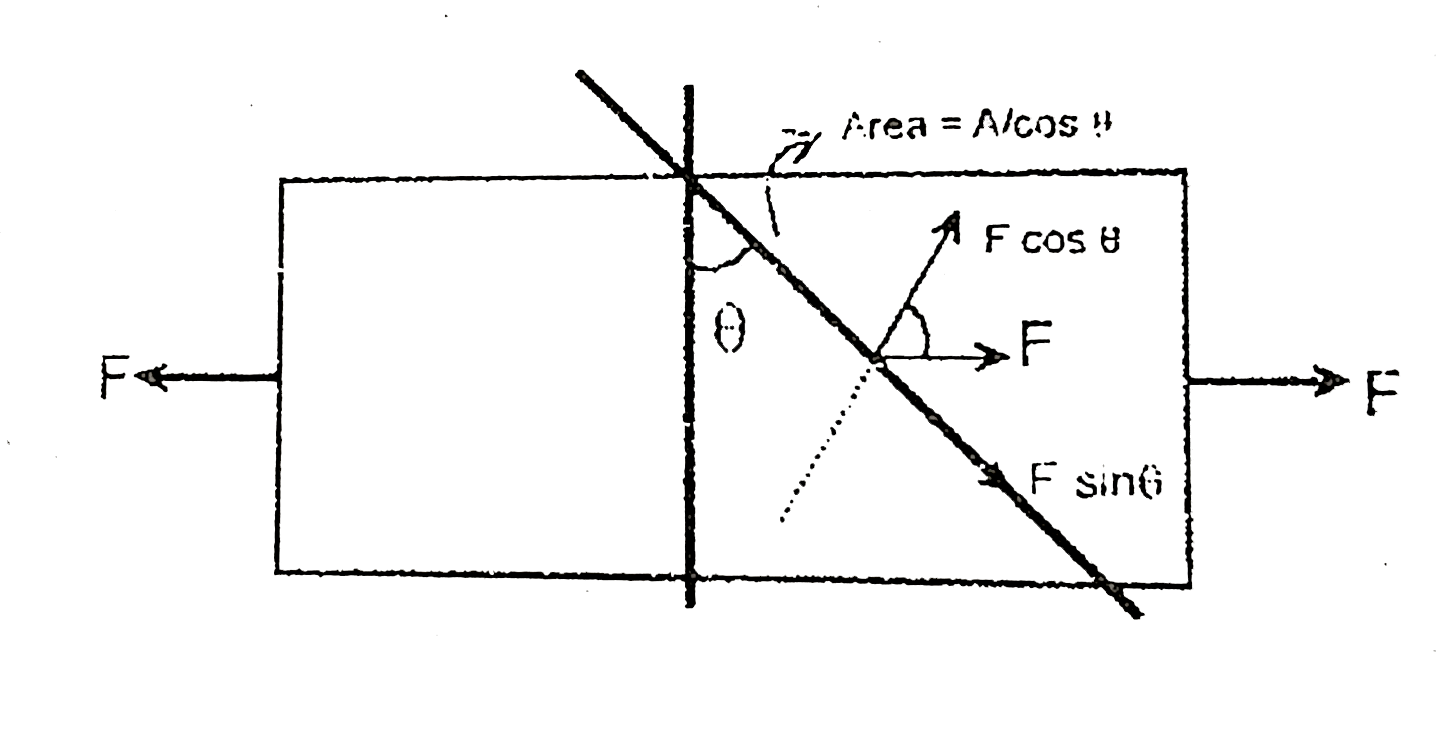
(a) tensile stress `= (Fcostheta)/(A//costheta) = (Fcos^(2)theta)/(A)`
(b) shearing stress `= (Fsintheta)/(A//costheta) = (F)/(A) sinthetacostheta`
for max. tensile stress
`theta = 0^(@)`
(d) for max. shering stress
`theta = 45^(@)`
Promotional Banner

Topper's Solved these Questions

  • ELASTICITY AND VISCOCITY

    RESONANCE ENGLISH|Exercise Exercise- 1 PART - II|14 Videos
  • ELASTICITY AND VISCOCITY

    RESONANCE ENGLISH|Exercise Exercise- 2 PART - I|9 Videos
  • ELASTICITY AND VISCOCITY

    RESONANCE ENGLISH|Exercise Advanced Level Problems|9 Videos
  • DAILY PRACTICE PROBLEMS

    RESONANCE ENGLISH|Exercise dpp 92 illustration|2 Videos
  • ELECTROMAGNETIC INDUCTION

    RESONANCE ENGLISH|Exercise Exercise|43 Videos

Similar Questions

Explore conceptually related problems

A bar of cross-section A is subjected two equal and opposite tensile forces at its ends consider a plane section of the bar whose makes an angle theta with the axis of the bar. (a) what is the tensile stress on this plane ? (b)what is the shearing stress on this plane ? (c )for what value of theta is the tensile stress is maximum ? (d) for what value of theta is the shearing stress maximum ?

A bar of cross-section A is subjected to equal and opposite tensile forces at its ends. Consider a plane section of the bar whose normal makes an angle theta with the axis of the bar . (i) What is the tensile stress on this plane? (ii) What is the shearing stress on this plane? (iii) For what value of theta is the tensile stress maximum (iv) For what value of theta is the shearing stress maximum?

A bar of cross section A is subjected to equal and opposite tensile force at its ends. Consider a plane section of the bar whose normal makes an angle theta with the axis of the bar. a. What is the tensile stress on the plane? b. What is the shearing stress on the this plane? c. For what value of theta is the tensile stress maximum? d. For what value of theta is the shearing stress maximum?

A bar of cross- sectional area A is is subjected two equal and opposite tensile forces at its ends as shown in figure. Consider a plane BB' making an angle theta with length. The ratio of tensile stress to the shearing stress on the plane BB' is

A rod area of cross section A is being acted upon by two forces F - F as shown in figure. Consider a section ab of rod whose normal makes angle theta with horimontal. The shear stress upon this section is maximum when theta=(180^(@))/(n) . Find n.

Consider a long steel bar under a tensile stress due to forces F, acting at the edges along the length of the bar Consider a plane making an angle theta with the length. What are the tensile and shering stresses on this plane ? (a) For what angle is the tensile stress a maximum ? (b) For what angle is the shearing stress a maximum ?

A massless uniform rod is subjected to froce F at its free end as shown in figure. The ratio of tensile stress at plane P_(1) to stress at P_(2) is

A string is wrapped on a uniform disc and the other end of the string connected to a wall. The system is placed on a smooth plane, inclined at an angle theta , with the string parallel to the plane, as shown in the figure. The acceleration of the disc is

A ball is projected form a point A on a smooth inclined plane which makes an angle a to the horizontal. The velocity of projection makes an angle theta with the plane upwards. If on the second bounce the ball is moving perpendicular to the plane, find e in terms of alpha and theta . Here e is the coefficient of restitution between the ball and the plane.

A horizontal force F is applied to a block of mass m on a smooth fixed inclined plane of inclination theta to the horizontal as shown in the figure. Resultant force on the block up the plane is:

