Home
Class 11
PHYSICS
Two blocks A and B are connected to each...

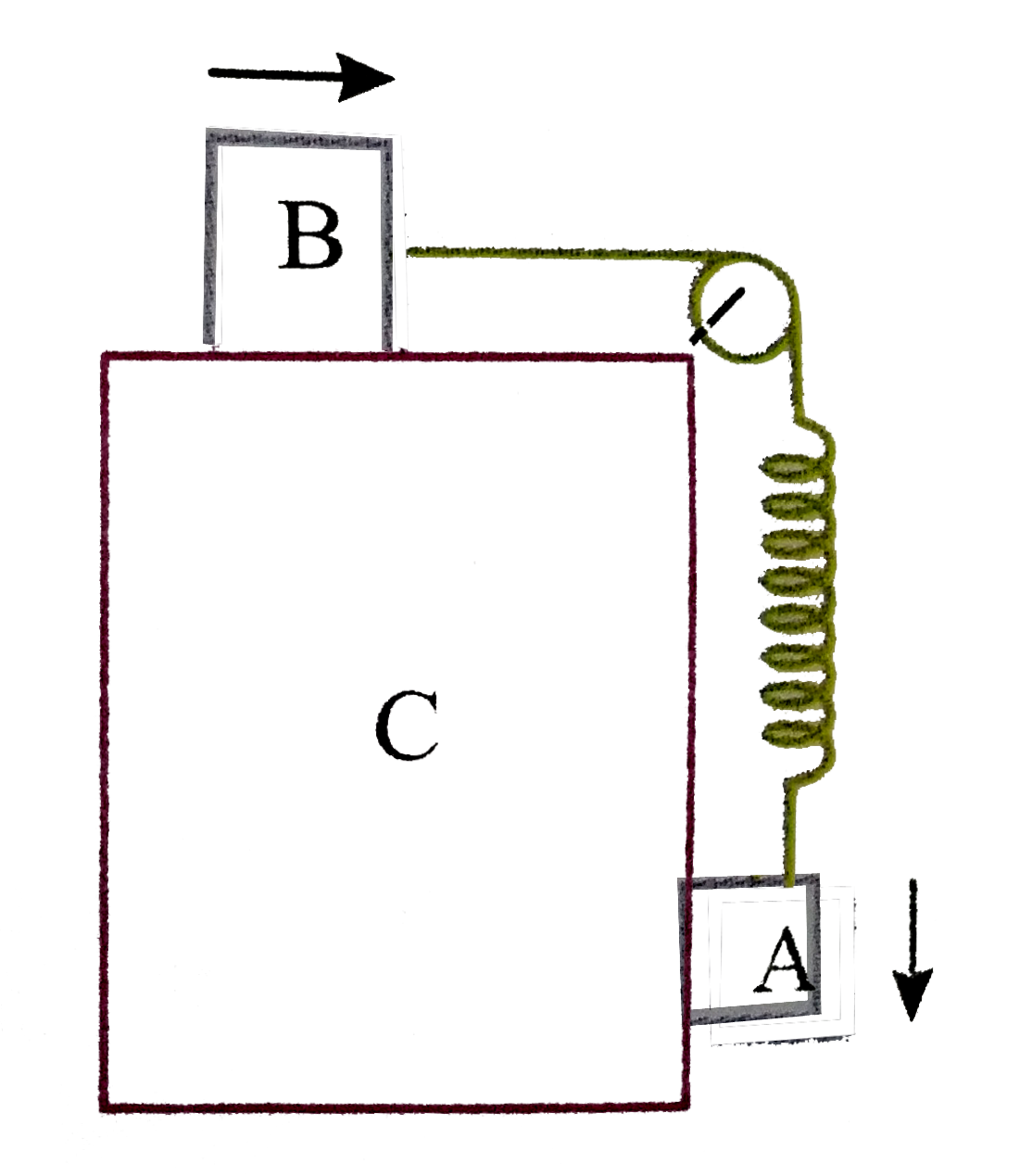
Two blocks `A` and `B` are connected to each other by a string and a spring , the string passes over a frictionless pulley as shown in the figure. Block `B` slides over the horizontal top surface of a stationary block `C` and the block A slides along the vertical side of `C`, both with the same uniform speed. The coefficient of friction between the surface and blocks is `0.5, K = 2000 N//m`. If mass of `A` is `2 kg` calculate mass of `B`.
.

Text Solution

Verified by Experts

The correct Answer is:

`100`
Promotional Banner

Topper's Solved these Questions

  • ELASTICITY AND VISCOCITY

    RESONANCE ENGLISH|Exercise Exercise- 2 PART - III|8 Videos
  • ELASTICITY AND VISCOCITY

    RESONANCE ENGLISH|Exercise Exercise- 3 PART - I|7 Videos
  • ELASTICITY AND VISCOCITY

    RESONANCE ENGLISH|Exercise Exercise- 2 PART - I|9 Videos
  • DAILY PRACTICE PROBLEMS

    RESONANCE ENGLISH|Exercise dpp 92 illustration|2 Videos
  • ELECTROMAGNETIC INDUCTION

    RESONANCE ENGLISH|Exercise Exercise|43 Videos

Similar Questions

Explore conceptually related problems

Two blocks A and B are connected to each other by a string and a spring, the string passes over a frictionless pulley as shown in the figure. Block B slides over the horizontal top surface of a stationary block C and the block A slides along the vertical side of C, both with the same uniform speed. The coefficient of friction between the surfaces of blocks is 0.2. Force constant of the spring is 1960 newtons/m. If mass of block A is 2 kg. The mass of block B and the energy stored in the spring are _____ kg and _____ J.

Two blocks A and B are connected to each other by a string and a spring , the spring passes through a friction less pulley as shown in the figure . Block B slides over the horizontal top surface of a stationary block C both with the vertical side of C , both with the same uniform speed The coefficient of friction between the surface the of block is 0.2 force constant of the spring is 1960 newtons/metre , if mass of block A is 2 kg , calculate the mass of block B and the energy stored is the spring ?

Two blocks of masses of 40 kg and 30 kg are connected by a weightless string passing over a frictionless pulley as shown in the figure.

Two blocks are connected by a cord passing over a small frictionless pulley and resting on frictionless planes as shown in the figure. The acceleration of the blocks is :

Two blocks, each having mass m, are connected with an ideal string through ideal pulleys on a frictionless fixed wedge as shown in the figure. The acceleration of the blocks is

Two blocks A & B are connected by a light inextensible string passing over a fixed smooth pulley as shown in the figure. The coefficient of friction between the block A and the horizontal table is mu=0.2 . If the block A is just to slip, find the ratio of the masses of the blocks.

Two blocks are connected by a long inextensible string passing over an ideal pulley as shown in the figure. If the system is released from rest then the common speed of blocks when block m_2 moves a distance I will be

If the two blocks moves with a constant uniform speed then find coefficient of fricition between the surface of the block B and the table. The spring is massless and the pulley is fricitionless.

Two block of masses M and m are connected to each other by a massless string and spring of force constant k as shown in the figure. The spring passes over a frictionless pulley connected rigidly to the egde of a stationary block A. The coefficient of friction between block M and plane horizontal surface of A is mu . The block M slides over the horizontal top surface of A and block m slides vertically downward with the same speed. The mass M is equal to

Two blocks A and B of respective masses 6 kg and 4 kg are connected with a string passing over a light friction less pulley as shown in the figure . The coefficient of friction between the block A and horizontal surface is 0.4 . Then the minimum mass of block C which should be placed over A to prevent it from moving is :
