Home
Class 11
PHYSICS
A circular disc of a diameter 'd' slowly...

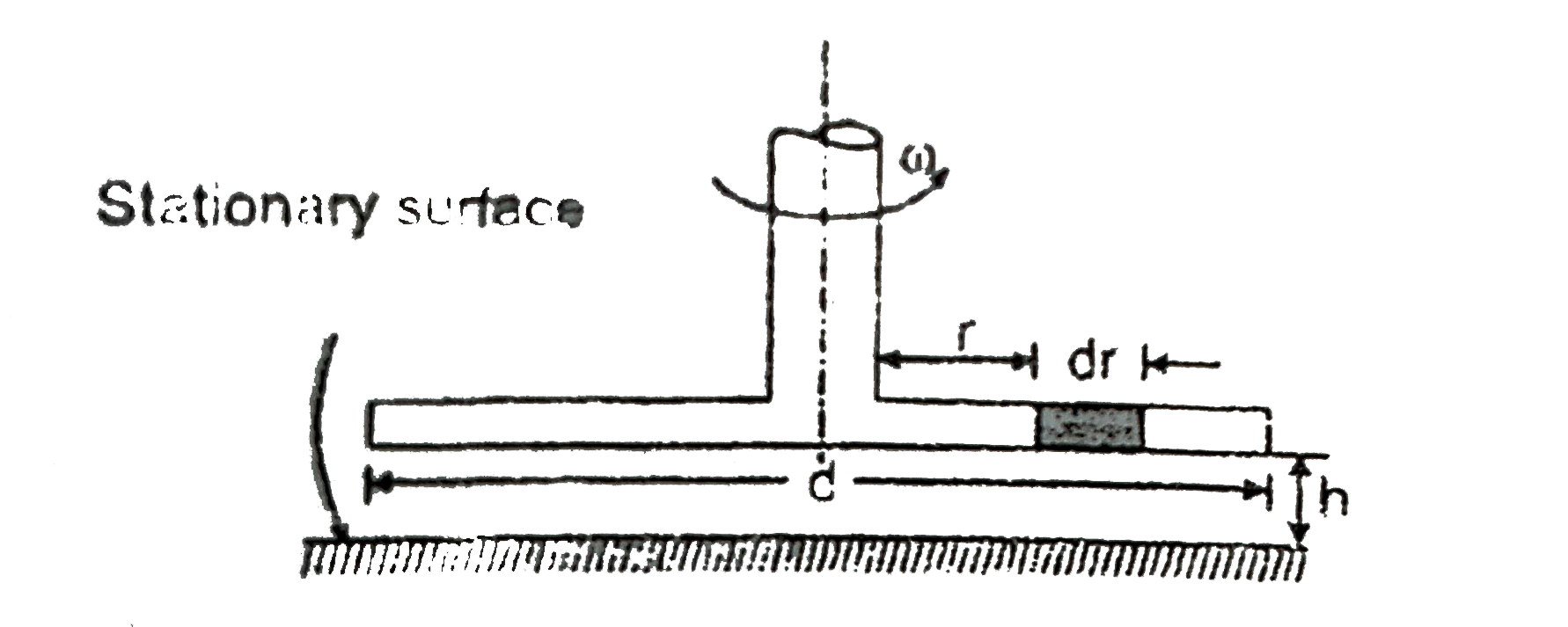
A circular disc of a diameter `'d'` slowly rotated in a liquid of large viscosity `'eta'` at a small distance `'h'` from a fixed surface as shown in figure. If an expression for torque `'tau'` necessary to maintain an angular velocity `'omega'` is `(pietad^(4))/(lambdah)` then fidn `lambda`.

Text Solution

Verified by Experts

The correct Answer is:

`32`

`dt = eta(2pirdr(omegar)/(h))`
`t = overset(r)underset(0)(int) (eta)/(h)2piomegar^(3)dr rArr t = int_(0)^(d//2)(etaomega)/(h)2pir^(3)dr`
`t = [(2pietaomega)/(h)(r^(4))/(4)]_(0)^(d//2) rArr t = (2pietaomega)/(h) (d^(4))/(4 xx 16)`
`t = ((pietaomegad^(4))/(32h))`
Promotional Banner

Topper's Solved these Questions

  • ELASTICITY AND VISCOCITY

    RESONANCE ENGLISH|Exercise Exercise- 2 PART - III|8 Videos
  • ELASTICITY AND VISCOCITY

    RESONANCE ENGLISH|Exercise Exercise- 3 PART - I|7 Videos
  • ELASTICITY AND VISCOCITY

    RESONANCE ENGLISH|Exercise Exercise- 2 PART - I|9 Videos
  • DAILY PRACTICE PROBLEMS

    RESONANCE ENGLISH|Exercise dpp 92 illustration|2 Videos
  • ELECTROMAGNETIC INDUCTION

    RESONANCE ENGLISH|Exercise Exercise|43 Videos

Similar Questions

Explore conceptually related problems

A disc of mass 4 kg and radius 6 metre is free to rotate in horizontal plane about a vertical fixed axis passing through its centre. There is a smooth groove along the diameter of the disc and two small blocks of masses 2 kg each are placed in it on either side of the centre of the disc as shown in figure. The disc is given initial angular velocity omega_(0) =12 rad/sec and released. Find the angular speed of disc (in radian/sec) when the blocks reach the ends of the disc.

A uniform rod of maass m and length L is placed on the fixed cylindrical surface of radius R at an small angular position theta from the vertical (vertical means line joining centre and vertex of the cylindrical path) as shown in the figure and released from rest. Find the angular velocity omega of the rod at the instant when it crosses the horizontal position (Assume that when rod comes at horizontal position its mid point and vertex of the circular surface coincide). Friction is sufficient to prevent any slipping.

A horizontal thin tube of length 2L completely filled with a liquid of density delta rotates about a vertical axis passing through one of its end and along the diameter of its side face with an constant angular velocity omega . Two vertical thin long tubes are fitted with the horizontal tube to measure the pressure difference between points A and B which are at same horizontal level as shown. Neglect viscous forces and surfaces tension of liquid. The difference in the heights (h) of the liquid column in the two vertical thin tubes is :

A horizontal thin tube of length 2L completely filled with a liquid of density delta rotates about a vertical axis passing through one of its end and along the diameter of its side face with an constant angular velocity omega . Two vertical thin long tubes are fitted with the horizontal tube to measure the pressure difference between points A and B which are at same horizontal level as shown. Neglect viscous forces and surfaces tension of liquid. The graph of the pressure gradient ((dP)/(dx)) with the distance x meaured from the axis of rotation is :

A thin plate AB of large area A is placed symmetrically in a small gap of height h filled with water of viscosity eta_(0) and the plate has a constant velocity v by applying a force F as shown in the figure. If the gap is filled with some other liquid of viscosity 0.75 eta_(0) at what minimum distance (in cm) from top wall should the plate be placed in the gap, so that the plate can again be pulled at the same constant velocity V . by applying the same force F ? (Take h=20 cm )

A uniform circular disc placed on a horizontal rough surface has initially a velocity v_(0) and an angular velocity omega_(0) as shown in the figure. The disc comes to rest after moving some distance in the direction of motion. Then v_(0)//r omega_(0) is :

A uniform circular disc placed on a horizontal rough surface has initially a velocity v_(0) and an angular velocity omega_(0) as shown in the figure. The disc comes to rest after moving some distance in the direction of motion. Then v_(0)//omega_(0) is :

A disc of mass m and radius R is free to rotate in a horizontal plane about a vertical smooth fixed axis passing through its centre. There is a smooth groove along the diameter of the disc and two small balls of mass m//2 each are placed in it on either side of the centre of the disc as shown in Fig. The disc is given an initial angular velocity omega_(0) and released. The angular speed of the disc when the balls reach the end of the disc is

A smooth disc of mass M and radius (L)/(sqrt(3)) is placed at rest horizontally on a smooth horizontal surface. A massless pin is fixed at point P at a distance L//2 from centre O of the disc as shown in the figure. Now a thin uniform rod of mass M and length L is placed horizontally on the surface of the disc parallel to the line OP such that its mid point and centre O of the disc just coincide as shown in figure. Now rod has given angular velocity omega_(0)=24 rad//sec in counter clockwise direction as shown. As a result, the end of the rod strikes the pin P and stricks to it rigidly. Calculate the angular velocity of disc just after collision.

A metal rod OA of mann 'm' and length 'r' is kept rotating with a constantangular speed omega in a vertical plane about a horizontal axis at the end O. The free end A is arraged to slide without friction along fixed conduction circular ring in the same plane as that of rotation. A uniform and constant magnetic induction vec(B) is applied perpendicular and into the plane of rotation as shown in the figure below. An inductor L and an external resistance R are connected through a swithch S between the point O and a point C on the ring to form an electrical circuit. Neglect the resistance of the ring and the rod. Initially, the switch is open. (a) What is the induced emf across the teminal of the switch? (b) The switch S is closed at time t=0. (i) Obtain an expression for the current as a function of time. (ii) In the steady state, obtin the time dependence of the torque required to maintain the constant angular speed, given that the rod OA was along th positive X-axis at t=0.
