Home
Class 11
PHYSICS
Viscosity is the property of fluid by vi...

Viscosity is the property of fluid by virtue of which fluid offers resistance to deformation under the influence of a tangential force.

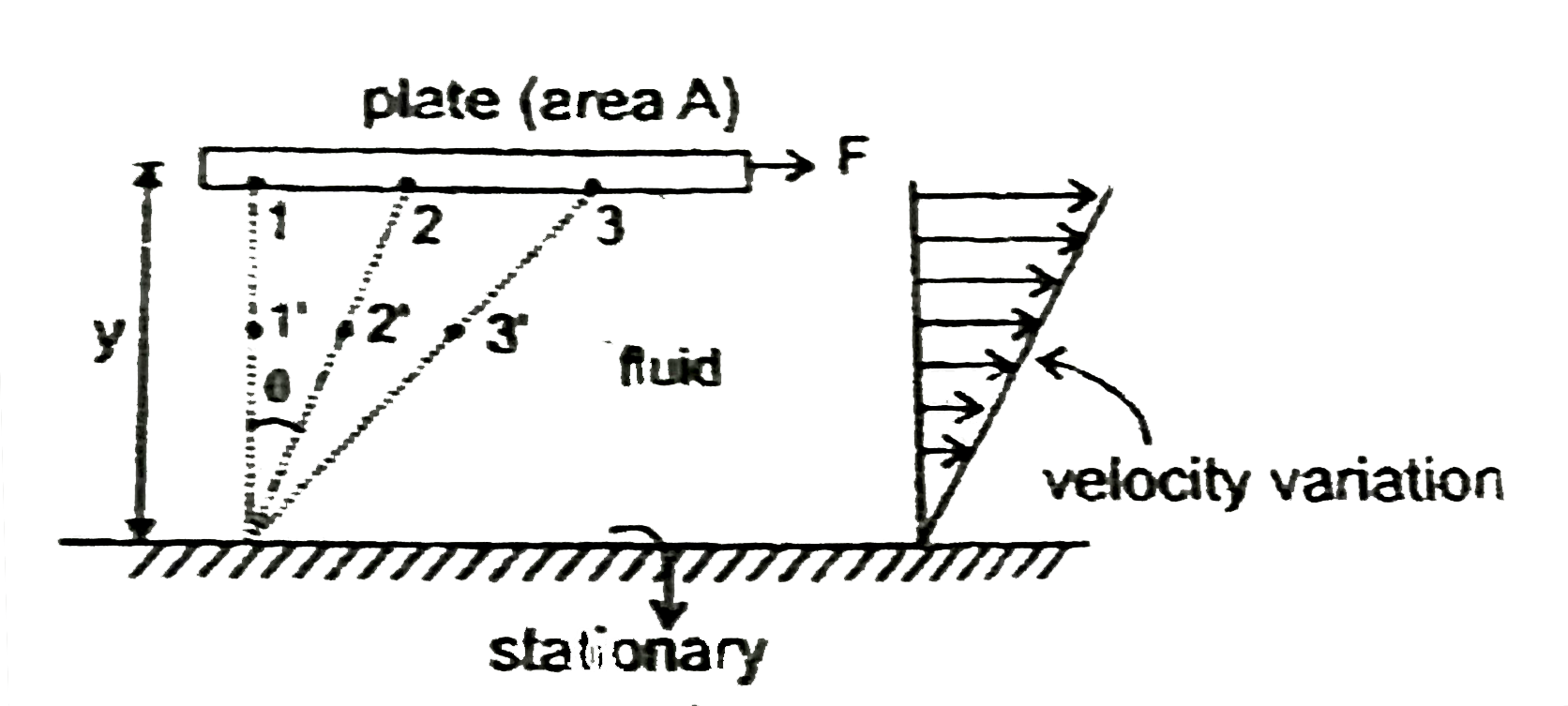
In the given figure as the the plate moves the fluid particle at the surface moves from position `1` to `2` and so on, but particles at the bottom boundry remain stationary. if the gap between palte and bottom boundary is small, fluid particles in between plate and bottom moves with velocities as shown by linear velocity distribution curve otherwise the velocity distribution may be parabolic. As per Newton's law of viscity the tangential force is related to time rate of deformation -
`(F)/(A) alpha (d' theta)/(dt)` but `y = (d' theta)/(dt) = u, (d' theta)/(dt) = (u)/(y)`
then `F = eta A(u)/(y), eta =` coefficient of viscosity
for non-linear velocity distribution -
`F = eta A(du)/(dy)`
where `(u)/(y)` or `(du)/(dy)` is known as velocity gradiant.
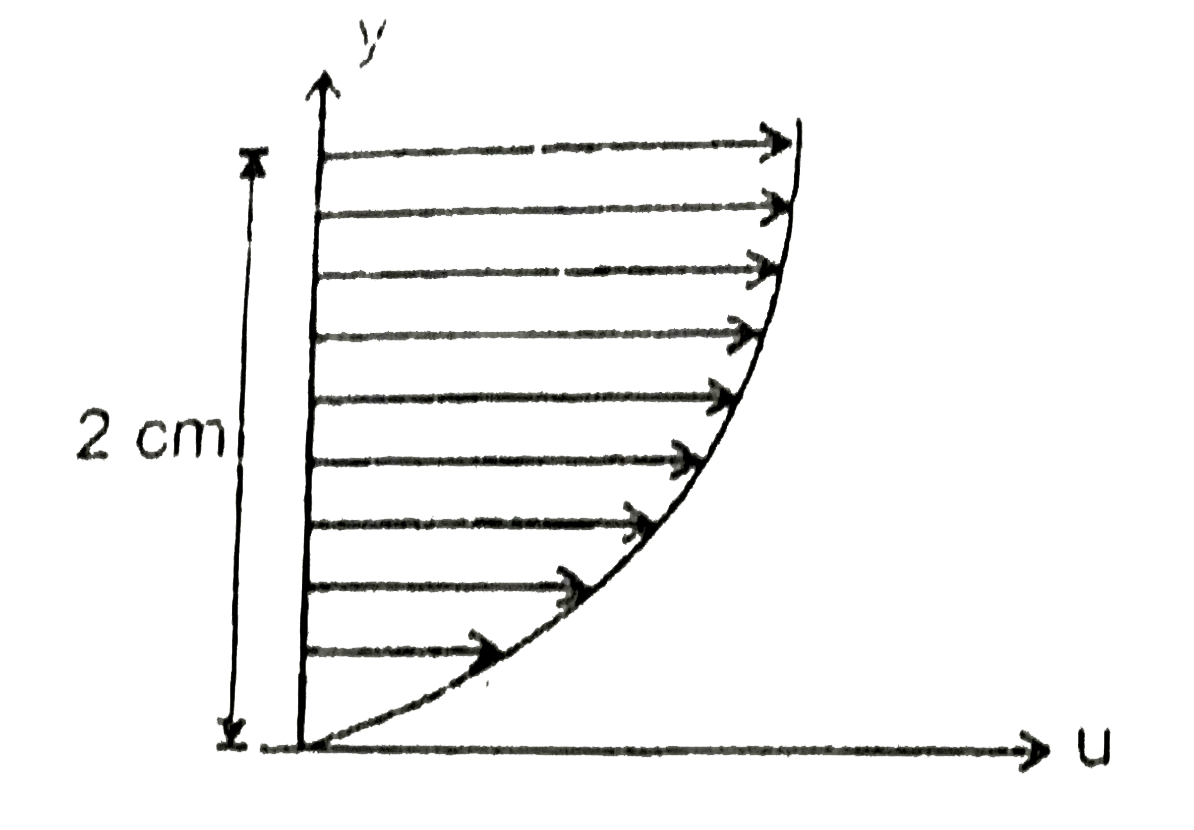
If velocity distribution is given as (parabolic)
`u = c_(1)y^(2) + c_(2)y + c_(3)`
For the same force of `2N` and the speed of the plate `2 m//sec`, and area of plate is 1 and viscousity is .001, the constant `C_(1), C_(2)` & `C_(3)` are

A

a.`200, 200, 0`

B

b.`5000, 200, 0`

C

c.`5000, 0 , 0`

D

d.`500, 200 , 0`

Text Solution

Verified by Experts

The correct Answer is:

C

`y = 0 , u = 0 , c_(3) = 0`
`y = 2 cm , u = 2 m//sec`
`2 = C_(1) 4 xx 10^(-4) + C_(2) 2 xx 10^(-2) …(1)`
`(du)/(dy) = 2C_(1)y + 2`
`F = eta A (du)/(dy)`
at `y = 2cm, F = 2 N`
`2 = 10^(-2) xx 1 xx[2 xx 2 xx 10^(-2)C_(1) + C_(2)]`
`4 xx 10^(-4)C_(1) + 10^(-2)C_(2) = 2.......(2)`
`4 xx 10^(-4)C_(1) + 2 xx 10^(-2)C_(2) = 2 .....(1)`
on solving
`C_(2) = 0` & `C_(1) = 5000`
Promotional Banner

Topper's Solved these Questions

  • ELASTICITY AND VISCOCITY

    RESONANCE ENGLISH|Exercise Exercise- 3 PART - I|7 Videos
  • ELASTICITY AND VISCOCITY

    RESONANCE ENGLISH|Exercise Exercise- 3 PART - IV|9 Videos
  • ELASTICITY AND VISCOCITY

    RESONANCE ENGLISH|Exercise Exercise- 2 PART - II|6 Videos
  • DAILY PRACTICE PROBLEMS

    RESONANCE ENGLISH|Exercise dpp 92 illustration|2 Videos
  • ELECTROMAGNETIC INDUCTION

    RESONANCE ENGLISH|Exercise Exercise|43 Videos

Similar Questions

Explore conceptually related problems

Viscosity is the property of fluid by virtue of which fluid offers resistance to deformation under the influence of a tangential force. In the given figure as the the plate moves the fluid particle at the surface moves from position 1 to 2 and so on, but particles at the bottom boundry remain stationary. if the gap between palte and bottom boundary is small, fluid particles in between plate and bottom moves with velocities as shown by linear velocity distribution curve otherwise the velocity distribution may be parabolic. As per Newton's law of viscity the tangential force is related to time rate of deformation - (F)/(A) alpha (d' theta)/(dt) but y = (d' theta)/(dt) = u, (d' theta)/(dt) = (u)/(y) then F = eta A(u)/(y), eta = coefficient of viscosity for non-linear velocity distribution - F = eta A(du)/(dy) where (u)/(y) or (du)/(dy) is known as velocity gradiant. The velocity gradient just near the bottom boundary is equal to -

Viscosity is the property of fluid by virtue of which fluid offers resistance to deformation under the influence of a tangential force. In the given figure as the the plate moves the fluid particle at the surface moves from position 1 to 2 and so on, but particles at the bottom boundry remain stationary. if the gap between palte and bottom boundary is small, fluid particles in between plate and bottom moves with velocities as shown by linear velocity distribution curve otherwise the velocity distribution may be parabolic. As per Newton's law of viscity the tangential force is related to time rate of deformation - (F)/(A) alpha (d' theta)/(dt) but y = (d' theta)/(dt) = u, (d' theta)/(dt) = (u)/(y) then F = eta A(u)/(y), eta = coefficient of viscosity for non-linear velocity distribution - F = eta A(du)/(dy) where (u)/(y) or (du)/(dy) is known as velocity gradiant. The velocity gradient just below the plate, in above problem is equal to - (per second)

Viscosity is the property of fluid by virtue of which fluid offers resistance to deformation under the influence of a tangential force. In the given figure as the the plate moves the fluid particle at the surface moves from position 1 to 2 and so on, but particles at the bottom boundry remain stationary. if the gap between palte and bottom boundary is small, fluid particles in between plate and bottom moves with velocities as shown by linear velocity distribution curve otherwise the velocity distribution may be parabolic. As per Newton's law of viscity the tangential force is related to time rate of deformation - (F)/(A) alpha (d' theta)/(dt) but y = (d' theta)/(dt) = u, (d' theta)/(dt) = (u)/(y) then F = eta A(u)/(y), eta = coefficient of viscosity for non-linear velocity distribution - F = eta A(du)/(dy) where (u)/(y) or (du)/(dy) is known as velocity gradiant. In the given figure if force of 2N required to maintain constant velocity of plate, the value of constant C_(1), & C_(2) are -

A fluid comparises of

The fluid produced by the stomach is called

Coelomic fluid of Pheretima is

Amniotic fluid protects the foetus from

State the function of the Synovial fluid.

Spinal fluid of Latimeria is believed to be

A particle moves in one dimension from rest under the influence of a force that varies with the distance travelled by the particle as shown in the figure. The kinetic energy of the particle after it has travelled 3m is:
