Home
Class 11
PHYSICS
Two sphere P and Q for equal radii have ...

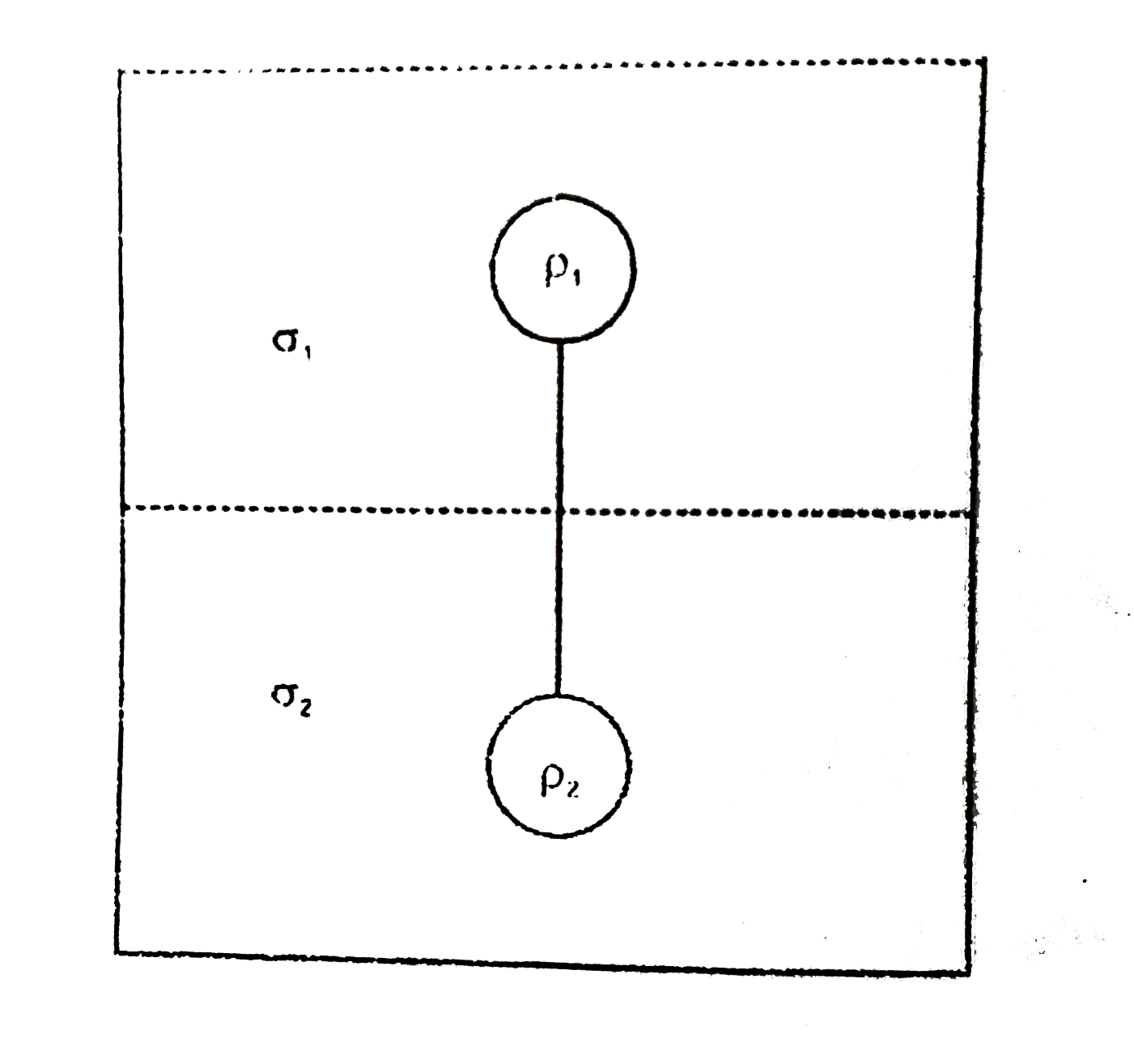
Two sphere P and Q for equal radii have densities ` rho_1 and rho_2 ` respectively. The spheres are connected by a massless string and placed in liquids ` L_1 and L_2 ` of densities ` sigma _ 1 and sigma _2 ` and viscosities ` eta _ 1 and eta _2 `, respectively. They float in equilibrium with the sphere P in ` L_1` and sphere Q in ` L_2 ` and the string being taut (see figure). If sphere P alone in ` L_2 ` has terminal velocity ` v _ P ` and Q along in ` L_1 ` has terminal velocity ` v_Q`, then :

A

`|vec(V_(P))/vec(V_(Q))|=(eta_(1))/(eta_(2))`

B

`|vec(V_(P))/vec(V_(Q))|=(eta_(2))/(eta_(1))`

C

`vec(V_(P)).vec(V_(Q))gt0`

D

`vecV_(P).vecV_(Q)lt0`

Text Solution

Verified by Experts

The correct Answer is:
A, D

For floating
`(rho_(1) + rho_(2))V = (sigma_(1) + sigma_(2))V`
`rho_(1) + rho_(2) = sigma _(1) + sigma_(2)`
since strings in taut so
`rho_(1) lt sigma_(1), rho_(2) gt sigma_(2)`
`V_(P) = (2)/(9)(r^(2)(sigma_(2) - rho_(1))g)/(eta_(2))`
`V_(Q) = (2)/(9)((sigma_(1) - rho_(2))g)/(eta_(1))`
since `sigma_(2) - rho_(1) = -(sigma_(1) - rho_(2))`
`|(V_(P))/(V_(Q))| = (eta_(1))/(eta_(2))`
`vec(V_(P)).vec(V_(Q)) lt 0` because `V_(P)` and `V_(Q)` are oppsite
Promotional Banner

Topper's Solved these Questions

  • ELASTICITY AND VISCOCITY

    RESONANCE ENGLISH|Exercise Exercise- 3 PART - IV|9 Videos
  • ELASTICITY AND VISCOCITY

    RESONANCE ENGLISH|Exercise Advanced Level Problems|9 Videos
  • ELASTICITY AND VISCOCITY

    RESONANCE ENGLISH|Exercise Exercise- 2 PART - III|8 Videos
  • DAILY PRACTICE PROBLEMS

    RESONANCE ENGLISH|Exercise dpp 92 illustration|2 Videos
  • ELECTROMAGNETIC INDUCTION

    RESONANCE ENGLISH|Exercise Exercise|43 Videos

Similar Questions

Explore conceptually related problems

Two spheres P and Q of equal radii have densities rho_1 and rho_2 , respectively. The spheres are connected by a massless string and placed in liquids L_1 and L_2 of densities sigma_1 and sigma_2 and viscosities eta_1 and eta_2 , respectively. They float in equilibrium with the sphere P in L_1 and sphere Q in L_2 and the string being taut(see figure). If sphere P alone in L_2 has terminal velocity vecV_p and Q alone in L_1 has terminal velocity vecV_Q , then

If two liquids of same mass but densities rho_1 and rho_2 respectively are mixed, then the density of the mixture is:

If two liquids of same volume but different densities rho_1 and rho_2 are mixed, then the density of the mixture is:

The insulated spheres of radii R_(1) and R_(2) having charges Q_(1) and Q_(2) respectively are connected to each other. There is

The insulated spheres of radii R_(1) and R_(2) having charges Q_(1) and Q_(2) respectively are connected to each other. There is

Two spheres A and B of equal radii R, each are uniformly dense with densities 2 rho and rho respectively are placed as shown in figure.The initial acceleration of particle placed at point P due to gravity of both the spheres will be (P is just above the surface of sphere B).

There are two spheres of radii R and 2R having charges Q and Q//2 , respectively. These two spheres are connected with a cell of emf V volts as show in. When the switch is closed, find the final charge on each sphere.

Equal masses of two substance of densities rho_(1) and rho_(2) are mixed together. What is the density of the mixture?

A sphere of density rho is half submerged in a liquid of density sigma and surface tension T. The sphere remains in equilibrium. Find radius of the sphere (assume the force due to surface tension acts tangentially to surface of sphere)

A metal sphere connected by a string is dipped in a liquid of density rho as shown in figure. The pressure at the bottom of the vessel will be, (p_(0) =atmospheric pressure )

