Home
Class 11
PHYSICS
Source and observer start moving simulat...

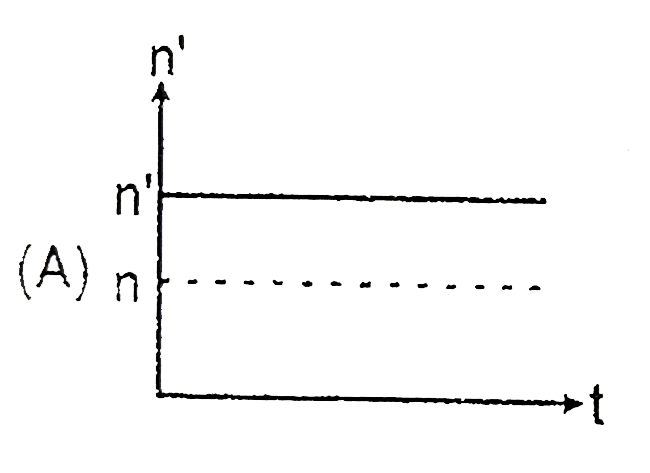
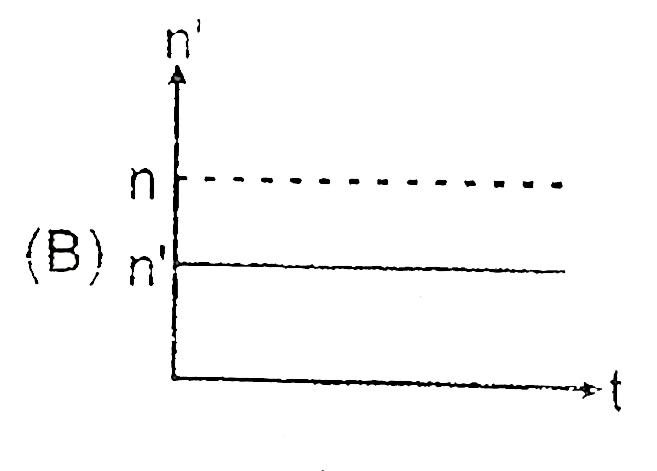
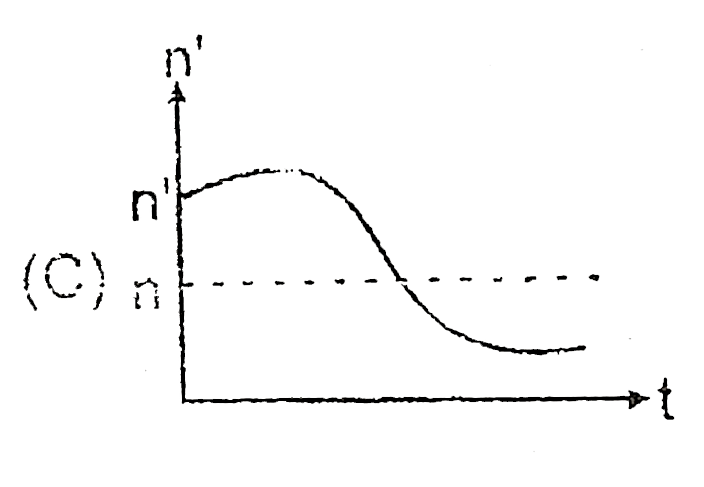
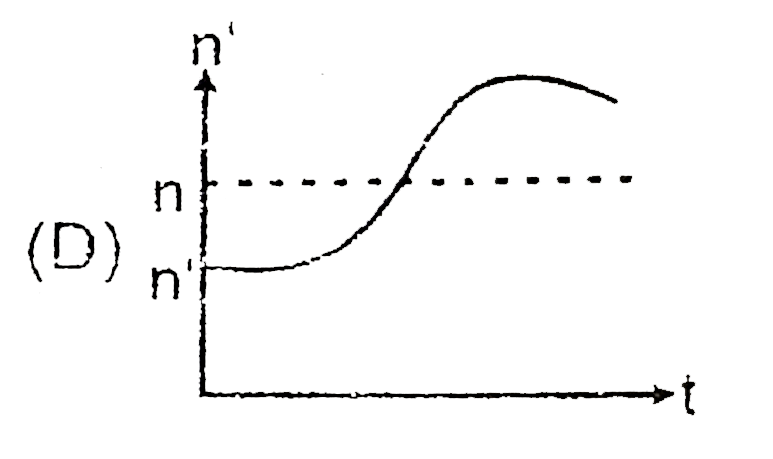
Source and observer start moving simulatneously along x and y-axis respectively. The speed of source is twice the speed of observer `V_0`. If the ratio of observer frequency to the frequency of the source is `0.75`, find the velocity of sound.

A

B

C

D

Text Solution

AI Generated Solution

The correct Answer is:

To solve the problem, we need to determine the velocity of sound given the conditions of the source and observer's motion and the ratio of their frequencies. Here’s a step-by-step breakdown of the solution: ### Step 1: Define the Variables Let: - \( V_0 \) = speed of the observer - \( V_s \) = speed of the source = \( 2V_0 \) - \( v \) = velocity of sound - \( n \) = actual frequency of the source - \( n_a \) = apparent frequency observed ### Step 2: Calculate the Distances In time \( t \): - Distance moved by the observer along the y-axis: \[ y = V_0 \cdot t \] - Distance moved by the source along the x-axis: \[ x = V_s \cdot t = 2V_0 \cdot t \] ### Step 3: Determine the Angles Using the distances moved, we can find the hypotenuse of the triangle formed by the movements of the source and observer: \[ \text{Hypotenuse} = \sqrt{(2V_0 t)^2 + (V_0 t)^2} = \sqrt{4V_0^2 t^2 + V_0^2 t^2} = \sqrt{5V_0^2 t^2} = V_0 t \sqrt{5} \] ### Step 4: Calculate the Cosines of the Angles - For the angle \( \alpha \) (source's angle): \[ \cos \alpha = \frac{2V_0 t}{\sqrt{5} V_0 t} = \frac{2}{\sqrt{5}} \] - For the angle \( \beta \) (observer's angle): \[ \cos \beta = \frac{V_0 t}{\sqrt{5} V_0 t} = \frac{1}{\sqrt{5}} \] ### Step 5: Apply the Doppler Effect Formula The ratio of the apparent frequency to the actual frequency is given by: \[ \frac{n_a}{n} = \frac{v - V_0 \cos \beta}{v + V_s \cos \alpha} \] Substituting \( V_s = 2V_0 \): \[ \frac{n_a}{n} = \frac{v - V_0 \cdot \frac{1}{\sqrt{5}}}{v + 2V_0 \cdot \frac{2}{\sqrt{5}}} \] ### Step 6: Substitute Known Values Given that \( \frac{n_a}{n} = 0.75 \): \[ 0.75 = \frac{v - \frac{V_0}{\sqrt{5}}}{v + \frac{4V_0}{\sqrt{5}}} \] This can be rewritten as: \[ \frac{3}{4} = \frac{v - \frac{V_0}{\sqrt{5}}}{v + \frac{4V_0}{\sqrt{5}}} \] ### Step 7: Cross Multiply and Solve for \( v \) Cross multiplying gives: \[ 3(v + \frac{4V_0}{\sqrt{5}}) = 4(v - \frac{V_0}{\sqrt{5}}) \] Expanding both sides: \[ 3v + \frac{12V_0}{\sqrt{5}} = 4v - \frac{4V_0}{\sqrt{5}} \] Rearranging gives: \[ v = \frac{16V_0}{\sqrt{5}} \] ### Final Answer The velocity of sound \( v \) is: \[ v = \frac{16V_0}{\sqrt{5}} \]

To solve the problem, we need to determine the velocity of sound given the conditions of the source and observer's motion and the ratio of their frequencies. Here’s a step-by-step breakdown of the solution: ### Step 1: Define the Variables Let: - \( V_0 \) = speed of the observer - \( V_s \) = speed of the source = \( 2V_0 \) - \( v \) = velocity of sound - \( n \) = actual frequency of the source ...
Promotional Banner

Topper's Solved these Questions

  • SOUND WAVES

    RESONANCE ENGLISH|Exercise Exercise- 2 PART - I|24 Videos
  • SOUND WAVES

    RESONANCE ENGLISH|Exercise Exercise- 2 PART - II|20 Videos
  • SOUND WAVES

    RESONANCE ENGLISH|Exercise Exercise- 1 PART - I|34 Videos
  • SIMPLE HARMONIC MOTION

    RESONANCE ENGLISH|Exercise Exercise|28 Videos
  • STRING WAVES

    RESONANCE ENGLISH|Exercise Exercise|32 Videos
RESONANCE ENGLISH-SOUND WAVES-Exercise- 1 PART - II
  1. When two waves with same frequency and constant phase difference inter...

    Text Solution

    |

  2. Sound waves from a tuning fork A reacha point P by two separate paths ...

    Text Solution

    |

  3. sound singal is sent through a compostie tube as shown in the figure....

    Text Solution

    |

  4. A person is talking in a small room and the sound intensity level is 6...

    Text Solution

    |

  5. An interference is observed due to two coherent sources separated by a...

    Text Solution

    |

  6. When a sound wave is reflected from a wall the phase difference betwee...

    Text Solution

    |

  7. If lambda(1), lamda(2)and lamda(3) are the wavelengths of the wave giv...

    Text Solution

    |

  8. An open organ pipe of length l vibrates in its fundamental mode. The p...

    Text Solution

    |

  9. The fundamental frequency of a closed organ pipe is sam eas the first ...

    Text Solution

    |

  10. Two identical tubes A and B are kept in air and water respetively as s...

    Text Solution

    |

  11. A tube of diameter d and of length l is open a both ends. Its fundamen...

    Text Solution

    |

  12. The second overtone of an open pipe A and a closed pipe B have the sam...

    Text Solution

    |

  13. A resonance tube is resonated with tunning fork of frequency 256Hz. If...

    Text Solution

    |

  14. A sound source of frequency 512 Hz is producing 6 beats with a guitar....

    Text Solution

    |

  15. Three sound waves of equal amplitudes have frequencies (v -1), v, (v +...

    Text Solution

    |

  16. A closed organ pipe and an open organ pipe of same length produce 4 be...

    Text Solution

    |

  17. Which of the following does not affect the apparent frequency in doppt...

    Text Solution

    |

  18. An engine driver moving towards a wall with velocity of 50ms^(-1) emit...

    Text Solution

    |

  19. Source and observer start moving simulatneously along x and y-axis res...

    Text Solution

    |

  20. A small source of sound moves on a circle as shown in figure and an ob...

    Text Solution

    |
