Home
Class 12
CHEMISTRY
Which is correct graph :...

Which is correct graph :

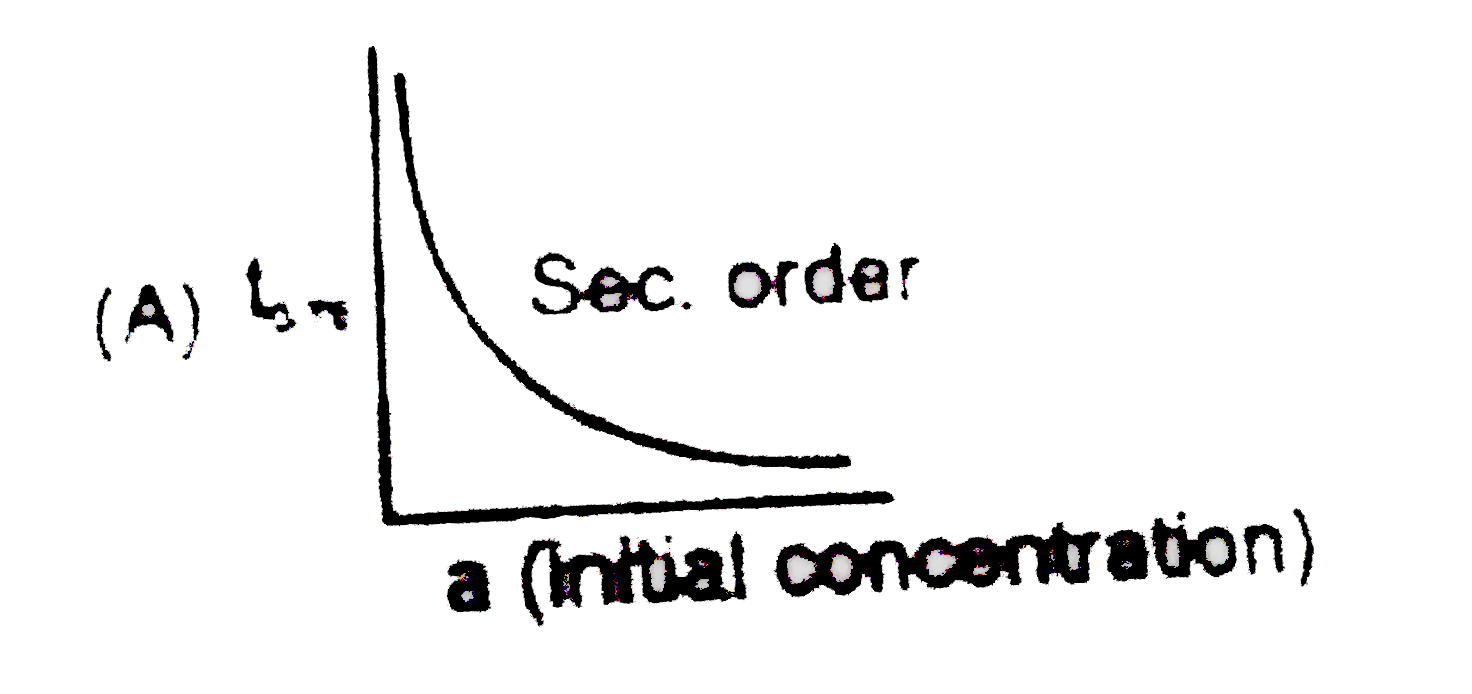
A

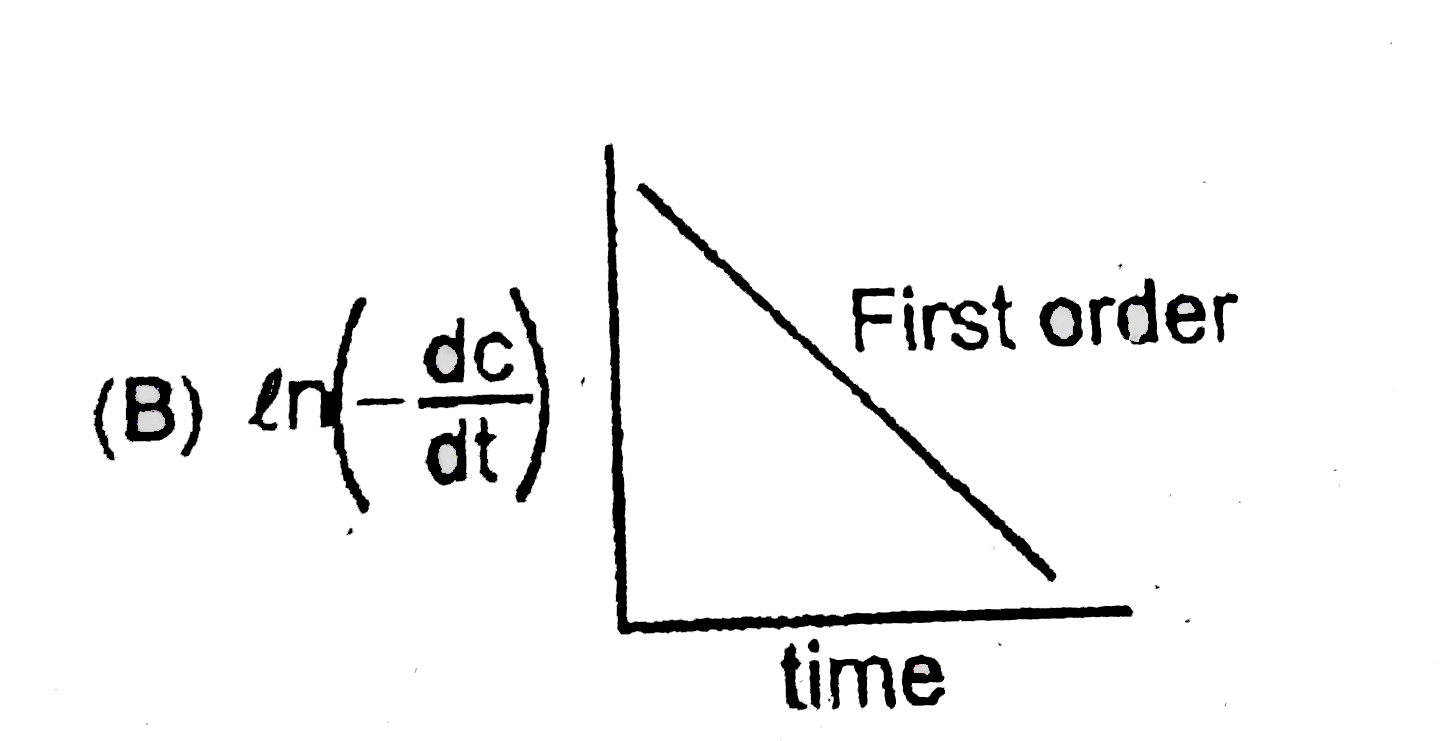
B

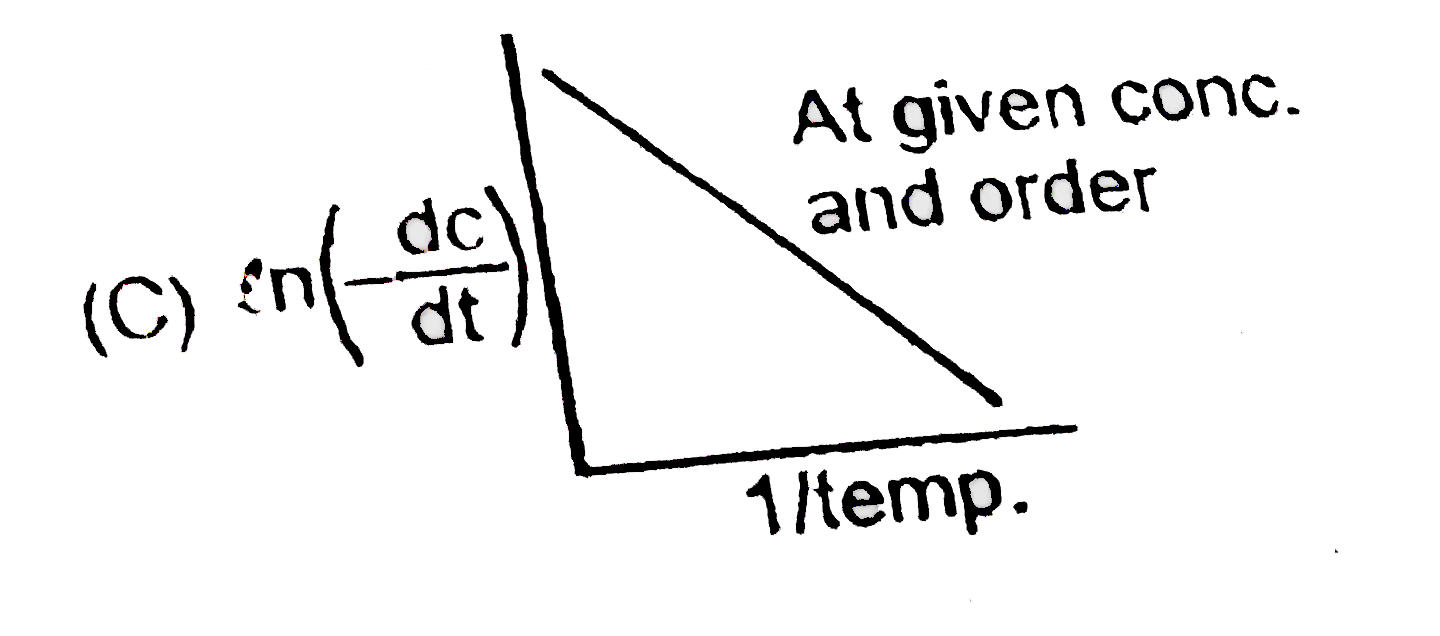
C

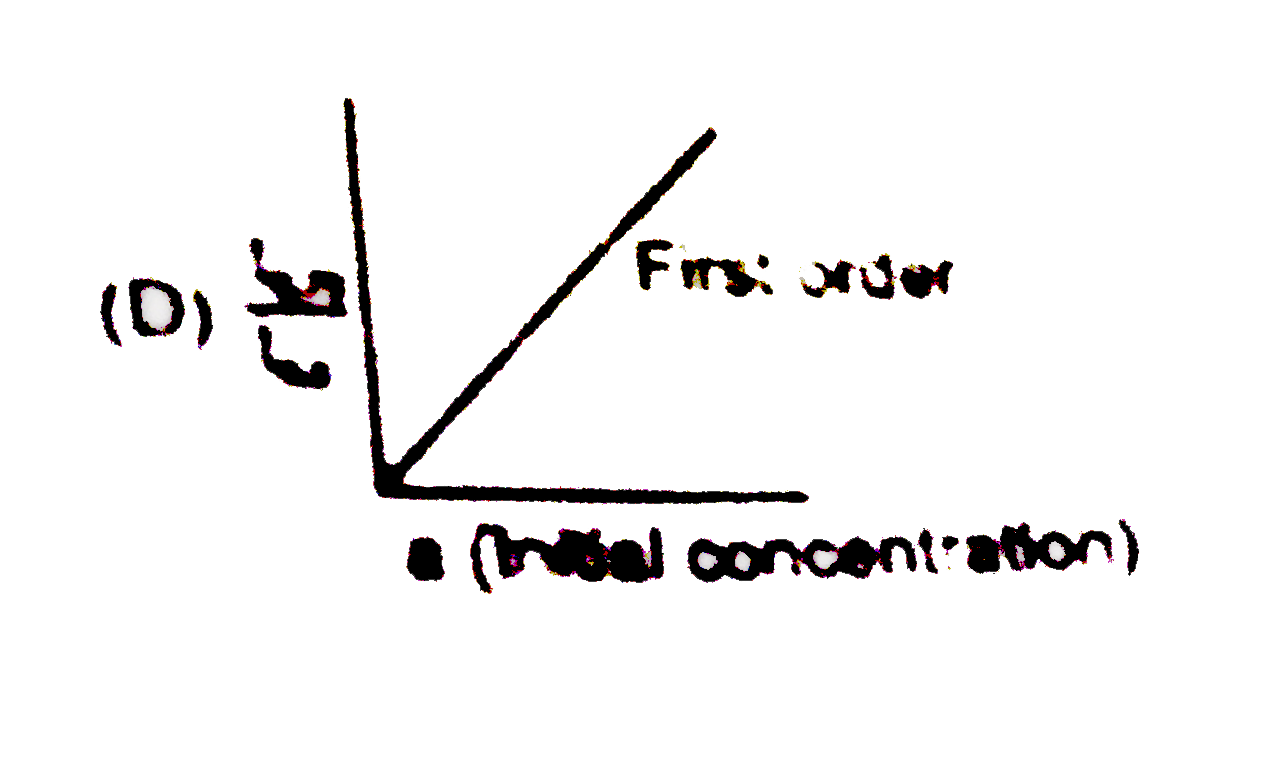
D

Text Solution

AI Generated Solution

The correct Answer is:

To determine which graph is correct for the given reactions, we need to analyze each option based on the principles of chemical kinetics. ### Step-by-Step Solution: 1. **Understanding Second-Order Reactions**: - For a second-order reaction, the half-life (\(t_{1/2}\)) is inversely proportional to the initial concentration (\(C_0\)): \[ t_{1/2} \propto \frac{1}{C_0} \] - This implies that if we plot \(t_{1/2}\) against \(C_0\), we will get a rectangular hyperbola. Therefore, **Option A** is correct. **Hint**: Recall that for second-order reactions, the half-life is dependent on the concentration of the reactant. 2. **Analyzing First-Order Reactions**: - For a first-order reaction, the rate of change of concentration is given by: \[ -\frac{dC}{dt} = kC \] - Integrating this gives: \[ C = C_0 e^{-kt} \] - Taking the natural logarithm, we find: \[ \ln(-\frac{dC}{dt}) = \ln(kC_0) - kt \] - This indicates a linear relationship where the slope is negative. Thus, **Option B** is also correct. **Hint**: Remember that for first-order reactions, the natural logarithm of the concentration change over time leads to a straight line. 3. **Graph of ln(-dC/dt) vs. 1/T**: - For any reaction, we can express the rate constant \(k\) using the Arrhenius equation: \[ k = A e^{-\frac{E_a}{RT}} \] - Substituting this into the expression for \(-\frac{dC}{dt}\) leads to: \[ \ln(-\frac{dC}{dt}) = n \ln(C) + \ln(A) - \frac{E_a}{RT} \] - At constant concentration, the graph of \(\ln(-\frac{dC}{dt})\) versus \(\frac{1}{T}\) will also be linear with a negative slope. Therefore, **Option C** is correct. **Hint**: Consider how temperature affects the rate constant and subsequently the rate of reaction. 4. **Analyzing the Ratio of Times for First-Order Reactions**: - For a first-order reaction, the relationship between time and concentration is given by: \[ t = \frac{1}{k} \ln\left(\frac{C_0}{C}\right) \] - If we consider the concentrations at different times, we can express: \[ t_{0.75} = \frac{1}{k} \ln(4) \quad \text{and} \quad t_{0.5} = \frac{1}{k} \ln(2) \] - The ratio \( \frac{t_{0.75}}{t_{0.5}} \) simplifies to: \[ \frac{t_{0.75}}{t_{0.5}} = \frac{\ln(4)}{\ln(2)} = 2 \] - This indicates that the ratio is constant and does not depend on the initial concentration, thus **Option D** is incorrect. **Hint**: Remember that for first-order reactions, the time taken to reach a certain concentration is logarithmic and can be compared directly. ### Conclusion: The correct graphs are **Option A, B, and C**. Option D is incorrect as it does not reflect the expected behavior of first-order reactions.

To determine which graph is correct for the given reactions, we need to analyze each option based on the principles of chemical kinetics. ### Step-by-Step Solution: 1. **Understanding Second-Order Reactions**: - For a second-order reaction, the half-life (\(t_{1/2}\)) is inversely proportional to the initial concentration (\(C_0\)): \[ t_{1/2} \propto \frac{1}{C_0} ...
Promotional Banner

Topper's Solved these Questions

  • QUALITATIVE ANALYSIS PART 1

    RESONANCE ENGLISH|Exercise A.L.P|39 Videos
  • SOLID STATE

    RESONANCE ENGLISH|Exercise PHYSICAL CHEMITRY (SOLID STATE)|45 Videos

Similar Questions

Explore conceptually related problems

Which is/are correct graph ?

A uniform solid sphere rolls up (witout slipping) the fixed inclined plane, and then back down. Which is the correct graph of acceleration a of centre of mass of solid sphere as function of time t (for the duration sphere is on the incline)? Assume that the sphere rolling up has a positive velocity.

Which of the following is correct graph for the reaction?

if current in solenoid is i_(1)=alphate^(betat) . Which of the followign is correct graph between induced current rod time (alpha and beta are positive)

Which one is the correct graph for arithmetic growth?

A velocity-time graph of two vehicals A & B starting from rest at the same time is given in the figure. The statements which is correct from graph.

Which of the following is the correct graph for EN values of carbon family :

For an endothermic the correct graph is

Figure shows graphs of pressure versus density for an ideal gas at two temperatures T_(1) and T_(2) Which is correct ? .

Compressibility factor (Z=(PV)/(nRT)) is plotted against pressure Which is the correct order of liquefiability of the gases shown in the above graph ?

RESONANCE ENGLISH-RANK BOOSTER-All Questions
  1. manganese metal has the electronic configuration [Ar]3d^4 in its +3...

    Text Solution

    |

  2. If the rate of reaction, 2SO2(g)+O2(g)overset(Pt)to2SO3(g) is given by...

    Text Solution

    |

  3. Which is correct graph :

    Text Solution

    |

  4. For a certain reaction Ato products, the t(1//2) as a function of [A]0...

    Text Solution

    |

  5. For the reaction 2A+BtoC with the rate low (d[C])/(dt)=k[A]^(1)[B]^(-1...

    Text Solution

    |

  6. The number of moles of nitrogen present in one litre of air containing...

    Text Solution

    |

  7. The number of moles of nitrogen present in one litre of air containing...

    Text Solution

    |

  8. Indentify the true statement(s)

    Text Solution

    |

  9. The half-period T for the decomposition of ammonia on tungsten wire, w...

    Text Solution

    |

  10. The substance undergoes first order decomposition.The decomposition fo...

    Text Solution

    |

  11. Elements having complete filled outermost s and p orbital are known as...

    Text Solution

    |

  12. A certain reaction A rarr B follows the given concentration (Molarity)...

    Text Solution

    |

  13. Consider the following case of competing 1^(st) order reactions. ...

    Text Solution

    |

  14. Decomposition of 3A(g)to2B(g)+2C(g) follows first order kinetics.Initi...

    Text Solution

    |

  15. Assertion (A) : If the activation energy of a reaction is zero, temper...

    Text Solution

    |

  16. Statement-1: For A+2BtoC(rate =K[A]^(1)[B]^(0)), the half life time of...

    Text Solution

    |

  17. For I^(st) order decomposition of SO2Cl2(g), SO2Cl2(g)toSO2(g)+Cl2(g...

    Text Solution

    |

  18. A mixture of NO2 and N2O4 has a vapour density of 38.3 at 300K. What i...

    Text Solution

    |

  19. At N.T.P the volume of a gas is found to be 270mL. What will be the vo...

    Text Solution

    |

  20. The initial rate of zero order reaction of the gaseous equation A(g)to...

    Text Solution

    |
