Home
Class 12
CHEMISTRY
The following data were observed for the...

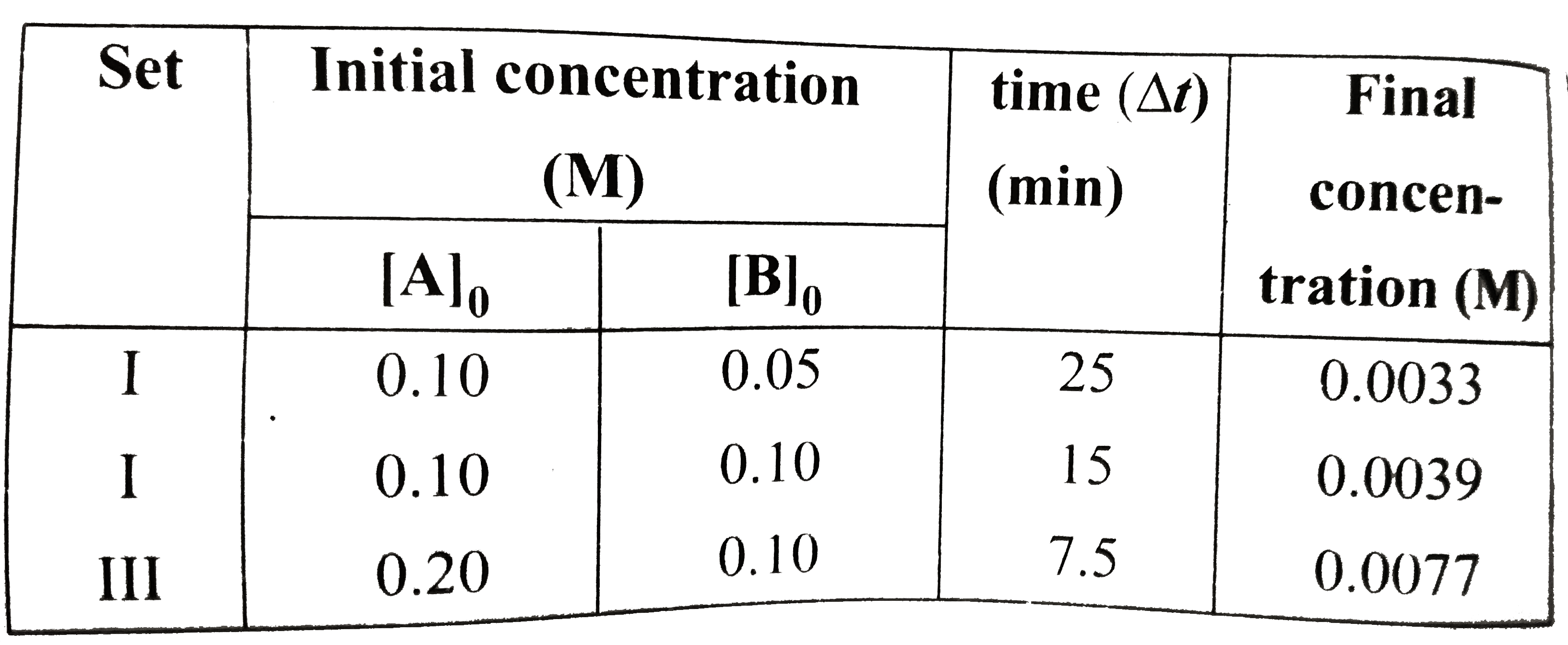
The following data were observed for the following reaction at `25^(@)C, CH_(3)OH + (C_(6)H_(5))_(3)C Clrarr(C_(6)H_(5))_(3)C.OCH_(3)+HCl`

Rates `(d[C])/(dt)` in sets I, II, and III are, respectively,
(in `M min^(-1)`):

A

r=k[A][B]

B

r=k`[A]^3` [B]

C

`r=k [A][B]^2`

D

`r= k [A]^2 [B]^2`

Text Solution

Verified by Experts

The correct Answer is:

B

(II)Rate of Rxn=Rate of formation of C
They we say by I data.
Suppose `["Rate"=k[A]^a[B]^b]`…(i)
`1.32xx10^(-4)=k[.10]^a[.05]^b`…(ii)
`2.6xx10^(-4)=k[.10]^a[.10]^b`…(iii)
`1.02xx10^(-3)=k[.20]^a[.10]^b`…(iv)
By equation (ii) and (iii) we find b=1
By (iii) and (iv) we find `a=2.97~~3`
Then Rate `=k[A]^3[B]^1`
Promotional Banner

Topper's Solved these Questions

  • QUALITATIVE ANALYSIS PART 1

    RESONANCE ENGLISH|Exercise A.L.P|39 Videos
  • SOLID STATE

    RESONANCE ENGLISH|Exercise PHYSICAL CHEMITRY (SOLID STATE)|45 Videos

Similar Questions

Explore conceptually related problems

The following data were observed for the following reaction at 25^(@)C, CH_(3)OH + (C_(6)H_(5))_(3)C Clrarr(C_(6)H_(5))_(3)C.OCH_(3)+HCl Rate constant of the above experiment is (in L^(2) M^(-2) min^(-1) ) :

Write the intermediate steps for each of the following reactions (i) C_(6)H_(5)CH(OH)-=overset(H_(3)O^(+))rarrC_(6)H_(5)CH-=CHCHO (ii)

Find DU of following compound:- (a) C_(6)H_(6)O , (b) C_(6)H_(5)I , ( c) C_(6)H_(6)ClBrO , (d) C_(5)H_(9)N

The following reaction is known as C_(6)H_(6)+CH_(3)Cl underset(("anhy."))overset(AlCl_(3))to C_(6)H_(5)CH_(3)+HCl

Identify the major product in the following reactions : (i) (ii) C_(6) H_(5) COOH + CH_(3) MgI rarr ? + ? .

Convert C_(2)H_(5)OH to C_(2)H_(5)OCH_(3) ?

The reaction, C_(6)H_(5)ONa +CO_(2)+H_(2)O rarr C_(6)H_(5)OH+NaHCO_(3) suggests that :

Which of the following hydrocarbons undergo addition reactions: C_(2)H_(6), C_(3)H_(8), C_(3)H_(6), C_(2)H_(2)" and "CH_(4) .

Arrange the following in order of decreasing acid strength: CH_(3)OH, H_(2)O, C_(6)H_(5)OH

RESONANCE ENGLISH-RANK BOOSTER-All Questions
  1. The variation of concentration of 'A' with time in two experiments sta...

    Text Solution

    |

  2. The following data were observed for the following reaction at 25^(@)C...

    Text Solution

    |

  3. The following data were observed for the following reaction at 25^(@)C...

    Text Solution

    |

  4. The following data were observed for the following reaction at 25^(@)C...

    Text Solution

    |

  5. At N.T.P the volume of a gas is found to be 237mL. What will be the vo...

    Text Solution

    |

  6. At N.T.P the volume of a gas is found to be 250mL. What will be the vo...

    Text Solution

    |

  7. At N.T.P the volume of a gas is found to be 150mL. What will be the vo...

    Text Solution

    |

  8. For a hypotherical elementary reaction where k1/k2=1/2 Initailly on...

    Text Solution

    |

  9. For a hypotherical elementary reaction where k1/k2=1/2 Initailly on...

    Text Solution

    |

  10. For a hypotherical elementary reaction where k1/k2=1/2 Initailly on...

    Text Solution

    |

  11. At N.T.P the volume of a gas is found to be 270mL. What will be the vo...

    Text Solution

    |

  12. At N.T.P the volume of a gas is found to be 240mL. What will be the vo...

    Text Solution

    |

  13. Match order of the reaction (in List-I) with the corresponding rate co...

    Text Solution

    |

  14. The number of moles of nitrogen present in one litre of air containing...

    Text Solution

    |

  15. The number of unpaired electrons in Zn^(2+) is

    Text Solution

    |

  16. Graph between log k and 1//T [k rate constant (s^(-1)) and T and the t...

    Text Solution

    |

  17. For the reaction Ato products, the following data is given for a parti...

    Text Solution

    |

  18. If (dx)/(dt)=k[H(3)O^(+)]n and rate becomes 100 times when pH change...

    Text Solution

    |

  19. The gas phase decomposition of dimethyl ether follows first order kine...

    Text Solution

    |

  20. In the decomposition of H2O2 at 300 K, the energy of activation was fo...

    Text Solution

    |
