

Home
Class 12
CHEMISTRY
When a sample of ideal gas is changed fr...

When a sample of ideal gas is changed from an initial state to a final state, various curves can be plotted for the process like P-V curve, V-T curve,P-T curve etc.
For example, P-V curve for a fixed amount of an ideal gas at constant temperature is a rectangular hyperbola, V-T curve for a fixed amount of an ideal gas at constant volume is again a straight line. However, the shapes may vary if the constant parameters are also changed.
Now, answer the following questions :
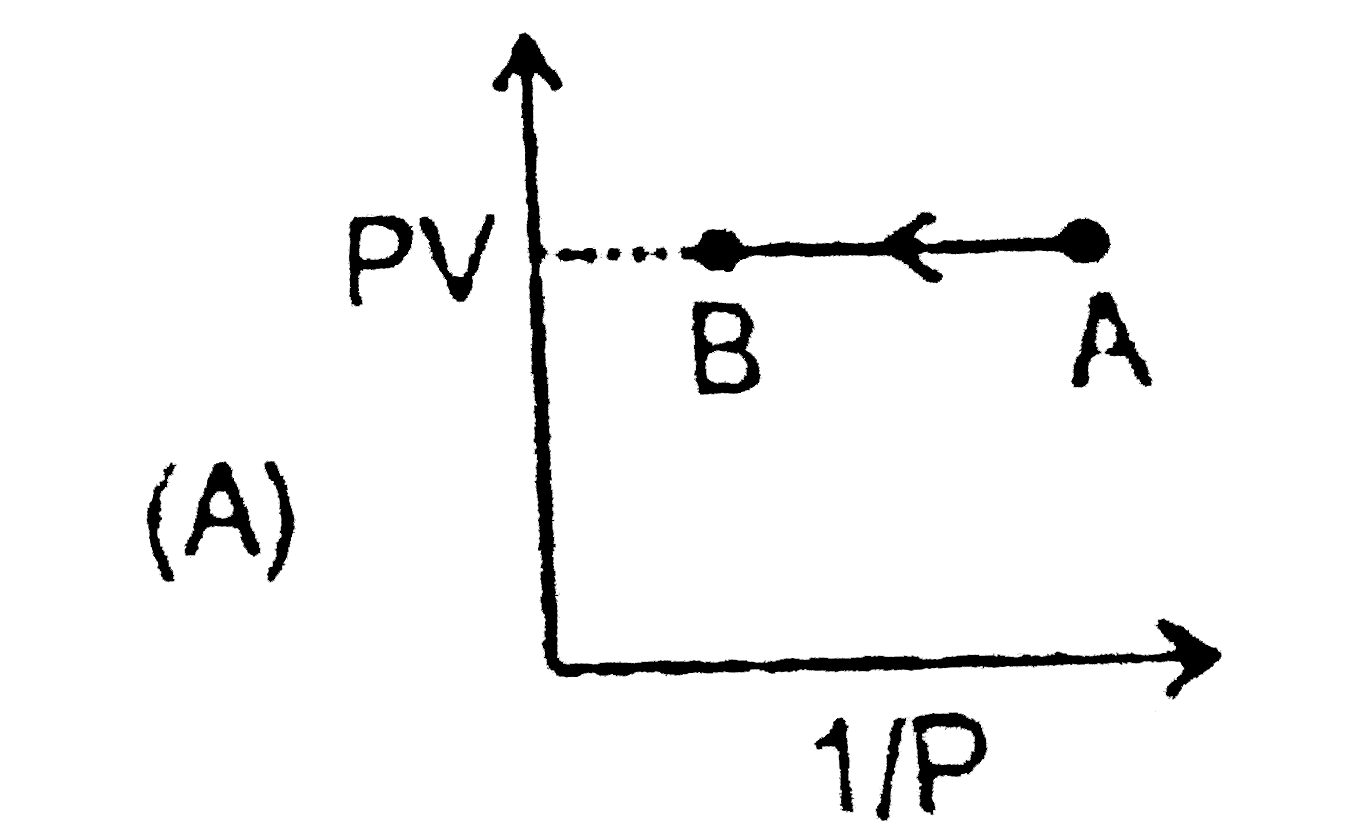
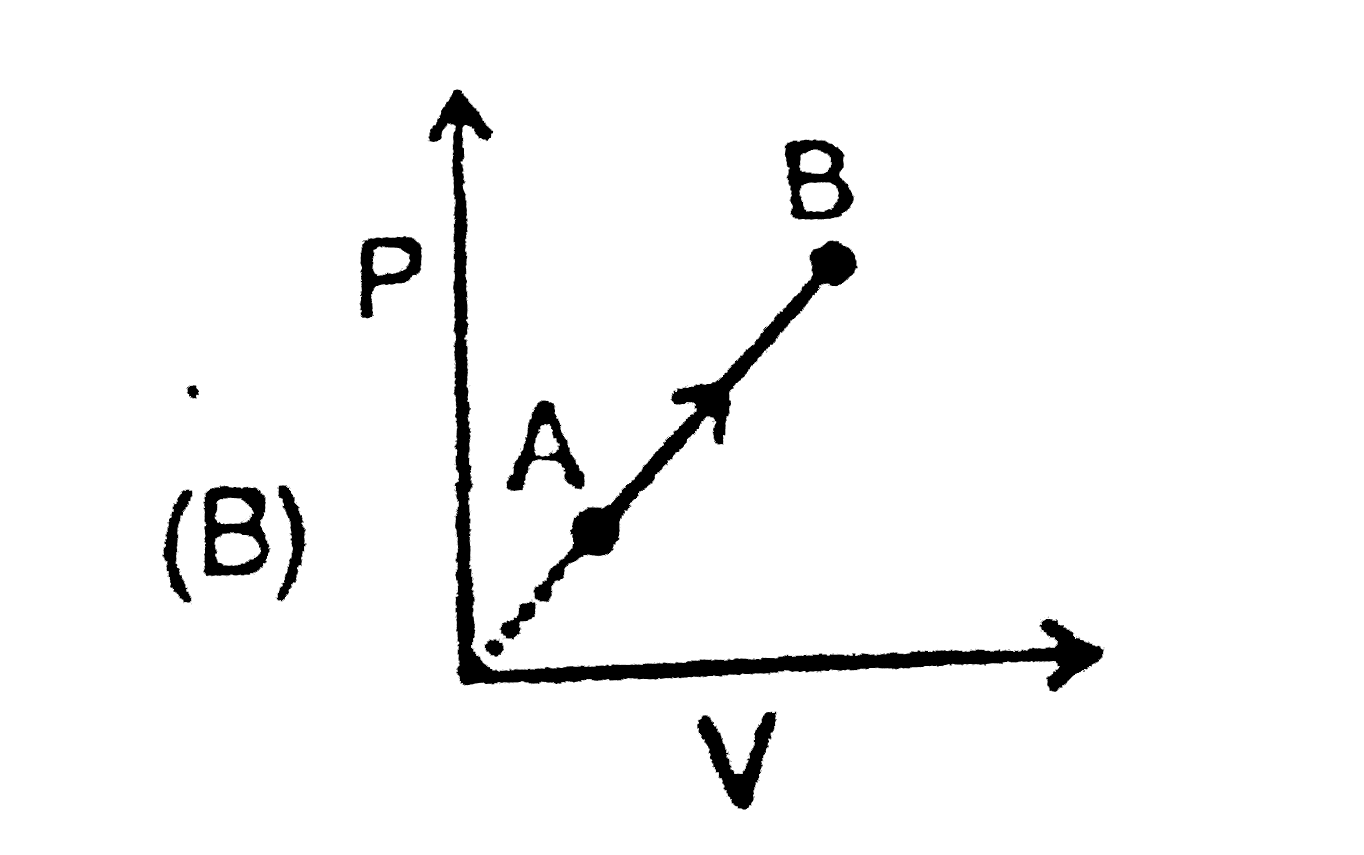
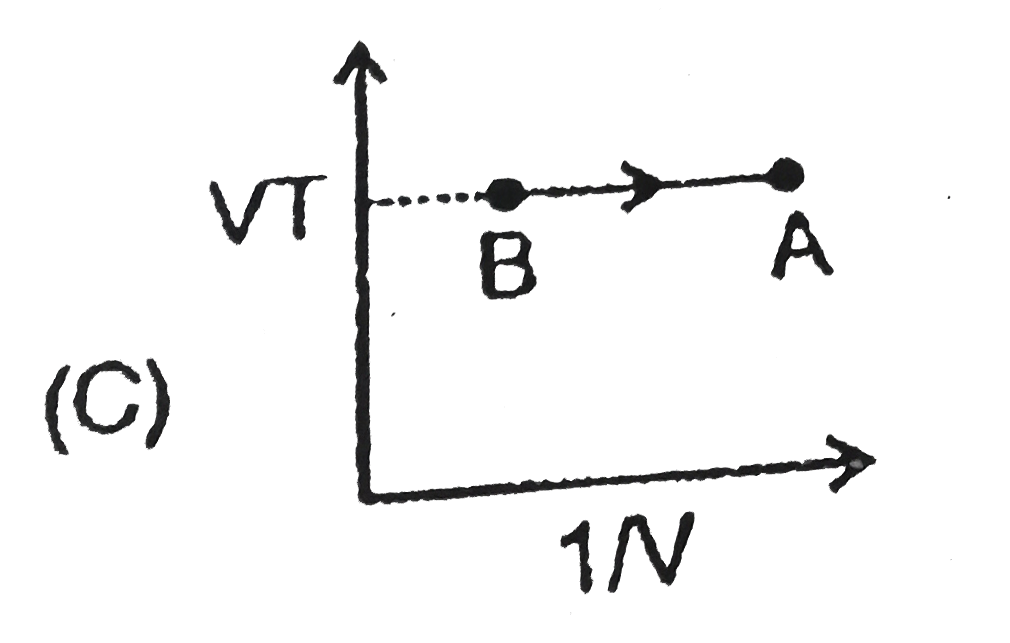
Which of the following graphs is not possible for a fixed amount of ideal gas upon moving from initial state A to final state B :

A

B

C

D

None of these

Text Solution

AI Generated Solution

The correct Answer is:
To determine which graph is not possible for a fixed amount of ideal gas moving from initial state A to final state B, we need to analyze the given graphs based on the properties of ideal gases and the relationships between pressure (P), volume (V), and temperature (T). ### Step-by-Step Solution: 1. **Understanding Ideal Gas Behavior**: - For a fixed amount of ideal gas, the number of moles (n) remains constant. The relationships between P, V, and T are described by the ideal gas law: \[ PV = nRT \] - This means that if any two of the variables (P, V, T) are known, the third can be determined. 2. **Analyzing the First Graph**: - The first graph is a P-V curve at constant temperature. According to Boyle's Law, for a fixed amount of gas at constant temperature, the graph of P vs. V is a rectangular hyperbola. - As we move from state A to state B, if pressure increases, volume must decrease to maintain the product PV constant. - **Conclusion**: This graph is possible. 3. **Analyzing the Second Graph**: - The second graph shows a linear increase in pressure with volume. This can occur if the temperature is increasing. - If temperature increases, the relationship can be linear under certain conditions, as described by the ideal gas law. - **Conclusion**: This graph is also possible. 4. **Analyzing the Third Graph**: - The third graph is a V-T curve, where V is constant. This indicates that the volume does not change while the temperature changes. - According to the ideal gas law, if V is constant, then as temperature increases, pressure must also increase proportionally. - This graph is also valid as it can represent a scenario where volume remains constant while temperature changes. - **Conclusion**: This graph is possible. 5. **Final Analysis**: - Since all three graphs analyzed (P-V, P-T, and V-T) are possible for a fixed amount of ideal gas transitioning from state A to state B, we conclude that none of the graphs presented are impossible. - Therefore, the answer to the question is that all graphs are possible. ### Final Answer: None of these graphs is impossible for a fixed amount of ideal gas moving from initial state A to final state B.

To determine which graph is not possible for a fixed amount of ideal gas moving from initial state A to final state B, we need to analyze the given graphs based on the properties of ideal gases and the relationships between pressure (P), volume (V), and temperature (T). ### Step-by-Step Solution: 1. **Understanding Ideal Gas Behavior**: - For a fixed amount of ideal gas, the number of moles (n) remains constant. The relationships between P, V, and T are described by the ideal gas law: \[ PV = nRT ...
Promotional Banner

Topper's Solved these Questions

  • QUALITATIVE ANALYSIS PART 1

    RESONANCE ENGLISH|Exercise A.L.P|39 Videos
  • SOLID STATE

    RESONANCE ENGLISH|Exercise PHYSICAL CHEMITRY (SOLID STATE)|45 Videos

Similar Questions

Explore conceptually related problems

When a sample of ideal gas is changed from an initial state to a final state, various curves can be plotted for the process like P-V curve, V-T curve,P-T curve etc. For example, P-V curve for a fixed amount of an ideal gas at constant temperature is a rectangular hyperbola, V-T curve for a fixed amount of an ideal gas at constant volume is again a straight line. However, the shapes may vary if the constant parameters are also changed. Now, answer the following questions : From the given plot between Z and P for a real gas the correct is :

When a sample of ideal gas is changed from an initial state to a final state, various curves can be plotted for the process like P-V curve, V-T curve,P-T curve etc. For example, P-V curve for a fixed amount of an ideal gas at constant temperature is a rectangular hyperbola, V-T curve for a fixed amount of an ideal gas at constant volume is again a straight line. However, the shapes may vary if the constant parameters are also changed. Now, answer the following questions : Two moles of an ideal gas is changed from its initial state (16 atm, 6L) to final state (4 atm, 15L) in such a way that this change can be represented by a straight line in P-V curve.The maximum temperature attained by the gas during the above change is :(Take : R=1/12L atm K^(-1) "mol"^(-1) )

When a sample of ideal gas is changed from an initial state to a final state, various curves can be plotted for the process like P-V curve, V-T curve,P-T curve etc. For example, P-V curve for a fixed amount of an ideal gas at constant temperature is a rectangular hyperbola, V-T curve for a fixed amount of an ideal gas at constant volume is again a straight line. However, the shapes may vary if the constant parameters are also changed. Now, answer the following questions : Two Vander waals gases have same value 'b' but different 'a' value then which of the following statement is correct under simialr condition .

Which of the following curve is correct for a given amount of an ideal gas at constant pressure?

What is the shape of the curve obtained on plotting P against PV at constant temperature for an ideal gas ?

Which of the following curve is correct for an ideal gas ?

A plot of P vs T for a given mass of gas at constant volume is a straight line . P vs T at constant volumes V_(1) and V_(2) for an ideal gas are shown below : Which of the following is correct ?

Figure shows a process for a given amount of an ideal gas. If volume in state 1 is V_(1) & in state 2 is V_(2) , then

V vs T curves at constant pressure P_1 and P_2 for an ideal gas are shown in the figure. Which of the following is correct?

1 mol of a gas is changed from its initial state (15 L, 2 atm) to final state (4 L, 10 atm) . If this change can be represented by a straight line in P-V curve, calculate the maximum temperature that, the gas attained.

RESONANCE ENGLISH-RANK BOOSTER-All Questions
  1. How many moles are represented by 110 g of glucose, C6H12O6.

    Text Solution

    |

  2. When a sample of ideal gas is changed from an initial state to a final...

    Text Solution

    |

  3. When a sample of ideal gas is changed from an initial state to a final...

    Text Solution

    |

  4. The figure shows the effect of pressure on the compressibility factor,...

    Text Solution

    |

  5. Two van der waal's gases have same value of a but different value of b...

    Text Solution

    |

  6. When a sample of ideal gas is changed from an initial state to a final...

    Text Solution

    |

  7. When a sample of ideal gas is changed from an initial state to a final...

    Text Solution

    |

  8. Sketch shows the plot of Z v/s P for a hypothetical gas for one mole a...

    Text Solution

    |

  9. Sketch shows the plot of Z v/s P for a hypothetical gas for one mole a...

    Text Solution

    |

  10. At 200 K and 500 atm value of compressibility factor is 2.Then volume ...

    Text Solution

    |

  11. At high pressure suppose all the constant temperature curve varies lin...

    Text Solution

    |

  12. Sketch shows the plot of Z v/s P for a hypothetical gas for one mole a...

    Text Solution

    |

  13. Match List : {:("Column-I","Column-II"),((A)PV^(gamma)="Constant",(p...

    Text Solution

    |

  14. The number of moles present in 54.5 g of HSO is

    Text Solution

    |

  15. The number of moles present in 84 g of HSO is

    Text Solution

    |

  16. How many moles are represented by 130 g of glucose,

    Text Solution

    |

  17. How many moles are represented by 150 g of glucose

    Text Solution

    |

  18. How many moles are represented by 120 g of glucose

    Text Solution

    |

  19. Consider the following figure at 500 K.Assuming ideal gas behaviour, c...

    Text Solution

    |

  20. If above tube is placed vertically with the open and upward then find ...

    Text Solution

    |