Home
Class 12
CHEMISTRY
The first (Delta(i), H(1)) and the secon...

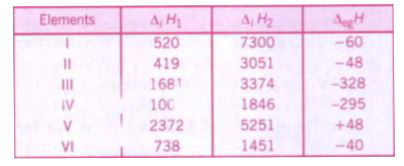
The first (`Delta_(i), H_(1)`) and the second (`Delta, H_(2)`) ionisation enthalpies (in kJ mo`l^(- 1)` ) and the `(Delta_(eg)H`) electron gain enthalpy (in kJ mo`l^(-1)` ) of a few elements are given below :

Which of the above elements is likely to be :
the least reactive element?

A

P

B

Q

C

R

D

T

Text Solution

Verified by Experts

The correct Answer is:

D

Value corresponds to noble gases.Hence , T is inert toward chemical reactivity.
Promotional Banner

Topper's Solved these Questions

  • QUALITATIVE ANALYSIS PART 1

    RESONANCE ENGLISH|Exercise A.L.P|39 Videos
  • SOLID STATE

    RESONANCE ENGLISH|Exercise PHYSICAL CHEMITRY (SOLID STATE)|45 Videos

Similar Questions

Explore conceptually related problems

The first ( Delta_(i), H_(1) ) and the second ( Delta, H_(2) ) ionisation enthalpies (in kJ mo l^(- 1) ) and the (Delta_(eg)H ) electron gain enthalpy (in kJ mo l^(-1) ) of a few elements are given below : Which of the above elements is likely to be : a reactive metal

The first (DeltaH_(1)) and second (DeltaH_(2)) ionisation enthalpies (in kJ mol^(-1)) and the (DeltaH_(eg)) electron gain enthalpy (in kJ mol^(-1)) of a elements are given below: Based on the above information match the following columns.

The first ( IE_(1) ) and the second (IE_(2)) ionisation energies (kJ mol^(-1) ) of a few elements are given below : Which of the above elements is likely to be a noble gas?

The first ( IE_(1) ) and the second (IE_(2)) ionisation energies (kJ mol^(-1) ) of a few elements are given below : Which of the above elements is likely to be a reactive non-metal?

The first ( IE_(1) ) and the second (IE_(2)) ionisation energies (kJ mol^(-1) ) of a few elements are given below : Which of the above elements is likely to be a reactive metal?

The first (Delta_(i)H_(1)) and second (Delta_(i)H_(2)) ionisation enthalpies ("in" kJ mol^(-1)) and the (Delta_(eg)H^(ө)) electron gain enthalpy ("in" kJ mol^(-1)) of a few elements are given below: {:("Elements",(Delta_(i)H_(1)),(Delta_(i)H_(2)),Delta_(eg)H^(ө)),(I,520,7300,-60),(II,419,3051,-48),(III,1681,3374,-328),(IV,1008,1846,-295),(V,2372,5251,+48),(VI,738,1451,-40):} Which of the above elements is likely to be a. the least reactive element. b. the most reactive metal. c. the most reactive non-metal. d. the least reactive non-metal. e. the metal which can form a stable binary halide of the formula MX_2 (X=halogen). f. the metal which can form a predominantly stable covalent halide of the formula MX(X=halogen).

First and second ionisation enthalpies(in KJ/mol) of few elements are given below: Which of the above elements will form halides with formula MX_(2) ?

The first and second ionization enthalpies and electron gain enthalpy of some elements are as given below: Which of the elements given above is the least reactive?

The first and second ionization enthalpies and electron gain enthalpy of some elements are as given below: Which of these elements is the most reactive metal?

The first and second ionization enthalpies and electron gain enthalpy of some elements are as given below: Which of these elements is the least reactive non-metal?

RESONANCE ENGLISH-RANK BOOSTER-All Questions
  1. The elements of group 1 describe, more clearly than any other group of...

    Text Solution

    |

  2. 150 mL of pure phosphine is decomposed to produce vapours of phosphoru...

    Text Solution

    |

  3. The first (Delta(i), H(1)) and the second (Delta, H(2)) ionisation ent...

    Text Solution

    |

  4. The first (DeltaiH1) and the second (DeltaiH2) ionization enthalpies (...

    Text Solution

    |

  5. The first (DeltaiH1) and the second (DeltaiH2) ionization enthalpies (...

    Text Solution

    |

  6. The amount of energy released when an atom in the gaseous state accep...

    Text Solution

    |

  7. Which one of the following statements is incorrect in relation to ioni...

    Text Solution

    |

  8. Considering the elements F, Cl, O and N, the correct order of their ch...

    Text Solution

    |

  9. 18 g of sodium chloride is dissolved in 100 g of water at 293 K. Find ...

    Text Solution

    |

  10. Ozone molecule has identical atoms even though its polar why ?

    Text Solution

    |

  11. Match the increasing orders given in column I with the property given ...

    Text Solution

    |

  12. Give the name and atomic number of the inert gas atom in which the tot...

    Text Solution

    |

  13. The Lanthanides and Actinides are placed in group and period number :

    Text Solution

    |

  14. A metal has electronic configuration [Ar]^(18)3d^7 4s^2.On the basis o...

    Text Solution

    |

  15. An ion having a 4+ charge and a mass of 51.99 amu has two electrons wi...

    Text Solution

    |

  16. Total Numbers of elements which are belong to same period(III). Li,N...

    Text Solution

    |

  17. The value of n (i.e. principal qunatum number ) for the valence shell ...

    Text Solution

    |

  18. In Mendeleev table, the triad of VIII group is :

    Text Solution

    |

  19. Outer configuration of X is 3d^5,4s^1 . It belongs to group number -

    Text Solution

    |

  20. In CuX2 , X belongs to which group?

    Text Solution

    |
