Home
Class 12
CHEMISTRY
In the valence bond theory, hybridisatio...

In the valence bond theory, hybridisation of orbitals is an integral part of bond formation.Hybridisation consists of mixing or linear combination of the "pure" atomic orbitals in such a way as to form new hybrid orbitals such as `sp, sp^2, sp^3, sp^3d , sp^3d^2` etc.
Now answer the following questions :
Which of the following are isostructural ?
`{:(NO_3^(-),CO_3^(2-),CIO_3^(-),SO_3,XeO_3),((I),(II),(III),(IV),"(V)"):}`

A

(I) and (IV)

B

(II) and (V)

C

(III) and (IV)

D

(IV) and (V)

Text Solution

Verified by Experts

The correct Answer is:
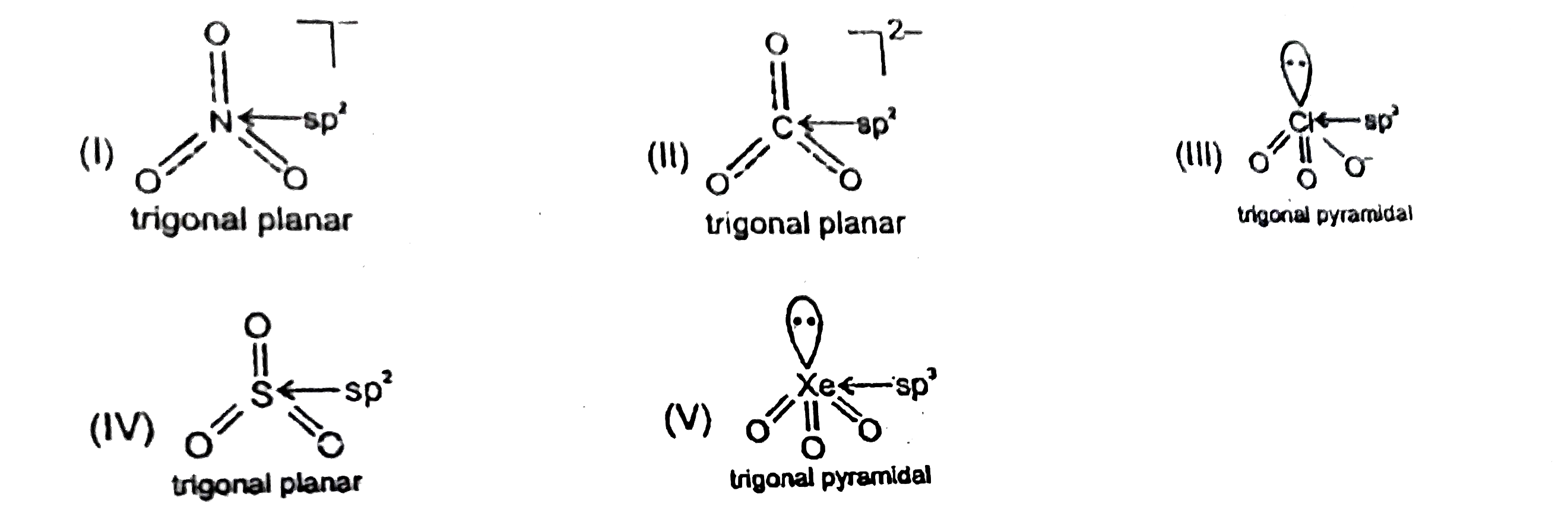
A

Promotional Banner

Topper's Solved these Questions

  • QUALITATIVE ANALYSIS PART 1

    RESONANCE ENGLISH|Exercise A.L.P|39 Videos
  • SOLID STATE

    RESONANCE ENGLISH|Exercise PHYSICAL CHEMITRY (SOLID STATE)|45 Videos

Similar Questions

Explore conceptually related problems

In the valence bond theory, hybridisation of orbitals is an integral part of bond formation.Hybridisation consists of mixing or linear combination of the "pure" atomic orbitals in such a way as to form new hybrid orbitals such as sp, sp^2, sp^3, sp^3d , sp^3d^2 etc. Now answer the following questions : Which one of the following molecular geometrices (i.e. shapes) is not possible for the sp^3d^3 hybridisation ?

In the valence bond theory, hybridisation of orbitals is an integral part of bond formation.Hybridisation consists of mixing or linear combination of the "pure" atomic orbitals in such a way as to form new hybrid orbitals such as sp, sp^2, sp^3, sp^3d , sp^3d^2 etc. Now answer the following questions : Which of the following atomic orbitals does not participitate in trigonal bipyramidal hybridisation i.e. sp^3d hybridisation ?

Sp^3d Hybridisation

Which of the following have sp^(3) d hybridisation ? .

An sp^(3) hybrid orbital possesses

What is meant by hybridisation of atomic orbitals? Describe the shapes of sp, sp^2, sp^3 hybrid orbitals.

In which reaction, the hybridisation on the central atom changes from sp^(2) to sp^(3) .

A molecule is formed by sp^3d^2 hybridisation. Bond angle in it is :

How much s and p characters are present in sp^3 hybrid orbitals?

The ion that has sp ^ 3 d ^ 2 hybridization for the central atom, is :

RESONANCE ENGLISH-RANK BOOSTER-All Questions
  1. In the valence bond theory, hybridisation of orbitals is an integral p...

    Text Solution

    |

  2. In the valence bond theory, hybridisation of orbitals is an integral p...

    Text Solution

    |

  3. In the valence bond theory, hybridisation of orbitals is an integral p...

    Text Solution

    |

  4. Nitrogen , oxygen and fluorine are the highly electronegative elements...

    Text Solution

    |

  5. Nitrogen , oxygen and fluorine are the highly electronegative elements...

    Text Solution

    |

  6. Nitrogen , oxygen and fluorine are the highly electronegative elements...

    Text Solution

    |

  7. The distribution of electrons among molecular orbitals is called the e...

    Text Solution

    |

  8. Arrange the following molecule/species in the order of their increasi...

    Text Solution

    |

  9. N2 has greater bond energy than N(2)^(+) but O2 has lower bond dissoci...

    Text Solution

    |

  10. 54 g of sodium chloride is dissolved in 100 g of water at 293 K. Find ...

    Text Solution

    |

  11. 100gm of an aq. solution of sugar contains 40% sugar by mass. How much...

    Text Solution

    |

  12. 1.49g of ammonia at STP occupies a volume of 2.48 dm^3 calculate the m...

    Text Solution

    |

  13. {:("Column-I","Column-II"),((A)XeF4,(p)sp^3d "see-saw geometry"),((B)S...

    Text Solution

    |

  14. 27 gm Al is heated with 49 ml of H2SO4(specific gravity =2) produces H...

    Text Solution

    |

  15. Match the compounds listed in column I with characteristic listed in c...

    Text Solution

    |

  16. Match the following : {:("Column-I","Column-II"),("Species","Charact...

    Text Solution

    |

  17. How many moles of potassium chlorate need to be heated to produce 10.2...

    Text Solution

    |

  18. How many of g of S are required to produce 10 moles and 20 g of H(2)SO...

    Text Solution

    |

  19. How many of the following compounds have significant involvement of d ...

    Text Solution

    |

  20. Is the following statements are correct ? (i)Among NH3, PH3, AsH3, a...

    Text Solution

    |

