Home
Class 12
CHEMISTRY
A crystalline solid (A) reacts with hydr...

A crystalline solid (A) reacts with hydrogen gas to form a monoatomic gas (B) and a highly associated liquid ( C).(A) is soluble in water and undergoes hydroloysis slowly to form (B),(C ) and a diatomic gas (D).When pure and dry (D) is subjected to a silent electric discharge an another pale blue gas (E) is produced which like (A) also acts a strong oxidising agent.(E) dissolves in potassium hydroxide forming an orange coloured solid which is paramagnetic in nature. (A) reacts with `IF_5, SbF_5, PF_5` etc to form the addition compounds. (C ) forms an addition compound (F) with KF with when electrolysed in molten state forms a most reactive gas (G).(B) and (G) (taken in 2:1) ratio when heated in nickel tube at `400^@ C` and 6 atm pressure forms (A).The first ionization energy `(IE_1)` of (B) is fairly close to (D).
Which of the following statements is correct for (A) ?

A

The central atom of (A) is `sp^3d` hybridised with three lone pairs of electrons

B

(A) reacts with `S_8` molecules in presence of (C ) to form a compound in which the S atom is `sp^3d^2` hybridised

C

(A) reacts with `SbF_5` as a lewis base

D

All of these

Text Solution

Verified by Experts

The correct Answer is:
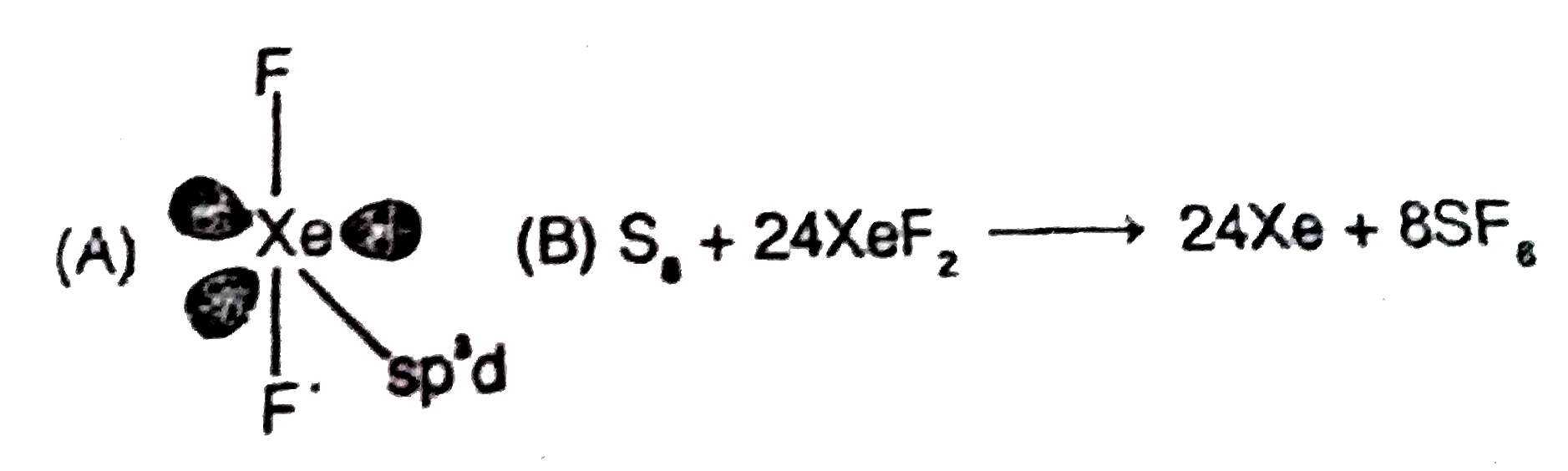
D

(A)
(B)`S_8+24XeF_2to24Xe+8SF_6(Stosp^3d^2)`
(C )`XeF_2+SbF_5 to [XeF]^(+)[SbF_6]^(-)`
Promotional Banner

Topper's Solved these Questions

  • QUALITATIVE ANALYSIS PART 1

    RESONANCE ENGLISH|Exercise A.L.P|39 Videos
  • SOLID STATE

    RESONANCE ENGLISH|Exercise PHYSICAL CHEMITRY (SOLID STATE)|45 Videos

Similar Questions

Explore conceptually related problems

A crystalline solid (A) reacts with hydrogen gas to form a monoatomic gas (B) and a highly associated liquid ( C).(A) is soluble in water and undergoes hydroloysis slowly to form (B),(C ) and a diatomic gas (D).When pure and dry (D) is subjected to a silent electric discharge an another pale blue gas (E) is produced which like (A) also acts a strong oxidising agent.(E) dissolves in potassium hydroxide forming an orange coloured solid which is paramagnetic in nature. (A) reacts with IF_5, SbF_5, PF_5 etc to form the addition compounds. (C ) forms an addition compound (F) with KF with when electrolysed in molten state forms a most reactive gas (G).(B) and (G) (taken in 2:1) ratio when heated in nickel tube at 400^@ C and 6 atm pressure forms (A).The first ionization energy (IE_1) of (B) is fairly close to (D). Which of the correct choice for (D) and (E) ?

Magnesium reacts with steam to form ______ and hydrogen gas

Aluminium acts as an oxidising agent. Aluminium gas a strong afinity for oxygen.

White crystalline solid (A) reacts with H_2 to form a highly associated liquid (B) and a monoatomic , colourless gas (C ). The liquid (B) is used for etching glass. Compound (A) undergoes hydrolysis slowly to form (C ), (B) and a diatomic gas (D ) whose IE is almost similar to that of (C ). (B) forms an addition compound with KF to form (E) which is electrolysed in the molten state to form a most reactive gas (F) which combines with (C ) in 2:1 ratio of produce (A). Which of the following is correct for the white crystalline solid (A) ?

White crystalline solid (A) reacts with H_2 to form a highly associated liquid (B) and a monoatomic , colourless gas (C ). The liquid (B) is used for etching glass. Compound (A) undergoes hydrolysis slowly to form (C ), (B) and a diatomic gas (D ) whose IE is almost similar to that of (C ). (B) forms an addition compound with KF to form (E) which is electrolysed in the molten state to form a most reactive gas (F) which combines with (C ) in 2:1 ratio of produce (A). The compound 'A' reacts with sulphur to form a compound in which hybridisation state of sulphur atom is :

A mixture of boron trichloride and hydrogen is subjected to silent electric discharge to form (A) and HCl. (A) is mixed with ammonia and heated to 200^@ C to from (B) . Identify (A) and (B) .

An element reacts with hydrogen to form a compound X which on treatment with water liberates hydrogen gas. The element can be

White crystalline solid (A) reacts with H_2 to form a highly associated liquid (B) and a monoatomic , colourless gas (C ). The liquid (B) is used for etching glass. Compound (A) undergoes hydrolysis slowly to form (C ), (B) and a diatomic gas (D ) whose IE is almost similar to that of (C ). (B) forms an addition compound with KF to form (E) which is electrolysed in the molten state to form a most reactive gas (F) which combines with (C ) in 2:1 ratio of produce (A). According to Molecular Orbital Theory, which of the following is correct about the molecule (D) ?

Name the drying agent: which is used in drying hydrogen chloride gas.

Hydrogen chloride gas being highly soluble in water is dried by:

RESONANCE ENGLISH-RANK BOOSTER-All Questions
  1. 3.49g of ammonia at STP occupies a volume of 4.48 dm^3 calculate the m...

    Text Solution

    |

  2. How much mass of sodium acetate is required to make 230 mL of 0.575 mo...

    Text Solution

    |

  3. A crystalline solid (A) reacts with hydrogen gas to form a monoatomic ...

    Text Solution

    |

  4. A crystalline solid (A) reacts with hydrogen gas to form a monoatomic ...

    Text Solution

    |

  5. A crystalline solid (A) reacts with hydrogen gas to form a monoatomic ...

    Text Solution

    |

  6. Compound (A) on reduction with LiAIH4 gives a hydride (P) containing 2...

    Text Solution

    |

  7. Compound (A) on reduction with LiAIH4 gives a hydribe (P) containing 2...

    Text Solution

    |

  8. Compound (A) on reduction with LiAIH4 gives a hydribe (P) containing 2...

    Text Solution

    |

  9. Fifth group elements form hydrides to type AH(3). The hydrides have a ...

    Text Solution

    |

  10. Fifth group elements form hydrides to type AH(3). The hydrides have a ...

    Text Solution

    |

  11. Fifth group elements form hydrides to type AH(3). The hydrides have a ...

    Text Solution

    |

  12. Lithium aluminium hydride reacts with silicon tetrachloride to form

    Text Solution

    |

  13. Match {:("Column I","Column II"),((A)"Sheet silicate",(p)"Contain Si...

    Text Solution

    |

  14. When aluminium is heated with conc. H(2)SO(4)

    Text Solution

    |

  15. Why does PCl(3) or PCl(5) fumes in air ?

    Text Solution

    |

  16. Match each of the reactions given in column I with the corresponding...

    Text Solution

    |

  17. Match the compounds listed in colomn-I with characteristic(s) type o...

    Text Solution

    |

  18. Match {:("Column I","Column II"),((A)O3+H2O2 " "to,(p)"Blue")...

    Text Solution

    |

  19. Alkyl substituted chlorosilane, Rn SiCl((4-n)), on hydrolysis and then...

    Text Solution

    |

  20. 3.49g of ammonia at STP occupies a volume of 3.49 dm^3 calculate the m...

    Text Solution

    |

