Home
Class 12
CHEMISTRY
Which of the following reactions give al...

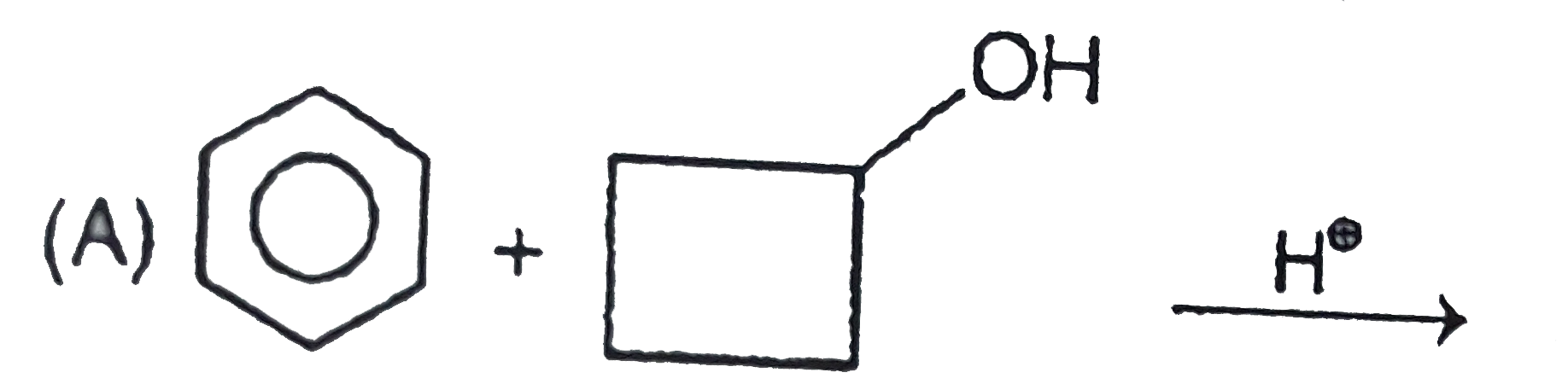
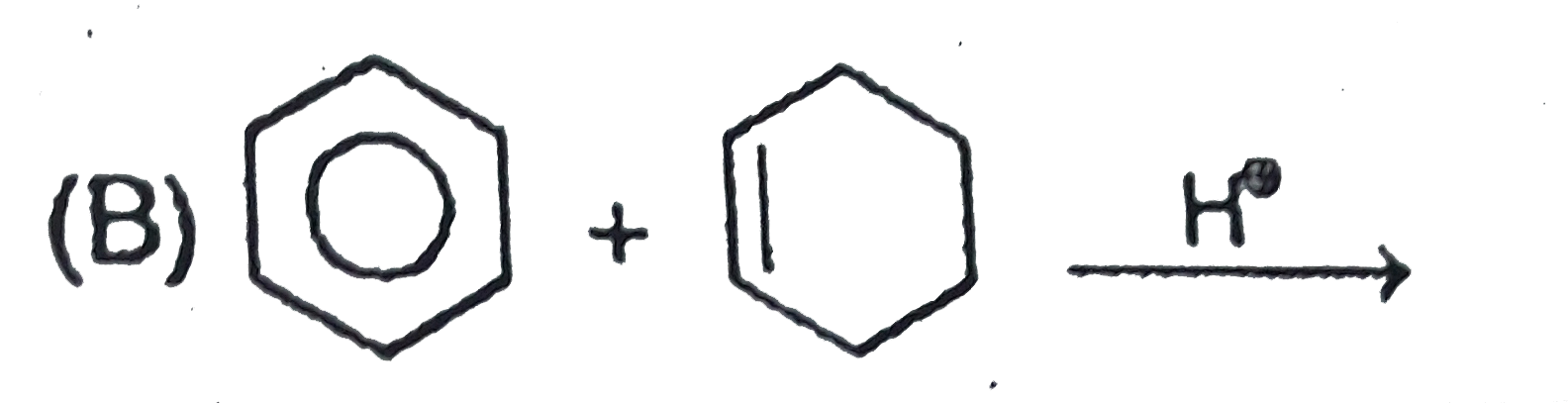
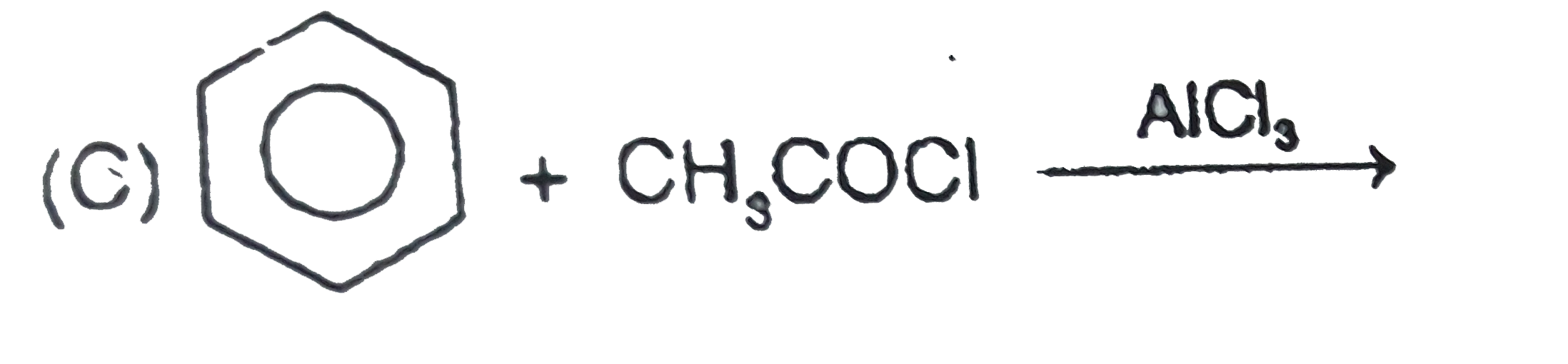
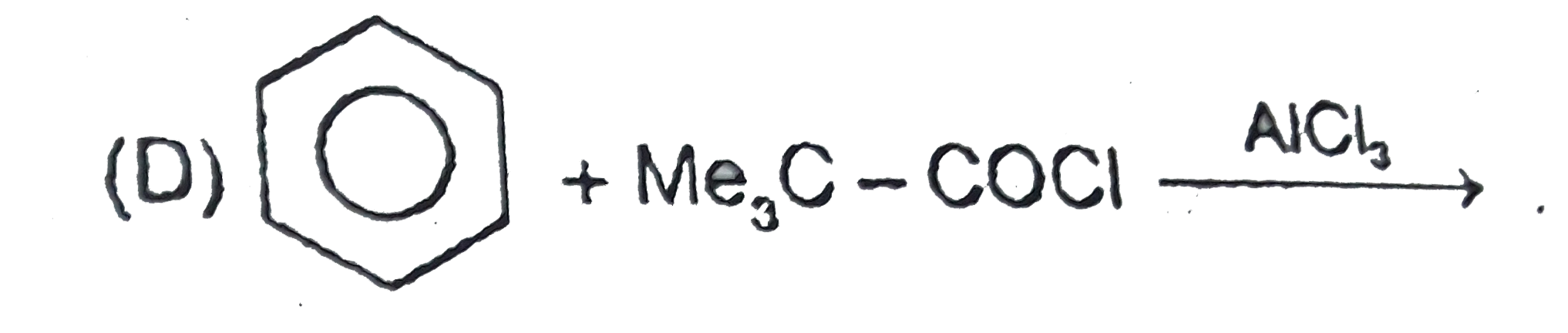
Which of the following reactions give alkylation product :

A

B

C

D

Text Solution

AI Generated Solution

The correct Answer is:

To determine which of the given reactions yield alkylation products, we need to analyze each reaction step by step. Alkylation refers to the introduction of an alkyl group into a molecule, typically through a reaction with an electrophile that does not contain any heteroatoms (like oxygen). ### Step-by-Step Solution: 1. **Reaction of Benzene with Cyclobutanol in Acidic Medium**: - Cyclobutanol acts as an electrophile in the presence of acid. - The cyclobutyl cation is formed when cyclobutanol loses a water molecule. - The benzene ring attacks the cyclobutyl cation, leading to the formation of an alkylation product. - **Conclusion**: This reaction gives an alkylation product. 2. **Reaction of Benzene with Cyclohexene in the Presence of H+**: - Cyclohexene can undergo electrophilic addition to form a cyclohexyl cation. - The benzene ring attacks this cyclohexyl cation, resulting in the formation of an alkylation product. - **Conclusion**: This reaction also gives an alkylation product. 3. **Reaction of Benzene with CH3COCl in the Presence of AlCl3**: - CH3COCl (acetyl chloride) reacts with AlCl3 to form an acylium ion (CH3C^+=O). - The benzene ring attacks this acylium ion, leading to the formation of acetophenone, which contains a carbonyl group (C=O). - **Conclusion**: This reaction gives an acylation product, not an alkylation product. 4. **Reaction of Benzene with Me3C(=O)Cl in the Presence of AlCl3**: - Me3C(=O)Cl reacts with AlCl3 to generate a tert-butyl cation (Me3C+). - The benzene ring attacks this tert-butyl cation, resulting in the formation of an alkylation product. - **Conclusion**: This reaction gives an alkylation product. ### Final Answer: The reactions that give alkylation products are: - Reaction with Cyclobutanol (A) - Reaction with Cyclohexene (B) - Reaction with Me3C(=O)Cl (D) Thus, the correct options are A, B, and D.

To determine which of the given reactions yield alkylation products, we need to analyze each reaction step by step. Alkylation refers to the introduction of an alkyl group into a molecule, typically through a reaction with an electrophile that does not contain any heteroatoms (like oxygen). ### Step-by-Step Solution: 1. **Reaction of Benzene with Cyclobutanol in Acidic Medium**: - Cyclobutanol acts as an electrophile in the presence of acid. - The cyclobutyl cation is formed when cyclobutanol loses a water molecule. - The benzene ring attacks the cyclobutyl cation, leading to the formation of an alkylation product. ...
Promotional Banner

Topper's Solved these Questions

  • QUALITATIVE ANALYSIS PART 1

    RESONANCE ENGLISH|Exercise A.L.P|39 Videos
  • SOLID STATE

    RESONANCE ENGLISH|Exercise PHYSICAL CHEMITRY (SOLID STATE)|45 Videos

Similar Questions

Explore conceptually related problems

Which of the following reaction/s give same product?

Which of the following reactions gives copper as a product

Which of te following reaction gives correct major product-

RESONANCE ENGLISH-RANK BOOSTER-All Questions
  1. The products of the following reactions can be :

    Text Solution

    |

  2. Which test can be used to distinguish propan-2-one and Propanal ?

    Text Solution

    |

  3. Which of the following reactions give alkylation product :

    Text Solution

    |

  4. The following conversion reaction can be carried out by using reacti...

    Text Solution

    |

  5. Which of the folllowing ion will be aromatic in nature ?

    Text Solution

    |

  6. Statement-1:Benzene and ethene both give reactions with electrophillic...

    Text Solution

    |

  7. Statement-1: Statement-2:Coplanar arrangement of three rings is flu...

    Text Solution

    |

  8. Statement-1:Polyacylation in benzene does not occur during Friedal Cra...

    Text Solution

    |

  9. Mole fraction of ethyl alcohol in aqueous ethyl alcohol (C2H5OH) solut...

    Text Solution

    |

  10. Mole fraction of ethyl alcohol in aqueous ethyl alcohol (C2H5OH) solut...

    Text Solution

    |

  11. Mole fraction of ethyl alcohol in aqueous ethyl alcohol (C2H5OH) solut...

    Text Solution

    |

  12. The general electrophilic substitution reaction (replacement of H. by ...

    Text Solution

    |

  13. The general electrophilic substitution reaction (replacement of H. by ...

    Text Solution

    |

  14. The product U is

    Text Solution

    |

  15. Which of the following will not be the product when S on reaction with...

    Text Solution

    |

  16. The compound C8H9Cl(A) on treatments with KCN followed by hydrolysis g...

    Text Solution

    |

  17. The compound C8H9Cl(A) on treatments with KCN followed by hydrolysis g...

    Text Solution

    |

  18. The compound C8H9Cl(A) on treatments with KCN followed by hydrolysis g...

    Text Solution

    |

  19. Mole fraction of ethyl alcohol in aqueous ethyl alcohol (C2H5OH) solut...

    Text Solution

    |

  20. Hydration of 3-phenylbut-1-ene in dil H(2)So(4) will give mainly :

    Text Solution

    |
