
Home
Class 12
CHEMISTRY
Catalytic hydrogenation of which of the ...

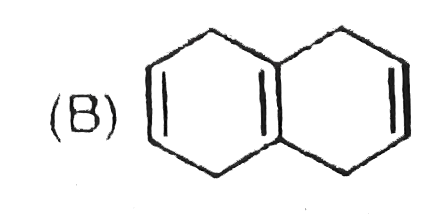
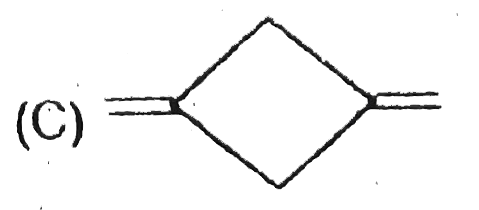
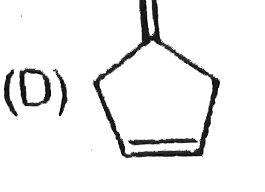
Catalytic hydrogenation of which of the following gives a product that further gives three photochemical monochlorination products (considering structural isomers only )?

A

B

C

D

Text Solution

AI Generated Solution

The correct Answer is:

To solve the question regarding the catalytic hydrogenation and subsequent photochemical monochlorination of the given compounds, we will follow these steps: ### Step 1: Identify the Compounds We need to analyze the compounds provided in the question. Let's denote them as A, B, C, and D. ### Step 2: Perform Catalytic Hydrogenation For each compound, we will perform catalytic hydrogenation. This process involves the addition of hydrogen (H₂) across the double bonds (alkenes) to convert them into alkanes (single bonds). - **Compound A**: After hydrogenation, it becomes an alkane. - **Compound B**: After hydrogenation, it also becomes an alkane. - **Compound C**: After hydrogenation, it becomes an alkane. - **Compound D**: After hydrogenation, it becomes an alkane. ### Step 3: Analyze Monochlorination Next, we will treat each hydrogenated compound with Cl₂ in the presence of light (Hν) to perform monochlorination. We will count the number of structural isomers produced. #### For Compound A: - After hydrogenation, let's assume it has 2 different types of hydrogen atoms. - Monochlorination can occur at these positions, but we find that it leads to only **2 unique products**. #### For Compound B: - After hydrogenation, it has 3 different types of hydrogen atoms. - Monochlorination can occur at these positions, leading to **3 unique products**. #### For Compound C: - After hydrogenation, it has 3 different types of hydrogen atoms. - Monochlorination can occur at these positions, leading to **3 unique products**. #### For Compound D: - After hydrogenation, it has multiple types of hydrogen atoms. - Monochlorination can occur at various positions, leading to more than **3 unique products**. ### Step 4: Conclusion Based on the analysis: - Compound B and Compound C yield **3 unique monochlorination products**. - Compound A yields **2 unique products**. - Compound D yields more than **3 unique products**. Thus, the answer to the question is that **the catalytic hydrogenation of Compound B or Compound C gives a product that further gives three photochemical monochlorination products**. ### Final Answer: **B and C are the correct options.** ---

To solve the question regarding the catalytic hydrogenation and subsequent photochemical monochlorination of the given compounds, we will follow these steps: ### Step 1: Identify the Compounds We need to analyze the compounds provided in the question. Let's denote them as A, B, C, and D. ### Step 2: Perform Catalytic Hydrogenation For each compound, we will perform catalytic hydrogenation. This process involves the addition of hydrogen (H₂) across the double bonds (alkenes) to convert them into alkanes (single bonds). ...
Promotional Banner

Topper's Solved these Questions

  • QUALITATIVE ANALYSIS PART 1

    RESONANCE ENGLISH|Exercise A.L.P|39 Videos
  • SOLID STATE

    RESONANCE ENGLISH|Exercise PHYSICAL CHEMITRY (SOLID STATE)|45 Videos

Similar Questions

Explore conceptually related problems

Which of the following give ether as a major product -

Which of the following give para major product with aniline?

Which of the following reaction/s give same product?

Which of the following will give same product on ozonolysis

Which of following gives only basic product on hydrolysis :-

Which of the following set gives the product that give two monochloro structural products after reaction with Cl//hv ?

Which of the following reactions gives copper as a product

Which of the following reactions give alkylation product :

RESONANCE ENGLISH-RANK BOOSTER-All Questions
  1. The density (in g ml^(−1) ) of a 3.60M sulphuric acid solution having...

    Text Solution

    |

  2. Acetaldehyde and acetylene can be distinguished by :

    Text Solution

    |

  3. Catalytic hydrogenation of which of the following gives a product that...

    Text Solution

    |

  4. The tautomers of the following compound can be :

    Text Solution

    |

  5. Broadly speaking there are four types of stereisomers namely conformat...

    Text Solution

    |

  6. Calculate the weight of lime (CaO) obtained by heating 150kg of 95% pu...

    Text Solution

    |

  7. Calculate the weight of lime (CaO) obtained by heating 175kg of 95% pu...

    Text Solution

    |

  8. Ortho effect is a special type of effect that is shown by d-substituen...

    Text Solution

    |

  9. The concept of resonance explains various properties of compounds.The ...

    Text Solution

    |

  10. The density (in g ml^(−1) ) of a 3.60M sulphuric acid solution having...

    Text Solution

    |

  11. Match the given compounds in Column-I with their appropriate descripti...

    Text Solution

    |

  12. State true or false Diamond is a non conductor of electricity.

    Text Solution

    |

  13. Find the concentration of solution in terms of weight percent if 35g o...

    Text Solution

    |

  14. Calculate the weight of lime (CaO) obtained by heating 270kg of 95% pu...

    Text Solution

    |

  15. The density (in g ml^(−1) ) of a 3.60M sulphuric acid solution having...

    Text Solution

    |

  16. Find the concentration of solution in terms of weight percent if 33g o...

    Text Solution

    |

  17. In how many compounds delocatisation of electrons is possible ?

    Text Solution

    |

  18. Which amongst the following is not free state of carbon?

    Text Solution

    |

  19. Find the sum of number of stereoismomers and stereocentres for the giv...

    Text Solution

    |

  20. How many optically active isomers of 2,3-Dichlorobutandioic acid are p...

    Text Solution

    |
