Home
Class 12
CHEMISTRY
For the consecutive reaction Aoverset(k1...

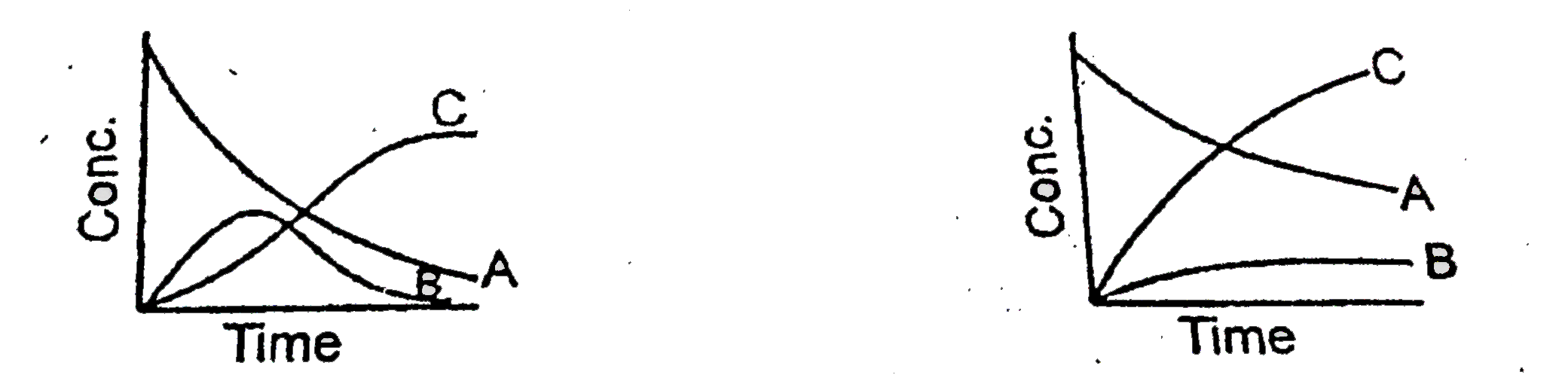
For the consecutive reaction `Aoverset(k_1("time"^(-1)))toBoverset(k_2("time"^(-1)))toC` following curves were obtained depending upon the relative values of `k_1 & k_2` .

Now which of the following is the correct match ?

A

Figure 1 `(k_1 lt k_2)`

B

Figure 2 `(k_1 lt k_2)`

C

Figure 2 - `(k_1 gt gt k_2)`

D

Figure 1 - `(k_1 gt gt k_2)`

Text Solution

Verified by Experts

The correct Answer is:

B,D

For `A overset(k_1)toBoverset(k_2)toC`
In figure 1, [B] increased to a maximum value during reaction.This is possible when rate of formation of B is more than rate of decay of B in C.
i.e. `k_1 gt gt k_2`
In figure 2, [B] is maintained to a very low value .This means that B is decaying as soon as it is formed.This is possible when `k_2 gt gt k_1`
Promotional Banner

Topper's Solved these Questions

  • QUALITATIVE ANALYSIS PART 1

    RESONANCE ENGLISH|Exercise A.L.P|39 Videos
  • SOLID STATE

    RESONANCE ENGLISH|Exercise PHYSICAL CHEMITRY (SOLID STATE)|45 Videos

Similar Questions

Explore conceptually related problems

Let S(k) = 1 + 3 + 5 +...+ (2k -1) = 3 + k^2 . Then which of the following is true ?

K_(w) of H_(2)O at 373 K is 1xx10^(-12) Identify which of the following is/are correct?

Aoverset(K_(1))toBoverset(K_(2))toC if all the reaction are 1^(st) order and (d[B])/(dt)=0 . Determine [B].

For a reaction scheme Aoverset(k_(1))toBoverset(k_(2))toD , If the rate of formation if B is set to be Zero then the concentration of B is given by :

In the series reaction Aoverset(K_(2))(rarr)Boverset(K_(2))(rarr)Coverset(K_(2))(rarr)D , if K_(1)gtK_(2)gtK_(3) then the rate determing step of the reaction is

Conisder parallel reaction: Aoverset(k_(1))rarrB, 2Aoverset(k_(2))rarrC+D What would be the rate expresison for [A] ?

Mechanism of the reaction is: A overset(k_(1))rarrB, 2Aoverset(k_(2))rarr C + D What is (-d[A])/(dt) ?

In the sequence of reaction A to^(k_1) B to^(k_2) C to^(k_3) D , it is know that k_3 gt k_2 gt k_1 . Then the rate determining step of the reaction is:

Two different first order reactions have rate consants k_(1) and k_(2) "at" T_(1)(k_(1)gtk_(2)) . If temperature is increased form T_(1) "to"T_(2) ,then new consant become k_(3) and k_(4) respeectively. Which among the following relartions is correct

Find the value of k, if 2x +1 is a factor of (3k+2)x^3 + (k-1).

RESONANCE ENGLISH-RANK BOOSTER-All Questions
  1. Three lines are drawn from a single corner of an FCC unit cell to meet...

    Text Solution

    |

  2. What is the origin of charge on colloidal particles?

    Text Solution

    |

  3. For the consecutive reaction Aoverset(k1("time"^(-1)))toBoverset(k2("t...

    Text Solution

    |

  4. For chloroform and acetone or for a solution of chloroform and acetone...

    Text Solution

    |

  5. The standard reduction potential E^(@) of the following systems are:- ...

    Text Solution

    |

  6. Rate of a chemical reaction 2A (g) to B(g) is defined as : 'rB'=1/V(...

    Text Solution

    |

  7. The carbon - carbon bond length in graphite is :

    Text Solution

    |

  8. Which of the following are match : {:((A)"Lyophilic colloids",-,"rev...

    Text Solution

    |

  9. Diamond is an example of covalent crystal.

    Text Solution

    |

  10. What is common in graphite and diamond:

    Text Solution

    |

  11. The molar conductance of NaCl varies with the concentration as shown i...

    Text Solution

    |

  12. The molar conductance of NaCl varies with the concentration as shown i...

    Text Solution

    |

  13. Properties, whose values depend only on the concentration of solute pa...

    Text Solution

    |

  14. Black diamonds are called:

    Text Solution

    |

  15. Name the purest from of carbon.

    Text Solution

    |

  16. Match the column : {:("Column I","Column II"),((A)"Cubic",(p)"Have 2...

    Text Solution

    |

  17. For a binary liquid solution of A and B. PA^0=pure vapour pressure of ...

    Text Solution

    |

  18. The longest C−C bond is present in

    Text Solution

    |

  19. Only can cut another diamond.

    Text Solution

    |

  20. The glittering nature of diamond is due to ?

    Text Solution

    |
