Home
Class 12
PHYSICS
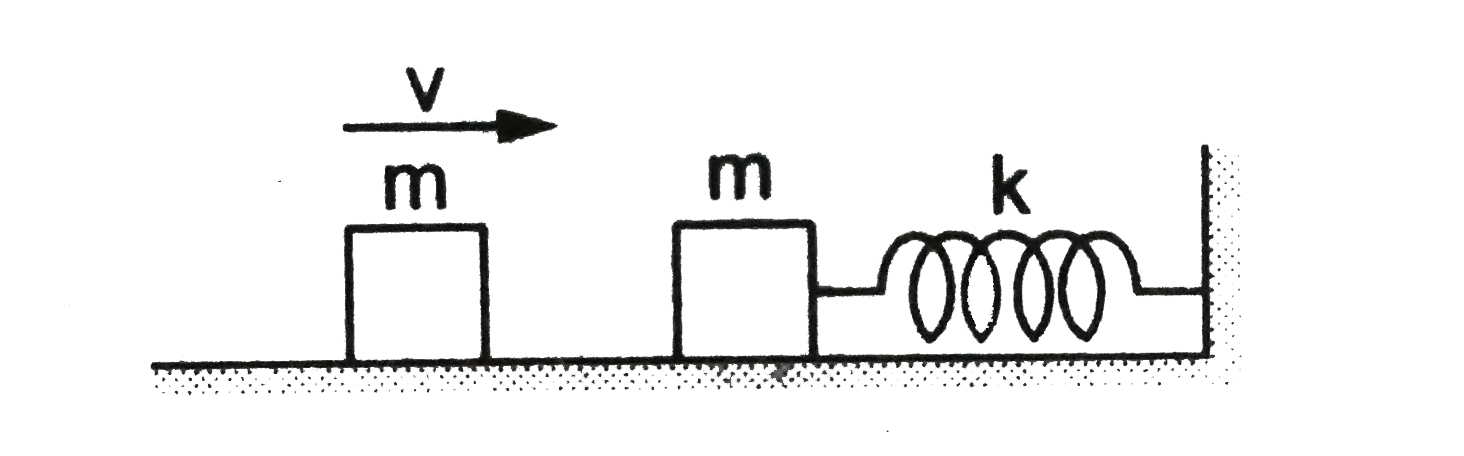
The left block in filgure collides inela...

The left block in filgure collides inelastically with the right block and sticks to it. Find the amplitude of the resulting simple harmonic motion.

Text Solution

Verified by Experts

Assuming the collision to last for a small interval only, we can apply the principle of conservation momentum. The common velocity after the collision is `(v)/(2)`. The kinectic energy `= (1)/(2)(2m) ((v)/(2))^(2) = (1)/(4) mv^(2)`. This is also the total energy of viberation as the spring isunstretched at this moment. If the amplitude is `A`, the total energy cen also be written as `(1)/(2)kA^(2)`. Thus,
`(1)/(2)kA^(2) = (1)/(4)mv^(2)`, giving `A = sqrt((m)/(2k))v`.
Promotional Banner

Topper's Solved these Questions

  • SIMPLE HARMONIC MOTION

    RESONANCE ENGLISH|Exercise Solved Miscellaneous Problems|9 Videos
  • SIMPLE HARMONIC MOTION

    RESONANCE ENGLISH|Exercise Board Level Exercise|24 Videos
  • SEMICONDUCTORS

    RESONANCE ENGLISH|Exercise Exercise 3|88 Videos
  • TEST PAPERS

    RESONANCE ENGLISH|Exercise PHYSICS|784 Videos

Similar Questions

Explore conceptually related problems

In figure, k = 100 N//m, M = 1kg and F = 10 N (a) Find the compression of the spring in the equilibrium position (b) A sharp blow by some external agent imparts a speed of 2 m//s to the block towards left. Find the sum of the potential energy of the spring and the kinetic energy of the block at this instant. (c) Find the time period of the resulting simple harmonic motion. (d) Find the amplitude. (e) Write the potential energy of the spring when the block is at the left estreme. (f) Write the potential energy of the spring when the block is at the right extreme. The answers of (b), (e) and (f) are different. Explain why this does not violate the principle of conservation of energy ?

In the figure shown, the block A of mass m collides with the identical block B and after collision they stick together. Calculate the amplitude of resulatant vibration.

In the figure shown, the block A of mass m collides with the identical block B and after collision they stick together. Calculate the amplitude of resulatant vibration.

A light inelastic thread passes over a small frictionless pulley. Two blocks of masses m = 1 kg and M = 3 kg, respectively, are attached with the thread and heavy block rests on a surface. A particle P of mass 1 kg moving upward with a velocity of 10 ms^(-1) collides with the lighter block and sticks to it. The speed of the bigger block just after the string is taut will be [g = 10 ms^(-2)]

A bullet of mass m strikes a block of mass M . The bullet remains embedded in the block. Find the amplitude of the resulting SHM.

A particle executing of a simple harmonic motion covers a distance equal to half its amplitude in on e second . Then the time period of the simple harmonic motion is

The mass M shown in figure ocillates in simple harmonic motion with amplitude A. The amplitude of the point P is

The amplitude of given simple harmonic motion is y=(3sinomegat+4cosomegat)m

A block with mass M attached to a horizontal spring with force constant k is moving with simple harmonic motion having amplitude A_(1) . At the instant when the block passes through its equilibrium position a lump of putty with mass m is dropped vertically on the block from a very small height and sticks to it. (a) Find the new amplitude and period. (b) Repeat part (a) for the case in which the putty is dropped on the block when it is at one end of its path.

A block with mass M attached to a horizontal spring with force constant k is moving with simple harmonic motion having amplitude A_(1) . At the instant when the block passes through its equilibrium position a lump of putty with mass m is dropped vertically on the block from a very small height and sticks to it. (a) Find the new amplitude and period. (b) Repeat part (a) for the case in which the putty is dropped on the block when it is at one end of its path.
