Home
Class 12
PHYSICS
The block of mass m(1) and m(2) are conn...

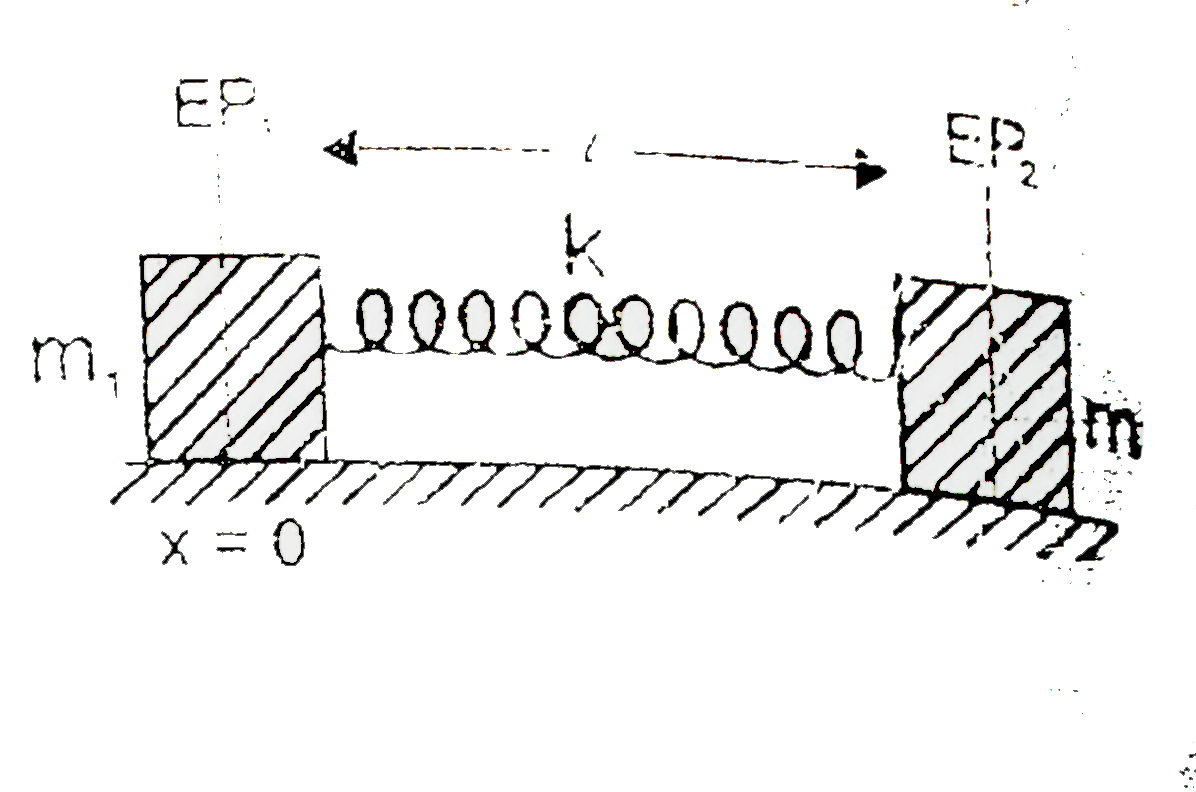
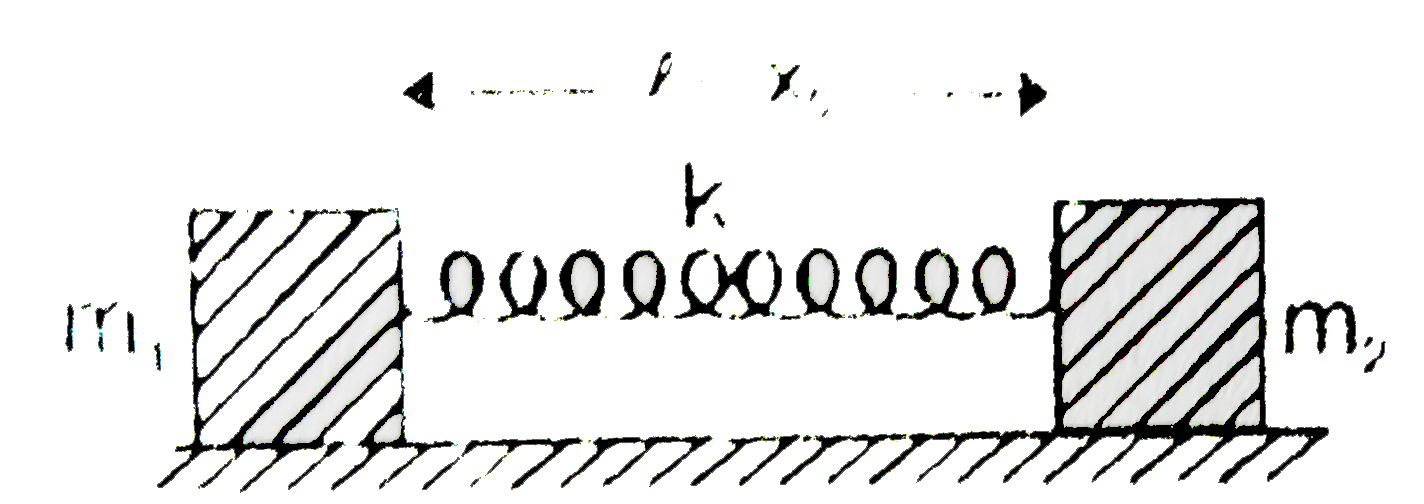
The block of mass `m_(1)` and `m_(2)` are connected with a spring of netural length `l` and spring constant `k`. The systeam is lying on a smoth horizontal surface. Initially spring is compressed by `x_(0)` as shown in figure.

Show that the two blocks will perform `SHM` about their equilibrium position. Also (a) find the time period, (b) find amplitude of each block and (c) length of spring as a funcation of time.

Text Solution

Verified by Experts
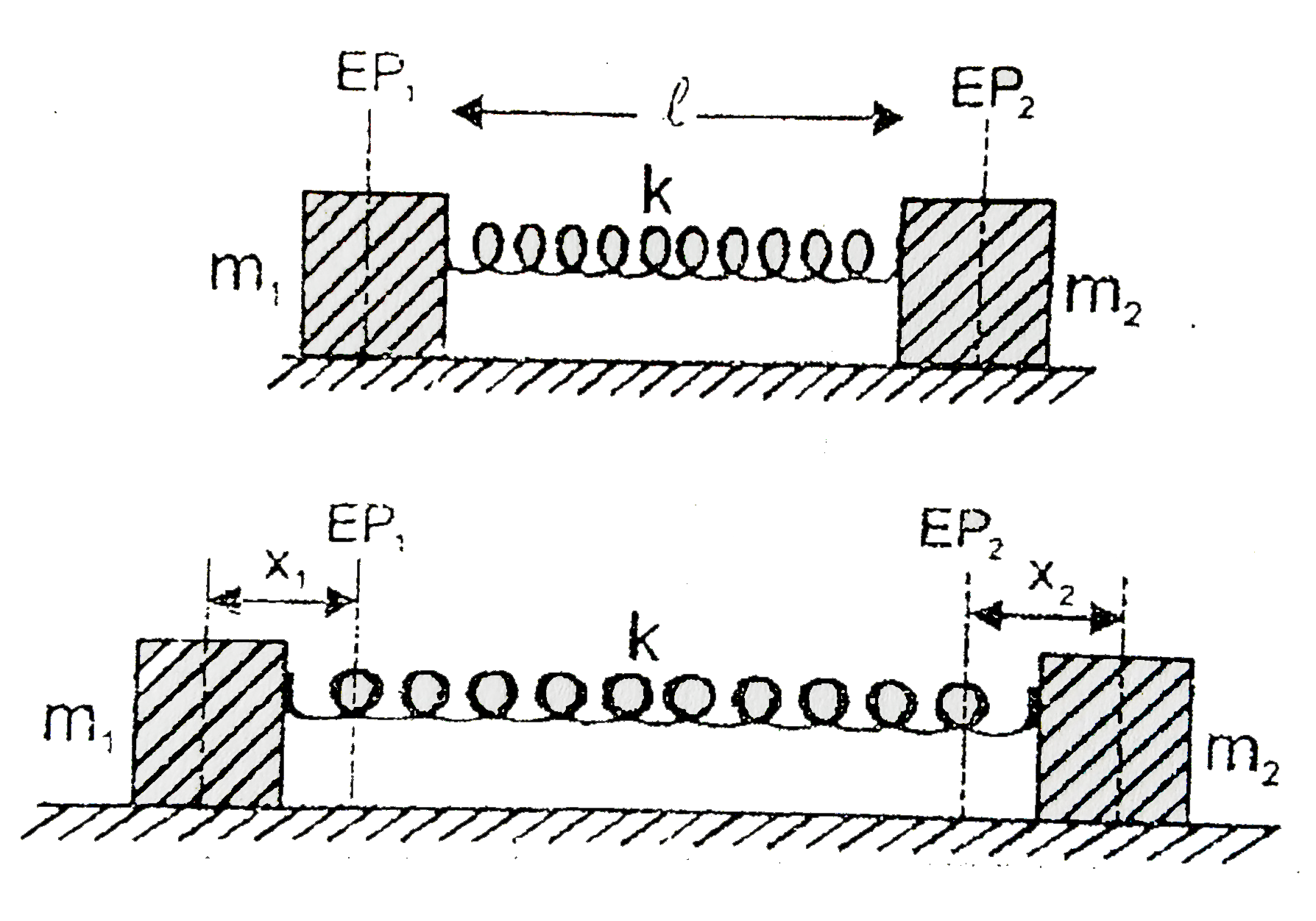
(a) Hence both the blocks will be in equilibrium at the same time when spring is in its natural length. Let `EP_(1)` and `EP_(2)` be equilibrium positions of block `A` and `B` as shown in figure.

Let at any time during oscillations, blocks are at a distance of `x_(1)` and `x_(2)` from their equilibrium positions.
As no external force is acting on the spring on the spring block systeam
`:. (m_(1) + m_(2))Deltax_(cm) = m_(1)x_(1) - m_(2) x_(2) = 0` or `m_(1)x_(1) - m_(2) x_(2)`
for `1st` particle, force equation can be written as
`k(x_(1) + x_(2)) = -m_(1)(d^(2)x_(1))/(dt^(2))` or `k(x_(1) + (m_(1))/(m_(2))x_(1)) = - m_(1)a_(1)`
or, `a_(1) = -(k(m_(1) + m_(2)))/(m_(1)m_(2))x_(1) :. omega^(2) = (k(m_(1) + m_(2)))/(m_(1)m_(2))`
Hence, `T = 2pisqrt((m_(1)m_(2))/(k(m_(1) + m_(2)))) = 2psqrt((mu)/(K))` where `mu = '(m_(1)m_(2))/((m_(1) + m_(2))` which is known as reduced mass
Ans (a)
Similarly time period of `2`nd particle can be found. Both will be having the same time period.
(b) Let the amplitude of blocks be `A_(1)` and `A_(2)`.
`m_(1)A_(1) = m_(2)A_(2)`
By energy conservation,
`(1)/(2)k(A_(1) + A_(2))^(2) = (1)/(2) kx_(0)^(2)` or, `A_(1) + A_(2) = x_(0)`
or, `A_(1) + A_(2) = x_(0)` or, `A_(1) + (m_(1))/(m_(2))A_(1) = x_(0)`
or, `A_(1) = (m_(2)x_(0))/(m_(1) + m_(2))` similarly, `A_(2) = (m_(1)x_(0))/(m_(1) + m_(2))`
(c) Consider equilibrium position of `1`st particle as origin, i.e. `x = 0`.
`x` co-ordinate of particles can be written as
`x_(1) A_(1)cosomegat` and `x_(2) = l - A_(2)cosomegat`
length `= x_(2) - x_(1)`
`= l - (A_(1) + A_(2))cosomegat`
Promotional Banner

Topper's Solved these Questions

  • SIMPLE HARMONIC MOTION

    RESONANCE ENGLISH|Exercise Solved Miscellaneous Problems|9 Videos
  • SIMPLE HARMONIC MOTION

    RESONANCE ENGLISH|Exercise Board Level Exercise|24 Videos
  • SEMICONDUCTORS

    RESONANCE ENGLISH|Exercise Exercise 3|88 Videos
  • TEST PAPERS

    RESONANCE ENGLISH|Exercise PHYSICS|784 Videos

Similar Questions

Explore conceptually related problems

The block of mass m is released when the spring was in its natrual length. Spring constant is k. Find the maximum elongation of the spring.

Two blocks of masses m_(1) and m_(2) are connected by a massless spring and placed on smooth surface. The spring initially stretched and released. Then :

Two blocks A and B of mass m and 2m respectively are connected by a light spring of force constant k. They are placed on a smooth horizontal surface. Spring is stretched by a length x and then released. Find the relative velocity of the blocks when the spring comes to its natural length

Two blocks of masses m_1 =1kg and m_2 = 2kg are connected by a spring of spring constant k = 24 N/m and placed on a frictionless horizontal surface. The block m_(1) is imparted an initial velocity v_(0) = 12cm/s to the right. The amplitude of oscillation is

Two blocks of masses m_(1) and m_(2) are connected by an ideal sprit, of force constant k . The blocks are placed on smooth horizontal surface. A horizontal force F acts on the block m_(1) . Initially spring is relaxed, both the blocks are at rest. What is acceleration of centre of mass of system at the instant of maximum elongation of spring

Two blocks of masses m and m' are connected by a light spring on a horizontal frictionless table . The spring is compressed and then released . Find the ratio of acceleration of masses .

Find the elastic potential energy stored in each spring shown in figure, when the block is in equilibrium. Also find the time period of vertical oscillation of the block.

A block of mass m is connect to another block of mass M by a massless spring of spring constant k. The blocks are kept on a smooth horizontal plane. Initially the blocks are at rest and the spring is upstretched when a constant force F starts acting on the block of mass M to pull it. Find the maximum extension of the spring.

A block of mass m is connect to another block of mass M by a massless spring of spring constant k. The blocks are kept on a smooth horizontal plane. Initially the blocks are at rest and the spring is unsrtretched when a constnt force F starts acting on the block of mass M to pull it. Find the maximum extension of the spring.

A block of mass m is connected with two ideal pullies and a massless spring of spring constant K as shown in figure. The block is slightly displaced from its equilibrium position. If the time period of oscillation is mupisqrt(m/K) . Then find the value of mu .