Home
Class 12
PHYSICS
Block of mass m(2) is in equilibrium as ...

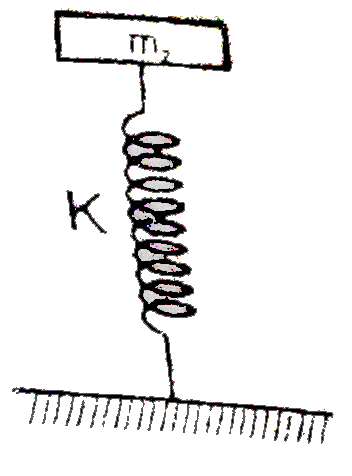
Block of mass `m_(2)` is in equilibrium as shown in figure. Anotherblock of mass `m_(1)` is kept gently on `m_(2)`. Find the time period of oscillation and amplitude.

Text Solution

Verified by Experts
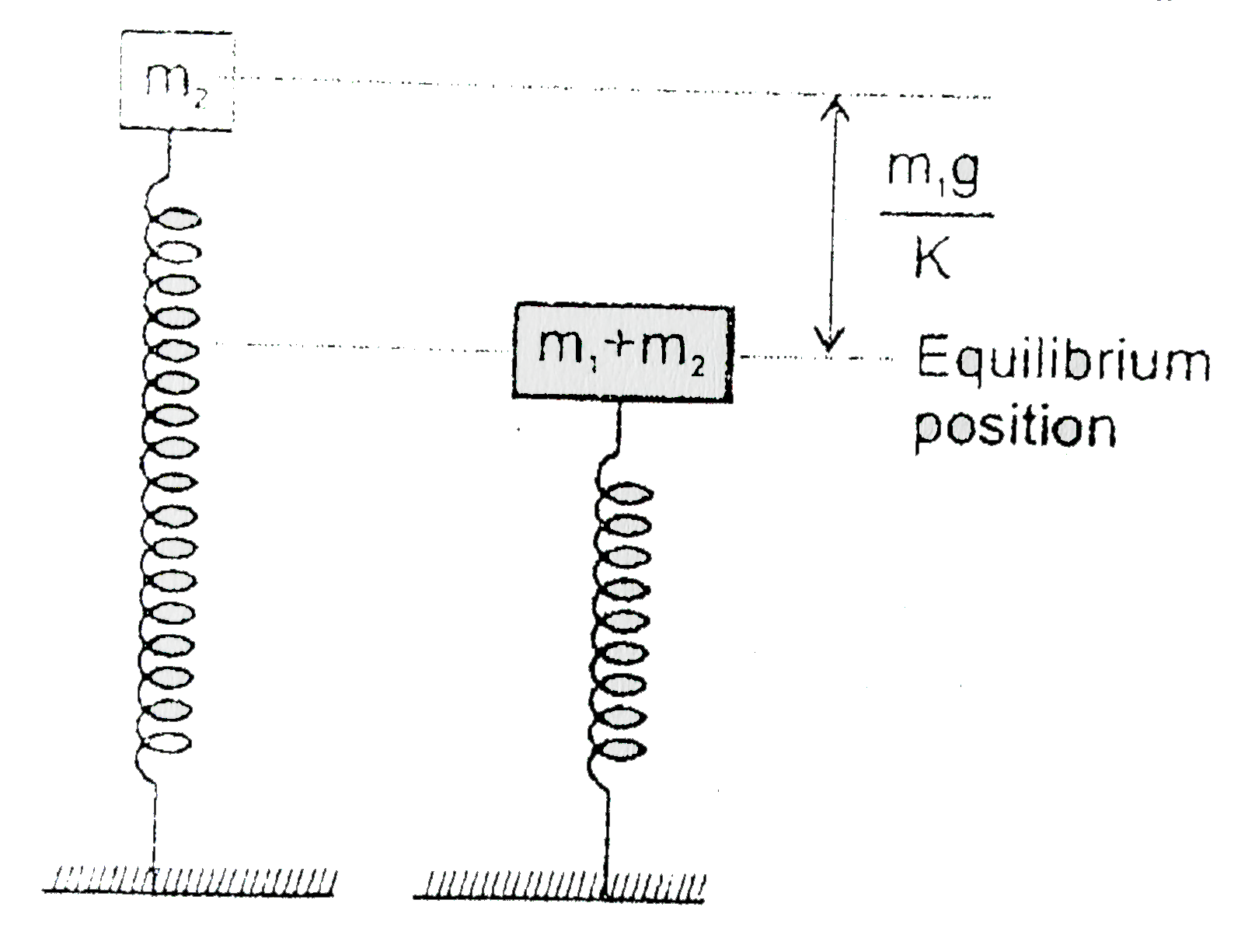
Time period `T = 2pisqrt((m_(1) + m_(2))/(K))`
At initial position since velocity is zero
it is the extreme position.
Amplitude `A = (m_(1)g)/(K)`
Ans. `T = 2pisqrt((m_(1) + m_(2))/(K))` Amplitude `= (m_(1)g)/(K)`
Promotional Banner

Topper's Solved these Questions

  • SIMPLE HARMONIC MOTION

    RESONANCE ENGLISH|Exercise Board Level Exercise|24 Videos
  • SIMPLE HARMONIC MOTION

    RESONANCE ENGLISH|Exercise Exercise- 1, PART - I|25 Videos
  • SIMPLE HARMONIC MOTION

    RESONANCE ENGLISH|Exercise Advanced Level Problems|13 Videos
  • SEMICONDUCTORS

    RESONANCE ENGLISH|Exercise Exercise 3|88 Videos
  • TEST PAPERS

    RESONANCE ENGLISH|Exercise PHYSICS|784 Videos

Similar Questions

Explore conceptually related problems

The time period of small oscillations of mass m :-

Spring of spring constant k is attached with a block of mass m_(1) , as shown in figure. Another block of mass m_(2) is placed angainst m_(1) , and both mass masses lie on smooth incline plane. Find the compression in the spring when lthe system is in equilibrium.

The system is in equilibrium and at rest. Now mass m_(1) is removed from m_(2) . Find the time period and amplituded of resultant motion. Spring constant is K .

A body of mass m is suspended from three springs as shown in figure. If mass m is displaced slightly then time period of oscillation is

Two blocks of masses m_(1) and m_(2) are kept on a smooth horizontal table as shown in figure. Block of mass m_(1) (but not m_(2) is fastened to the spring. If now both the blocks are pushed to the left so that the spring is compressed a distance d. The amplitude of oscillatin of block of mass m_(1) after the system is released is

Block of mass m_(2) is in equilibrium and at rest. The mass m_(1) moving with velocity u vertically downwards collids with m_(2) and sticks to it. Find the energy of oscillation.

Block of mass m_(2) is in equilibrium and at rest. The mass m_(1) moving with velocity u vertically downwards collids with m_(2) and sticks to it. Find the energy of oscillation.

Block A of mass m is performing SHM of amplitude a. Another block B of mas m is gently placed on A when it passes through mean position and B sticks to A . Find the time period and amplitude of new SHM .

A block of mass m is connected with two ideal pullies and a massless spring of spring constant K as shown in figure. The block is slightly displaced from its equilibrium position. If the time period of oscillation is mupisqrt(m/K) . Then find the value of mu .

Find the acceleration of the body of mass m_(2) in the arrangement shown in figure. If the mass m_(2) is eta time the mass m_(1) and the angle that the inclined plane forms with the horizontal is equal to theta . The masses of the pulley and threads, as well as the friction, are assumed to be negligible.

