Home
Class 12
PHYSICS
Spring of spring constant k is attached ...

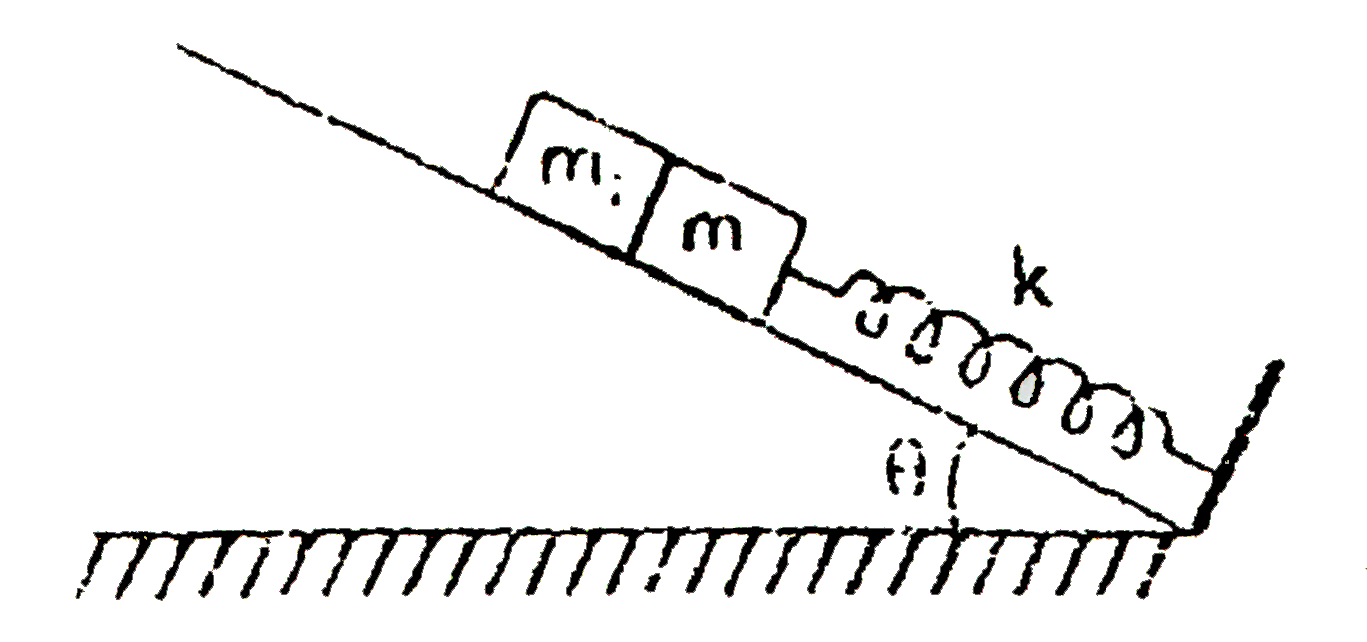
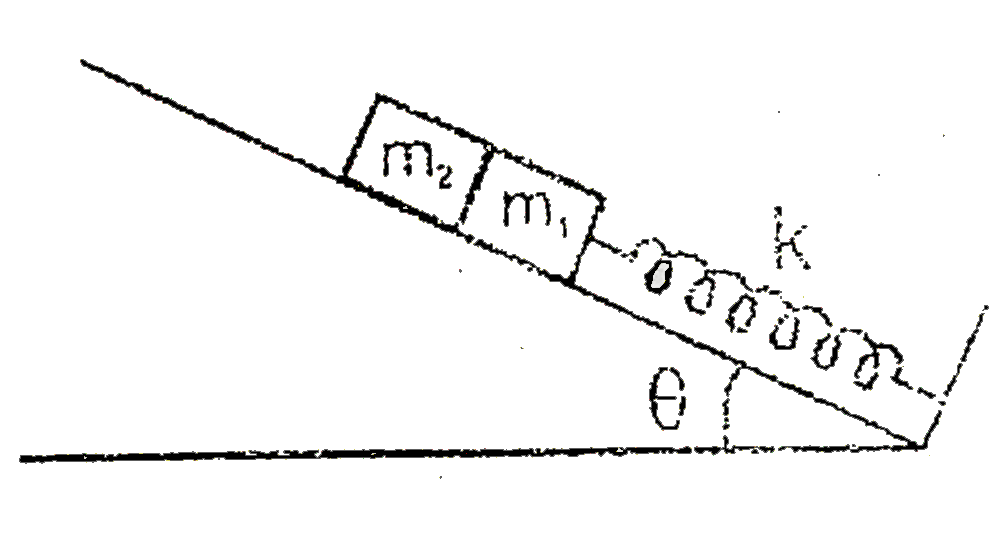
Spring of spring constant `k` is attached with a block of mass `m_(1)`, as shown in figure. Another block of mass `m_(2)` is placed angainst `m_(1)`, and both mass masses lie on smooth incline plane.

Find the compression in the spring when lthe system is in equilibrium.

A

`((m_(1) + m_(2))gsintheta)/(2k)`

B

`((m_(1) + m_(2))gsintheta)/(k)`

C

`((m_(1) + m_(2))g)/(k)`

D

`(2(m_(1) + m_(2))gsintheta)/(k)`

Text Solution

Verified by Experts

The correct Answer is:
B

At equilibrium position : `rarr`
`Kx_(0) = m_(1)g sintheta + m_(2)g sintheta`
`x_(0) = ((m_(1) + m_(2))gsintheta)/(k)`
Block will separate when acceleration of block of mass `m_(1)` will be just equal to `g sin theta`
`rArr a = omega^(2)x = g sintheta`
`rArr (K)/(m_(1) + m_(2)) xx x = g sin theta`
`x = (m_(1) + m_(2))/(K)g sintheta = x_(0)`
So, blocks will separate when blocks are at distance `x = (m_(1) + m_(2))/(K) g sintheta`
From mean position
i.e. spring is at its natural position (amplitude `A = ((2)/(K)(m_(1) + m_(2))g sintheta')`)
Blocks will seoparte at distance `x = x_(0)` from mean position.
`v = sqrt(A^(2) - x_(0)^(2))`
`= sqrt((K)/(m_(1) + m_(2))) sqrt(((2)/(K)(m_(1) + m_(2))g sintheta)^(2) - (((m_(1) + m_(2))/(K))g sintheta)^(2))`
`= sqrt((3)/(k)(m_(1) + m_(2)))gsintheta`
Promotional Banner

Topper's Solved these Questions

  • SIMPLE HARMONIC MOTION

    RESONANCE ENGLISH|Exercise Exercise- 3, PART - I|20 Videos
  • SIMPLE HARMONIC MOTION

    RESONANCE ENGLISH|Exercise Exercise- 3, PART - II|17 Videos
  • SIMPLE HARMONIC MOTION

    RESONANCE ENGLISH|Exercise Exercise- 2, PART - III|12 Videos
  • SEMICONDUCTORS

    RESONANCE ENGLISH|Exercise Exercise 3|88 Videos
  • TEST PAPERS

    RESONANCE ENGLISH|Exercise PHYSICS|784 Videos

Similar Questions

Explore conceptually related problems

Two identical springs of spring constant k are attached to a block of mass m and to fixed supports as shown in the figure. The time period of oscillation is

Tow identical springs of spring constant k are attached to a block of mass m and to fixed supports as shown in figure. When the mass is displaced from equilibrum position by a distance x towards right, find the restoring force.

The block of mass m is released when the spring was in its natrual length. Spring constant is k. Find the maximum elongation of the spring.

Two blocks of masses m_(1) and m_(2) are connected by a massless spring and placed on smooth surface. The spring initially stretched and released. Then :

Two blocks of mass 2kg and 5kg are given speed as shown in the figure. System is lying on a frictionless surface and the blocks are connected by a massless spring if spring constant 35 N/m . Find the maximum compression in the spring.

A block of mass m moving with velocity v_(0) on a smooth horizontal surface hits the spring of constant k as shown. The maximum compression in spring is

A block of mass m is relesed from rest from a height h onto a smooth surface of mass M fitted with an ideal spring of stiffness k . find the maximum compression in the spring.

A block of mass m is released from a height h from the top of a smooth surface. There is an ideal spring of spring constant k at the bottom of the track. Find the maximum compression in the spring (Wedge is fixed)

A constant force F is applied on a spring block system as shown in figure. The mass of the block is m and spring constant is k. The block is placed over a smooth surface. Initially the spring was unstretched. Choose the correct alternative(s)

A block of mass m is dropped onto a spring of constant k from a height h . The second end of the spring is attached to a second block of mass M as shown in figure. Find the minimum value of h so that the block M bounces off the ground. If the block of mass m sticks to the spring immediately after it comes into contact with it.

