Home
Class 12
PHYSICS
Two light spring of force constants k(1)...

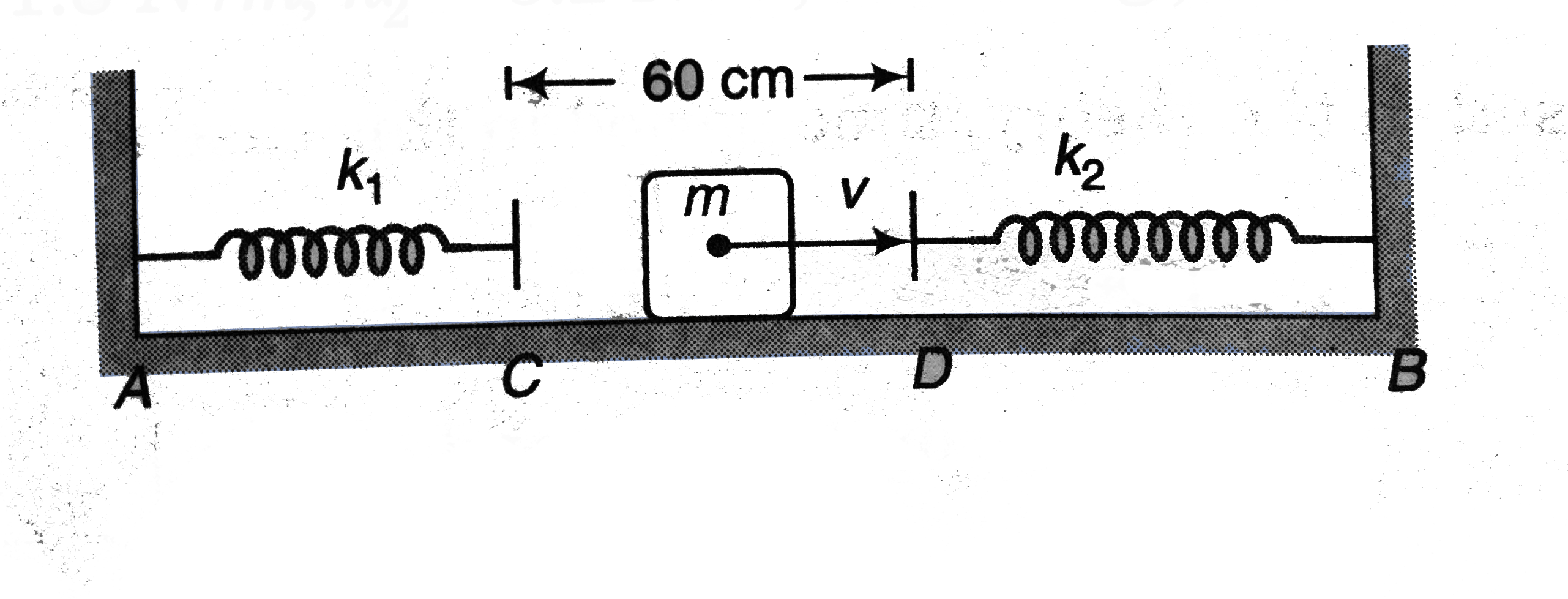
Two light spring of force constants `k_(1)` and `k_(2)` and a block of mass m are in one line `AB` on a smooth horizontal table such that one end of each spring is fixed on rigid supports and the other end is free as shown in the figure. The distance `CD` between the spring is `60cm`. If the block moves along `AB` with a velocity `120 cm//s` in between the springs, calculate the period of oscillation of the block. (take `k_(1) = 1.8 N//m`, `k_(2) = 3.2 N//m`, `m = 200 g`)

Text Solution

Verified by Experts

The correct Answer is:

`2.82 s`

Between `C` and `D` block will move with constant speed of `120 cm//s`. Therefore, period of oscillation will be (starting from `C`).
`T = t_(CD) + (T_(2))/(2) + t_(DC) + (T_(1))/(2)`
Here, `T_(1) = 2pisqrt((m)/(k_(1))` and `T_(2) = 2pisqrt((m)/(k_(2))`
and `t_(CD) = T_(DC) = (CD)/(v) = (60)/(120) = 0.5 s`
`:. T = 0.5 + (2pi)/(2)sqrt((0.2)/(3.2)) + 0.5 + (2pi)/(2)sqrt((0.2)/(1.8))`
`(m = 200 g = 0.2 kg)`
`T = 2.82 s`
Promotional Banner

Topper's Solved these Questions

  • SIMPLE HARMONIC MOTION

    RESONANCE ENGLISH|Exercise Exercise- 3, PART - II|17 Videos
  • SEMICONDUCTORS

    RESONANCE ENGLISH|Exercise Exercise 3|88 Videos
  • TEST PAPERS

    RESONANCE ENGLISH|Exercise PHYSICS|784 Videos

Similar Questions

Explore conceptually related problems

Two light spring of force constants k_(1) and k_(2) and a block of mass m are in the line AB on a smooth horizontal table such that one end of each spring is fixed on right supports and the other end is free as shown in figure The distance CD between the free ends of the spring is 60 cm . If the block (k_(1) = 1.8 N//m, k_(2) = 3.2 N//m and m = 200g) . Is the motion simple harmonic?

A block of mass m, lying on a smooth horizontal surface, is attached to a spring (of negligible mass) of spring constant k. The other end of the spring is fixed, as shown in the figure. The block is initally at rest in its equilibrium position. If now the block is pulled withe a constant force F, the maximum speed of the block is :

As shown in the figure, two light springs of force constant k_(1) and k_(2) oscillate a block of mass m. Its effective force constant will be

Two identical springs of spring constant k are attached to a block of mass m and to fixed supports as shown in the figure. The time period of oscillation is

A block of mass m, attacted to a string of spring constant k, oscillates on a smooth horizontal table. The other end of the spring is fixed to a wall. The block has a speed v when the spring is at its natural length. Before coming to an instantaneous rest. If the block moves a distance x from the mean position, then

A block of mass m moving with velocity v_(0) on a smooth horizontal surface hits the spring of constant k as shown. The maximum compression in spring is

Two springs are in a series combination and are attached to a block of mass 'm' which is in equilibrium. The spring constants and extension in the springs are as shown in the figure. Then the force exerted by the spring on the block is :

A block of mass m sliding n a smooth horizontal surface with velocity vecv meets a long horizontal spring fixed ast one end and having spring constant k as shown n figure. Find the maximum compression of the spring. Will the velocity of the block be the same as v whenit comes back to the original position shown?

A block of mass m compresses a spring iof stifffness k through a distacne l//2 as shown in the figure .If the block is not fixed to the spring the period of motion of the block is

A block of mass m held touching the upper end of a light spring of force constant K as shown in figure. Find the maximum potential energy stored in the spring if the block is released suddenly on the spring.
