Home
Class 12
PHYSICS
A metal wire with density ρ and Young's ...

A metal wire with density ρ and Young's modulus Y is stretched between rigid support At temperature T the speed of transverse wave is found to be `v_1`. When temperature is increased to `T+ΔT` the speed decreases to `v_2 lt v_1`. If the change in cross section area of the wire is ignored then the coefficient of linear expansion of the wire is

Text Solution

Verified by Experts
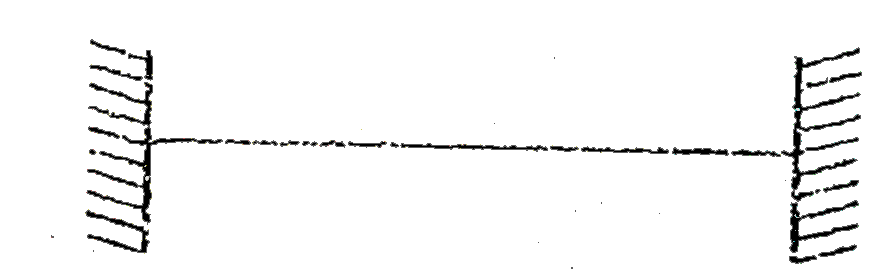

If temperature decreases,s tension in wire increases and `v` increases
`v_(1) = sqrt((F)/(mu))`
`F = muv_(1^(2))`
`DeltaF = YAalphaDeltaT`
`v_(2) = sqrt((F + DeltaF)/(mu)) = sqrt((F + YAalphaDeltaT)/(mu))`
`v_(2^(2)) = v_(1^(2)) + (YAalphaDeltaT)/((m//l)) = v_(2^(2)) - v_(1^(2))`
`(YalphaDeltaT)/(rho) = v_(2^(2)) - v_(1^(2))`
`alpha = (rho(v_(2^(2)) - v_(1^(2))))/(YDeltaT)`
Promotional Banner

Topper's Solved these Questions

  • WAVE ON STRING

    RESONANCE ENGLISH|Exercise Exercise- 3 PART II|7 Videos
  • WAVE ON STRING

    RESONANCE ENGLISH|Exercise Exercise- 2 PART IV|9 Videos
  • TRAVELLING WAVES

    RESONANCE ENGLISH|Exercise Exercise- 3 PART I|19 Videos
  • WAVE OPTICS

    RESONANCE ENGLISH|Exercise Advanced Level Problems|8 Videos

Similar Questions

Explore conceptually related problems

A metal wire with volume density rho and young's modulus Y is stretched between rigid supports. At temperature T , the speed of a transverse wave is found to be v_(1) . When temperature decreases T - DeltaT , the speed increases to v_(2) . Datermine coefficient of linear expansion of wire.

A metal wire of length L, area of cross-section A and young's modulus Y is stretched by a variable force F such that F is always slightly greater than the elastic forces of resistance in the wire. When the elongation of the wire is l

The speed of a transverse wave going on a wire having a length 50 cm and maas 5.0 g is 80ms^(-1) The area of cross section of the wire is 1.0mm.^2 and its Young modulus is 16 xx 10^(11) N m^(-2). Find the extension of the wire over its natural lenth.

Speed of transverse wave on a straight wire (mass m, length l , area of cross-section A) is. If the young’s modulus of wire is Y, the extension of wire over its natural length, is independent of

A metal rod has length L, radius of its cross-section r. Youngs modulus Y and thermal coefficient of linear expansion is α.It is clamped between two rigid supports with negligible tension. If its temperature is increased by T^@C , then force exerted by the rod on any of the supports is

A wire of uniform cross - section is suspended vertically from a fixed point , with a load attached at the lower end . Calculate the fractional change in frequency of the wire due to rise in temperature by t^(@) C . The coefficient of expansion of the wire is alpha .

A string of density 7.5 gcm^(-3) and area of cross - section 0.2mm^(2) is stretched under a tension of 20 N. When it is plucked at the mid-point, the speed of the transverse wave on the wire is

A metal wire of length L_1 and area of cross section A is attached to a rigid support. Another metal wire of length L_2 and of the same cross sectional area is attached to the free end of the first wire. A body of mass M is then suspended from the free end of the second wire, if Y_1 and Y_2 are the Young's moduli of the wires respectively the effective force constant of the system of two wires is

A metal wire of length L_1 and area of cross section A is ttached to a rigid support. Another metal wire of length L_2 and of the same cross sectional area is attached to the free end of the first wire. A body of mass M is then suspended from the free end of the second wire, if Y_1 and Y_2 are the Young's moduli of the wires respectively the effective force constant of the system of two wires is

Two wires of different densities but same area of cross-section are soldered together at one end and are stretched to a tension T . The velocity of a transverse wave in the first wire is double of that in the second wire. Find the ratio of density of the first wire to that of the second wire.

RESONANCE ENGLISH-WAVE ON STRING -Exercise- 3 PART I
  1. A transverse wave travelling in a string produce maximum transverse ve...

    Text Solution

    |

  2. A 20 cm long string, having a mass of 1.0 g, is fixed at both the ends...

    Text Solution

    |

  3. When two progressive waves y(1)=4sin(2x-6t)andy(2)=3sin(2x-6t-(pi)/(2)...

    Text Solution

    |

  4. A massless rod of length l is hung from the ceiling with the help of t...

    Text Solution

    |

  5. A transverse sinusoidal wave moves along a string in the positive x-di...

    Text Solution

    |

  6. A horizontal stretched string, fixed at two ends, is vibrating in its ...

    Text Solution

    |

  7. One end of a taut string of length 3 m along the x-axis is fixed at x ...

    Text Solution

    |

  8. A string is stretched betweeb fixed points separated by 75.0 cm. It ob...

    Text Solution

    |

  9. An aluminium wire and a steel wire of same cross-sectional of 10^(-2)c...

    Text Solution

    |

  10. An aluminium wire of cross-sectional area (10^-6)m^2 is joined to a st...

    Text Solution

    |

  11. The fundamental frequency of a wire of certain length is 400 Hz. When ...

    Text Solution

    |

  12. A metal wire with density ρ and Young's modulus Y is stretched between...

    Text Solution

    |

  13. Find velocity of wave is string A &B.

    Text Solution

    |

  14. A string of length 50 cm is vibrating with a fundamental frequency of ...

    Text Solution

    |

  15. A string fixed at both ends is vibrating in the lowest possible mode o...

    Text Solution

    |

  16. A guitar string is 90 cm long and has a fundamental frequency of 124 H...

    Text Solution

    |

  17. A piano wire weighing 6.00 g and having a length of 90.0 cm emits a fu...

    Text Solution

    |

  18. Length of a sonometer wire is 1.21 m. Find the length of the three seg...

    Text Solution

    |

  19. In the figure shown A and B are two ends of a string of length 100m. S...

    Text Solution

    |

