Home
Class 12
PHYSICS
Using formula of spherical surface or ot...

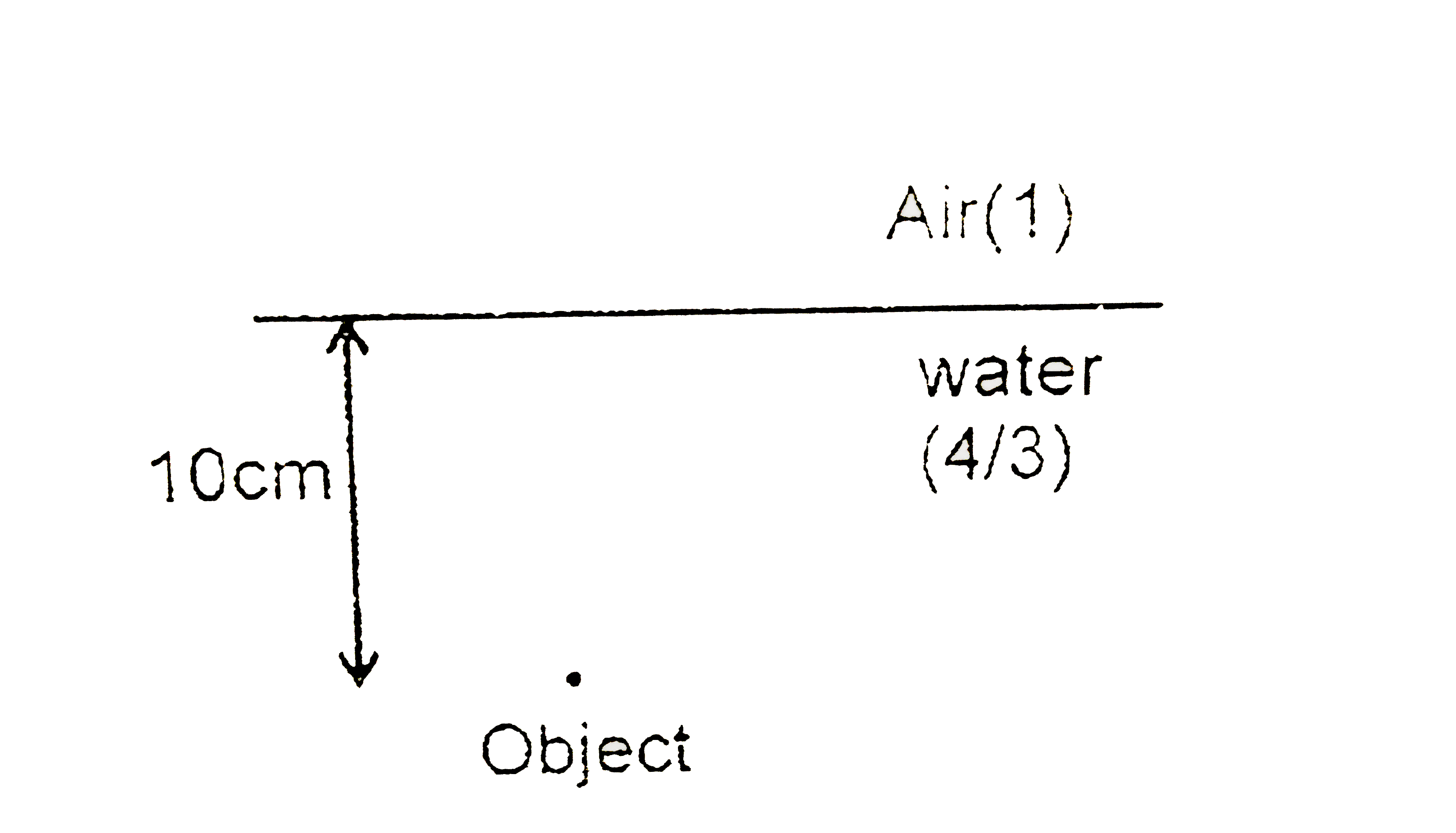
Using formula of spherical surface or otherwise, find the apparent depth of an object placed `10cm` below the water surface, if seen near normally form air.

Text Solution

Verified by Experts
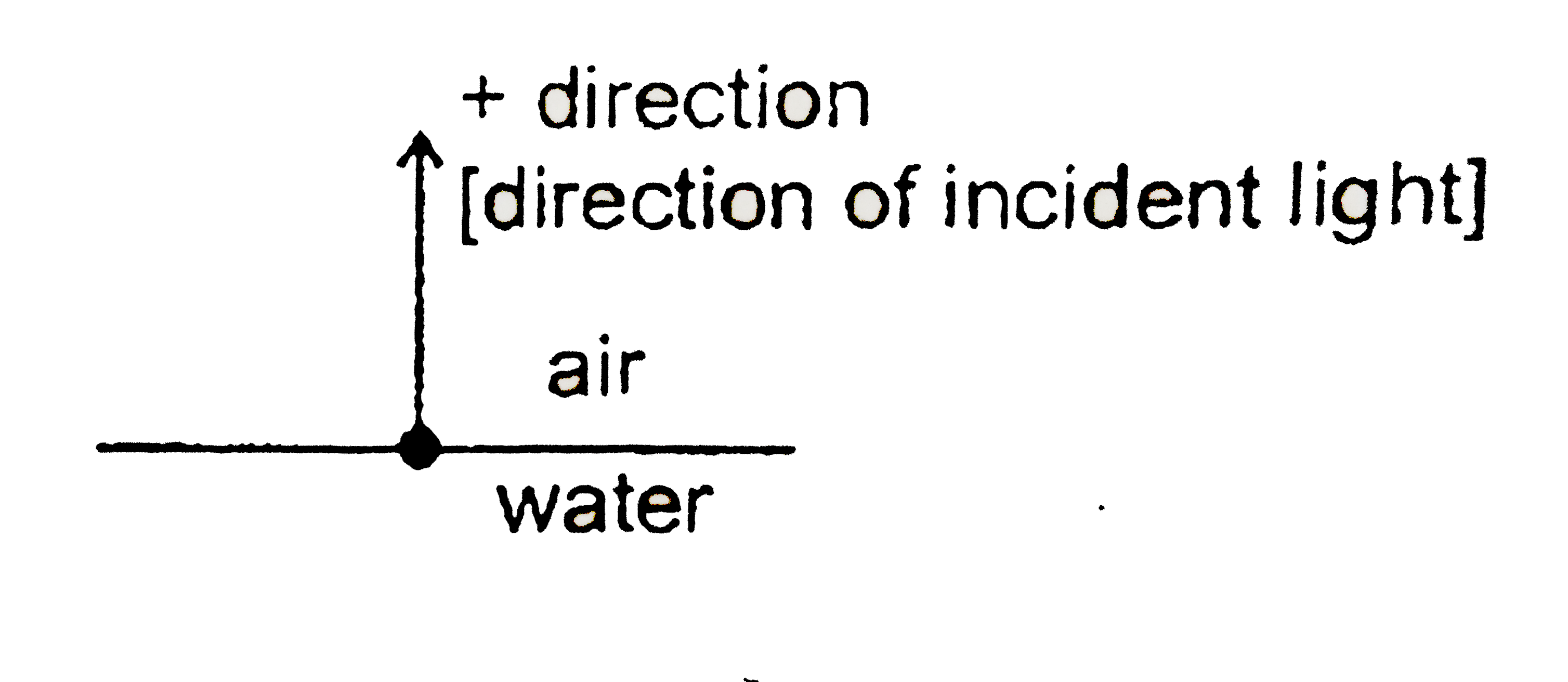
Put `R = oo` in the formula of the Refraction at Spherical Surfaces we get,
`v = (un_(2))/(n_(1))`
`u = -10cm`
`n_(1) = (4)/(3)`
`n_(2) = 1`
`v = (10xx1)/(4//3) = 7.5cm`

negative sign imples that the images is formed in water.
`d_(app) = (d_("real"))/(mu_("rel"))`
`= (10)/(4//3) = (30)/(4) = 7.5cm`
Promotional Banner

Topper's Solved these Questions

  • GEOMATRICAL OPTICS

    RESONANCE ENGLISH|Exercise Problem|33 Videos
  • GEOMATRICAL OPTICS

    RESONANCE ENGLISH|Exercise Exercise-1|141 Videos
  • EXPERIMENTAL PHYSICS

    RESONANCE ENGLISH|Exercise PART -II|10 Videos
  • GRAVITATION

    RESONANCE ENGLISH|Exercise HIGH LEVEL PROBLEMS|16 Videos

Similar Questions

Explore conceptually related problems

In Fig. , find the apparent depth of the object seen below surface AB.

Find the apparent depth of object O below surface AB , seen by an observer in mediumn of refractive index mu_(2)

In above question if observer is in medium mu_(3) what is the apparenet depth of object seen below surface 1CD .

A plano-convex lens has a maximum thickness of 6 cm. When placed on a horizontal table with the curved surface in contact with the table surface, then the apparent depth of the bottom most point of the lens is found to be 4 cm. If the lens is inverted such that the plane face of the lens is in contact with the surface of the table, then the apparent depth of the centre of the plane face is found to be 17/4 cm. The radius of curvature of the lens is

There is small air bubble inside a glass sphere (mu = 1.5) of radius 5 cm . The bubble is at 'O' at 7.5cm below the surface of the glass. The sphere is placed inside water (mu = (4)/(3)) such that the top surface of glass is 10cm below the surface of water. The bubble is viewed normally from air. Find the apperent depth of the bubble.

A spherical mirror is placed 10 cm below the level of water. A point oject is placed in air 30 cm above the water surface on the axis of the mirror such that two images seen by an observer above the water surface coincide. The images are formed by partial reflection at the water surface and due to emerging light after feflection from the mirror. Find the focal length of the mirror. (mu_("water")=(4)/(3))

A convex mirror is formed from a spherical surface of radius 20 cm. Find the power of the mirror.

A point source of light is placed inside water and a thin converging lens of focal length f is placed just outside the surface of water. The image of source is formed at a distance of 50 cm from the surface of water. When the lens is placed just inside the water surface the image is formed at a distance of 40 cm from the surface of water. if focal length of the lens in air is f=(100k)/8 cm, then find the value of k. (given refractive index of lens is 3/2 and that of water is 4/3 and in both cases image is formed inside water for the viewer in air).

A glass sphere (mu=1.5) of radius 20 cm has a small air bubble 4 cm below its centre. The sphere is viewed from outside and along a vertical line through the bubble. The apparent depth of the bubble below the surface of sphere is (in cm)

A small object is placed at the centre of the bottom of a cylindrical vessel of radius 3 cm and height 4 cm filled completely with water. Consider the ray leaving the vessel through a corner. Suppose this ray and the ray along the axis of the vessel are used to trace the image. Find the apparent depth of the image and the ratio of real depth to the apparent depth under the assumptions taken. Refractive index -of water = 1-33.

RESONANCE ENGLISH-GEOMATRICAL OPTICS -Advance level Problems
  1. Using formula of spherical surface or otherwise, find the apparent de...

    Text Solution

    |

  2. A U-shaped wire is placed before a concave having radius of curvature ...

    Text Solution

    |

  3. A paperweight in the form of a hemisphere of radius 3.0 cm is used to ...

    Text Solution

    |

  4. A hollow sphere of glass of refractive index mu has a small mark on it...

    Text Solution

    |

  5. Two media each of refractive index 1.5 with plane parallel boundaries ...

    Text Solution

    |

  6. Two converging lenses of the same focal length f are separated by a di...

    Text Solution

    |

  7. Two plane mirrors makes an angle of 120^(@) with each other. The dista...

    Text Solution

    |

  8. A kid of height 1.1 ft is sleeping straight between focus and centre o...

    Text Solution

    |

  9. The average size of an Indian face is 24xx16 cm^(2). Find the minimum ...

    Text Solution

    |

  10. As shown in Figure,. And object O is at the position (-10,2) with resp...

    Text Solution

    |

  11. A point sourcs S is moving with a speed of 10 m//s in x-y plane as sho...

    Text Solution

    |

  12. A man is standing at the edge of a 1m deep swimming pool, completely f...

    Text Solution

    |

  13. An object lies in front if a thick parallel glass slab, the bottom of ...

    Text Solution

    |

  14. A beam of parallel rays of diameter 'b' propagates in glass at an angl...

    Text Solution

    |

  15. A small ball is thrown from the edge of one bank of a river of width 1...

    Text Solution

    |

  16. Two concave mirrors each of focal length 'f' are placed infront of eac...

    Text Solution

    |

  17. An observer observer a fish moving upwards in a cylindrical container ...

    Text Solution

    |

  18. The figure shows the square face (of side 'a') of a transparent cuboid...

    Text Solution

    |

  19. An insect at point 'P' sees its two images in the water mirror system ...

    Text Solution

    |

  20. A ray of light is incident on a surface in a direction given by vector...

    Text Solution

    |

  21. If an observer sees the bottom of the vessel shown in Figure., at 8cm,...

    Text Solution

    |