Home
Class 12
PHYSICS
A ray of light travelling in air is inci...

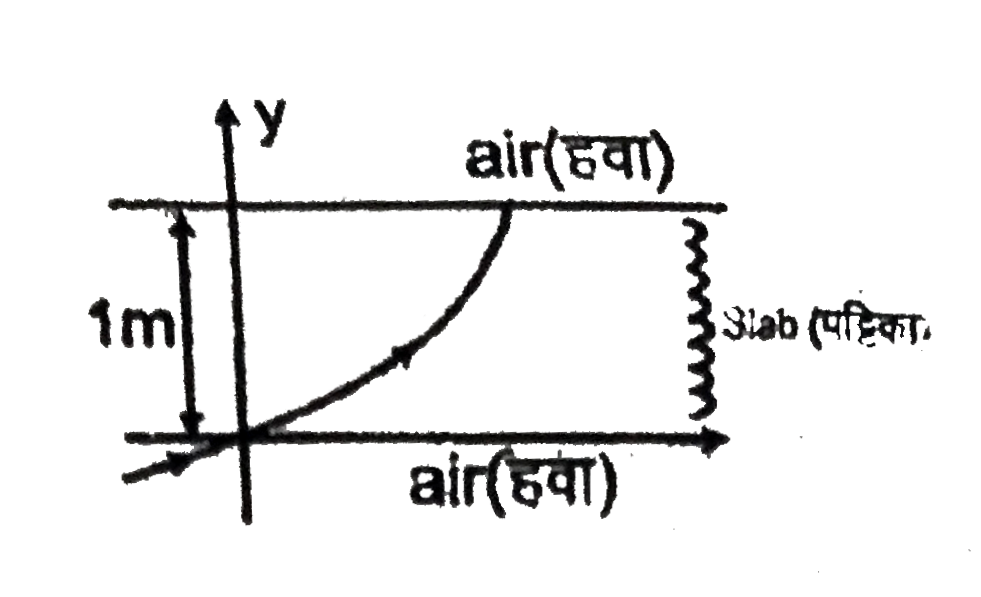
A ray of light travelling in air is incident at grazing incidence on a slab with variable refractive index, n `(y) = [ky^(3//2) + 1 ]^(1//2)` where `k=1 m^(-3//2)` and follows path as shown in the figure. What is the total deviation produced by slab when the ray comes out.

A

`60^(@)`

B

`53^(@)`

C

`sin^(-1)(4//9)`

D

no deviation at all

Text Solution

Verified by Experts

The correct Answer is:

D

As n varies `'y'` , parallel slabs can be taken , and we kown in parallel slabs `n_(r) sin i_(r)` = constant . As `n_(1)sini_(1)` `=1xxsin90^(@)=1` = constant
`n_("final")=n_(air)=1`
`implies 1=1xxsin r_("final" implies r_("final")=90^(@)`
:. Deviation is zero.
Promotional Banner

Topper's Solved these Questions

  • GEOMATRICAL OPTICS

    RESONANCE ENGLISH|Exercise Exercise-2|62 Videos
  • GEOMATRICAL OPTICS

    RESONANCE ENGLISH|Exercise Exercise-3|80 Videos
  • GEOMATRICAL OPTICS

    RESONANCE ENGLISH|Exercise Problem|33 Videos
  • EXPERIMENTAL PHYSICS

    RESONANCE ENGLISH|Exercise PART -II|10 Videos
  • GRAVITATION

    RESONANCE ENGLISH|Exercise HIGH LEVEL PROBLEMS|16 Videos

Similar Questions

Explore conceptually related problems

A ray of light travelling in air is inciden at angle of inciden 30^@ on one surface of slab in which refractive index varies with y. The light travels along the curve y =4x^(2) ( y and x are in meter) in the slab. Find out the refractive index of the slab at y=1//2m in the slab.

A ray of light travelling in air is incident at grazing angle (incident angle= 90^(@)) on a long rectangular slab of a transparent medium of thickness t=1.0 (see figure). The point of incidence is the origin A(O,O) .The medium has a variable index of refraction n(y) given by : n(y)=[ky^(3//2)+1]^(1//2) ,where k= 1.0m^(-3//2) .the refractive index of air is 1.0 (i) Obtain a relation between the slope of the trajectory of the ray at a point B(x,y) in the medium and the incident angle at that point (ii) obtain an equation for the trajectory y(x) of the ray in the medium. (ii) Determine the coordinates ( x_(1),y_(1)) of the point P .where the ray the ray intersects upper surface of the slab -air boundary. Indicate the path of the ray subsequently.

A ray of light travelling in air is incident at angle of incidence I~~90^(@) on a long rectangular slab of a transparent medium of thickness y_(0) . The medium has a variable refractive index of mu(x)=sqrt(1+ke^(2x//a),xge0 wher a is a positive constant

A ray of light suffers a minimum deviation when incident on equilateral prism of refractive index sqrt2 The angle of deviation is

There is a equilateral prism of refractive index 3 on which a light ray is incident normally on one face as shown in the figure. Find the length of the path traveled by the light ray inside the prism.

A light ray is incident on a glass sphere of reflective index mu = sqrt3 at an angle of incidence 60^(@) as shown in Fig. Find the angles r, r^(') e and the total deviation after two refractions.

Two parts of long cylinder having refractive index sqrt(3) and (3)/(2) are arranged as shown in figure. When a light ray is incident an one plane surface as shown, total deviation produced in the path of light ray is (pi)/(3x)rad . Then calculate x . .

When a ray of light is incident normally on one refracting surface of an equilateral prism (Refractive index of the material of the prism =1.5

When a ray of light is incident normally on one refracting surface of an equilateral prism (Refractive index of the material of the prism =1.5 )

A long rectangular slab of transparent medium of thickness d placed on a table with its length parallel to the x-axis and width parallel to the axis. A ray of light travelling inair makes a near normal incidence on the slab as shown. Taking the point of incidence as orign (0,0,0). The refraction index mu of the medium varies as mu=(mu_(0))/(1-(x/r) where mu_(1) and r(gtd) are constants. The refractive index of air is mu_(0) The x-coordinate of the point A where the ray intersects the upper surface of the slab air boundary is

RESONANCE ENGLISH-GEOMATRICAL OPTICS -Exercise-1
  1. A ray of light passes from vaccum into a medium of refractive index n....

    Text Solution

    |

  2. A ray of light is incident on a parallel slab of thickness t and refra...

    Text Solution

    |

  3. A ray of light travelling in air is incident at grazing incidence on a...

    Text Solution

    |

  4. A beam of light is converging towards a point. A plane parallel plate ...

    Text Solution

    |

  5. Given that, velocity of light in quartz =1.5xx10^(8)m//s and velocity ...

    Text Solution

    |

  6. The critical angle of light from medium A to medium B is theta. The sp...

    Text Solution

    |

  7. A ray of monochromatic light is incident on one refracting face of a p...

    Text Solution

    |

  8. A prism having refractive index sqrt2 and refractive angle 30^@ has on...

    Text Solution

    |

  9. A ray of light is incident at angle I on a surface of a prism of small...

    Text Solution

    |

  10. A prism of refractive index sqrt2 has refractive angle 60^@. In the or...

    Text Solution

    |

  11. A prism of refractive index sqrt2 has refractive angle 60^@. In the or...

    Text Solution

    |

  12. A prism of refractive index sqrt2 has refractive angle 60^@. In the or...

    Text Solution

    |

  13. The maximum refractive index of a material, of a prism of apex 90^(@) ...

    Text Solution

    |

  14. A prism having an apex angle 4^(@) and refraction index 1.5 is located...

    Text Solution

    |

  15. There is a small black dot at the centre C of a solid glass sphere of ...

    Text Solution

    |

  16. The image for the converging beam after refraction through the curved ...

    Text Solution

    |

  17. A plano-concave lens is placed on a paper on which a flower is drawn. ...

    Text Solution

    |

  18. A beam of diameter 'd' is incident on a glass hemisphere as shown. If ...

    Text Solution

    |

  19. A convexo-concave convergent lens is made of glass of refractive index...

    Text Solution

    |

  20. Two symmetric double convex lenses A and B have same focal length but ...

    Text Solution

    |
