Home
Class 12
PHYSICS
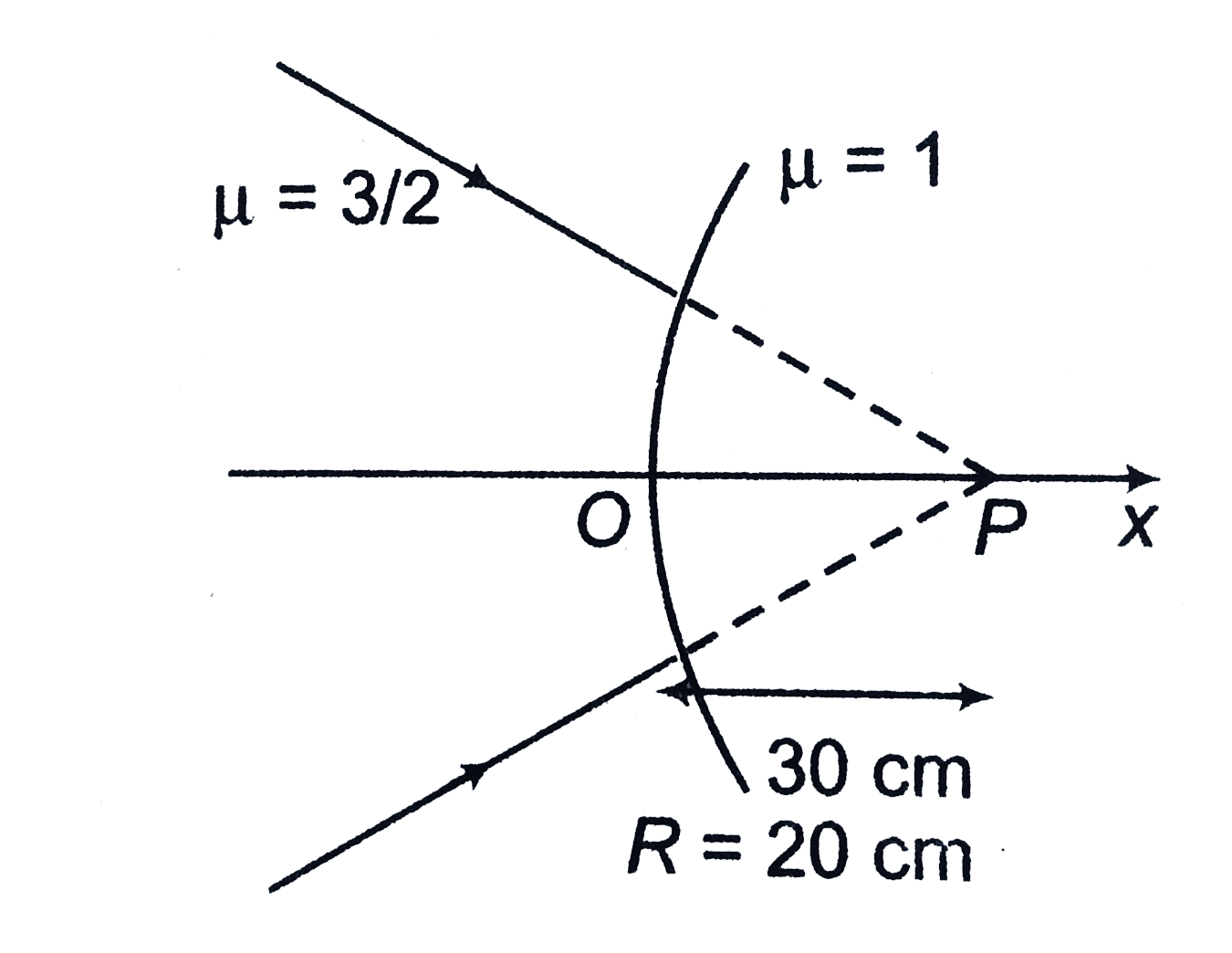
The image for the converging beam after ...

The image for the converging beam after refraction through the curved surface is formed at

A

`x=40 cm`

B

`x=(40)/(3)cm`

C

`x=-(40)/(3)cm`

D

`x=(180)/(7) cm`

Text Solution

Verified by Experts

The correct Answer is:

D

`(1)/(v)-(3)/(2xx30)=(1-(3)/(2))/(+20) (1)/(v)=-(1)/(40)+(1)/(20)=+(1)/(40) v=40 cm` .
Promotional Banner

Topper's Solved these Questions

  • GEOMATRICAL OPTICS

    RESONANCE ENGLISH|Exercise Exercise-2|62 Videos
  • GEOMATRICAL OPTICS

    RESONANCE ENGLISH|Exercise Exercise-3|80 Videos
  • GEOMATRICAL OPTICS

    RESONANCE ENGLISH|Exercise Problem|33 Videos
  • EXPERIMENTAL PHYSICS

    RESONANCE ENGLISH|Exercise PART -II|10 Videos
  • GRAVITATION

    RESONANCE ENGLISH|Exercise HIGH LEVEL PROBLEMS|16 Videos

Similar Questions

Explore conceptually related problems

Figure shows a transparent hemisphere of radius 3.0 cm made of a material of refractive index 2.0. (a) A narrow beam of parallel rays is incident on the hemisphere as shown in the figure. Are the rays totally reflected at the plane surface ? (b) Find the image formed by the refraction at the first surface. (c) Find the image formed by the reflection or by the refraction at the plane surface. (d) Trace qualitatively the final rays as they come out of the hemisphere.

An extended object of size 2cm is placed at a distance of 10cm in air (n = 1) form pole, on the other side of refracting surface has refractive index n = 2 . Find the positon, nature and size of image formed after single refraction through the curved surface.

A block is released from rest from a height h=5m . After travelling through the smooth curved surface it moves on the rough horizontal surface through a length 1=8m and climbs onto the other smooth curved surface through a height h^' . If mu=0.5 , find h^' .

A ray of light incident on one of the face of a prism as shown. After refraction through this surface ray is incident on base of the prism. The refractive index of the prism is sqrt(3) . The net deviation of the ray due to prism is

If final image after two refractions through the lens and one reflection from the mirror forms at the same point O. Refrative index of the material of the lens mu=3//2 . Then find d.

Plane surface of a thin planoconvex lens reflects 50% of light, while the curved surface is completely transparent, if final image of O after refraction through lens coinsides with the image formed due to partial reflection from plane surface. if distance (in m) between O and lens is x then find x//4

A parallel beam falls on solid glass sphere of radius R and refractive index mu . What is the distance of final image after refractioin from two surfaces of sphere? What is the condition for the image to be real?

A point object lies 30 cm above water on the axis of a convex mirror of focal length 40 cm lying 20 cm below water surface. Consider two images. (i) Image formed by the partial reflection from water surface. (ii) Image formed by refraction from water surface followed by reflection from mirror and again refraction out of the water surface. find the distance between these two images.

The refractive index of the material of a prism is sqrt(2) and the angle of the prism is 30^(@) . One of the two refracting surfaces of the prism is made a mirror inwards, by silver coating. A beam of monochromatic light entering the prism from the other face will retrace its path (after reflection from the silvered surface) if its angle of incidence on the prism is

At what distance eye E will observe the fourth image (after four refractions from plane surfaces) of object O from itself.

RESONANCE ENGLISH-GEOMATRICAL OPTICS -Exercise-1
  1. A prism having an apex angle 4^(@) and refraction index 1.5 is located...

    Text Solution

    |

  2. There is a small black dot at the centre C of a solid glass sphere of ...

    Text Solution

    |

  3. The image for the converging beam after refraction through the curved ...

    Text Solution

    |

  4. A plano-concave lens is placed on a paper on which a flower is drawn. ...

    Text Solution

    |

  5. A beam of diameter 'd' is incident on a glass hemisphere as shown. If ...

    Text Solution

    |

  6. A convexo-concave convergent lens is made of glass of refractive index...

    Text Solution

    |

  7. Two symmetric double convex lenses A and B have same focal length but ...

    Text Solution

    |

  8. When a lens of power P (in air) made of material of refractive index m...

    Text Solution

    |

  9. A lens behaves as a converging lens in air and a diverging lens in wat...

    Text Solution

    |

  10. The sun subtends an angle of (1//2)^(@) on earth. The image of sun is ...

    Text Solution

    |

  11. A lens having focal length f and aperture of diameter d forms an image...

    Text Solution

    |

  12. A thin symmetrical double convex lens of power P is cut into three par...

    Text Solution

    |

  13. In the figure shown, there are two convex lenses L(1) and L(2) having ...

    Text Solution

    |

  14. An object is placed at a distance u from a concave mirror and its real...

    Text Solution

    |

  15. A real inverted image in a concave mirror represented by graph (u, v, ...

    Text Solution

    |

  16. What should be the value of distance d so that final image is formed o...

    Text Solution

    |

  17. An object is kept on the principal axis of a concave mirror of focal l...

    Text Solution

    |

  18. A biconvex lens is used to project a slide on screen. The slide is 2 c...

    Text Solution

    |

  19. The minimum distance between a real object and its real image formed b...

    Text Solution

    |

  20. Two planoconvex lenses each of the focal length of10cm&refractive inde...

    Text Solution

    |
