Home
Class 12
PHYSICS
In the shown figure M(1) and M(2) are tw...

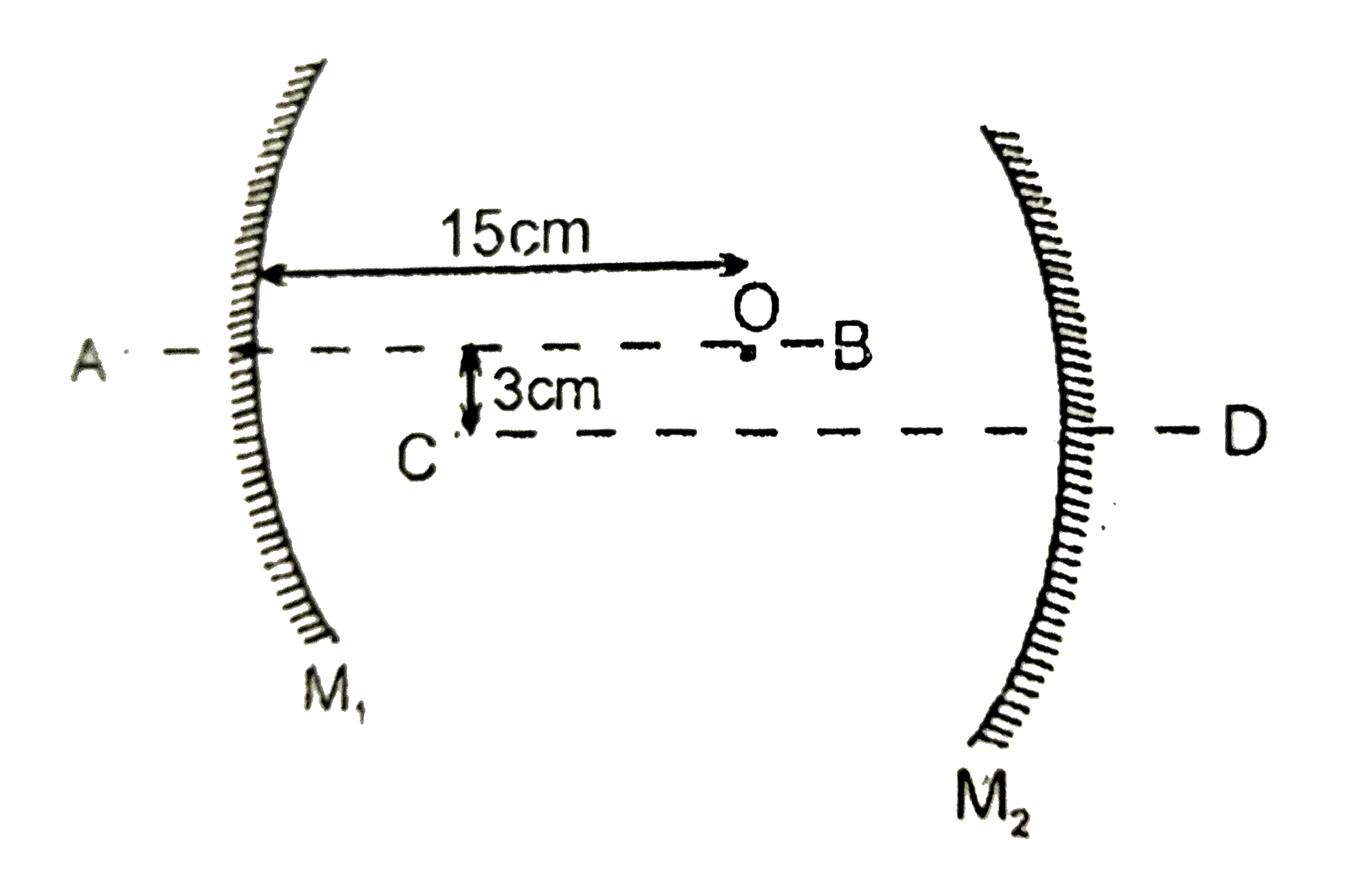
In the shown figure `M_(1)` and `M_(2)` are two concave mirrors of the same focal length `10 cm` . `AB` and `CD` are their pricipal axes respectively. `A` point object `O` is kept on the line `AB` at a distance `15 cm` from `M_(1)` . The distance between the mirror is `20 cm` . Considering two successive reflections first on `M_(1)` and then on `M_(2)` . The distance of final image from the line `AB` is:

A

`3 cm`

B

`1.5 cm`

C

`4.5 cm`

D

`1 cm`

Text Solution

Verified by Experts

The correct Answer is:

B

For `M_(1)`
`v=(uf)/(u-f) =(-15xx(-10))/(-15-(-10))=-30 cm`
For `M_(2) u=10 cm`
`therefore v=(10xx(-10))/(10-(-10))=-5 cm`
magnification `m=(-v)/(u)=-((-5)/(10))=(1)/(2)`
so, distance of image from `CD=(1)/(2)xx3=(3)/(2) cm`
`therefore` distance of image from `AB=3-(3)/(2)=(3)/(2) cm`
Promotional Banner

Topper's Solved these Questions

  • GEOMATRICAL OPTICS

    RESONANCE ENGLISH|Exercise Exercise-3|80 Videos
  • GEOMATRICAL OPTICS

    RESONANCE ENGLISH|Exercise Advance level Problems|35 Videos
  • GEOMATRICAL OPTICS

    RESONANCE ENGLISH|Exercise Exercise-1|141 Videos
  • EXPERIMENTAL PHYSICS

    RESONANCE ENGLISH|Exercise PART -II|10 Videos
  • GRAVITATION

    RESONANCE ENGLISH|Exercise HIGH LEVEL PROBLEMS|16 Videos

Similar Questions

Explore conceptually related problems

In the figure shown M_(1) and M_(2) are two spherical mirrors of focal length 20 cm each. AB and CD are their principal axes respectively which are separated by 1 cm. PQ is an object of height 2 cm and kept at distance 20 cm from M_(1) . The separation between the mirrors is 50 cm Consider two successive reflections first on M_(1) then on M_(2) . Find the size of the 2^(nd) image. Also find distances of and points P'' and Q'' of that image from the line AB . .

An object is kept on the principal axis of a concave mirror of focal length 10cm, at a distance of 15 cm from its pole. The image formed by the mirror is:

Two concave mirrors each of radius of curvature 40cm are placed such that their principla axes are parallel to each other and at a distance of 1cm to each other. Both the mirrors are at a distance of 100cm to each other. Consider first reflection at M_(1) and then at M_(2) , find the coordinates of teh image thus formed. Take location of object as the origin

An object is placed on the principle axis of a concave mirror of focal length 10cm at a distance of 21cm from it. A glass slab is placed between the mirror and the object as shown in figure. Find the distance of final image formed by the mirror.

An object is present on the principal axis of a concave mirror at a distance 30cm from it. Focal length of mirror is 20cm. Q. Image formed by mirror is

The focal length of a convex mirror is 40 cm. A point source of light is kept at distance 40 cm from the mirror. Find the distance of image from the mirror.

The focus of a parabolic mirror as shown in figure is at a distance of 5 cm from its vertex. If the mirror is 45 cm deep, find the distance AB

Radius of curvature of each mirror is R. 'O' is object. Consider first reflection from concave mirror. Consider only first three reflection. The distance of final image from convex mirror is

Two plane mirrors are placed parallel to each other. The distance between the mirrors is 10cm. An object is placed between the mirrors at a distance of 4cm from one of them, say M_(1) . What is the distance between the first time formed at M_(1) and the second image formed at M_(2) ?

A concave mirror has a focal length 20 cm. The distance between the two positions of the object for which the image size is double of the object size is

RESONANCE ENGLISH-GEOMATRICAL OPTICS -Exercise-2
  1. The distance between an object and its doubly magnified image by a con...

    Text Solution

    |

  2. In the figureshownm the image of a real object is formed at point I. A...

    Text Solution

    |

  3. In the shown figure M(1) and M(2) are two concave mirrors of the same ...

    Text Solution

    |

  4. In the given figure a parallel beam of ligth is incident on the upper ...

    Text Solution

    |

  5. In an isosceles prism of angle 45^@, it is found that when the angle o...

    Text Solution

    |

  6. In the figure shown the radius of curvature of the left & right surfac...

    Text Solution

    |

  7. STATEMENT -1: A white parallel beam of light is incident on a plane gl...

    Text Solution

    |

  8. A fluorescent lamp of length 1m is placed horizontally at a depth of 1...

    Text Solution

    |

  9. A plane mirror 50 cm long, is hung on a vetical wall of a room, with i...

    Text Solution

    |

  10. A light ray I is incident on a plane mirror M. The mirror is rotated i...

    Text Solution

    |

  11. A buring candle is placed in front of a concave spherical mirror on it...

    Text Solution

    |

  12. A concave mirror forms real image of a point source lying on the optic...

    Text Solution

    |

  13. A concave mirror of focal length 10cm and a convex mirror of focal len...

    Text Solution

    |

  14. The x-y plane is the boundary between two transparent media. Medium-1 ...

    Text Solution

    |

  15. (a) In the figure shown a slab of refractive index (3)/(2) is moved to...

    Text Solution

    |

  16. Mirror in the arrangement shown in figure is moving up with speed 8 cm...

    Text Solution

    |

  17. A point object is placed on principal axis of a concave mirror of radi...

    Text Solution

    |

  18. Light is incident from glass to are. The variation of the angle of dev...

    Text Solution

    |

  19. A hemispherical portion of the surface of a solid glass sphere (mu = 1...

    Text Solution

    |

  20. In the figure, a point object O is placed in air. A spherical boundry ...

    Text Solution

    |
