Home
Class 12
PHYSICS
Mirror in the arrangement shown in figur...

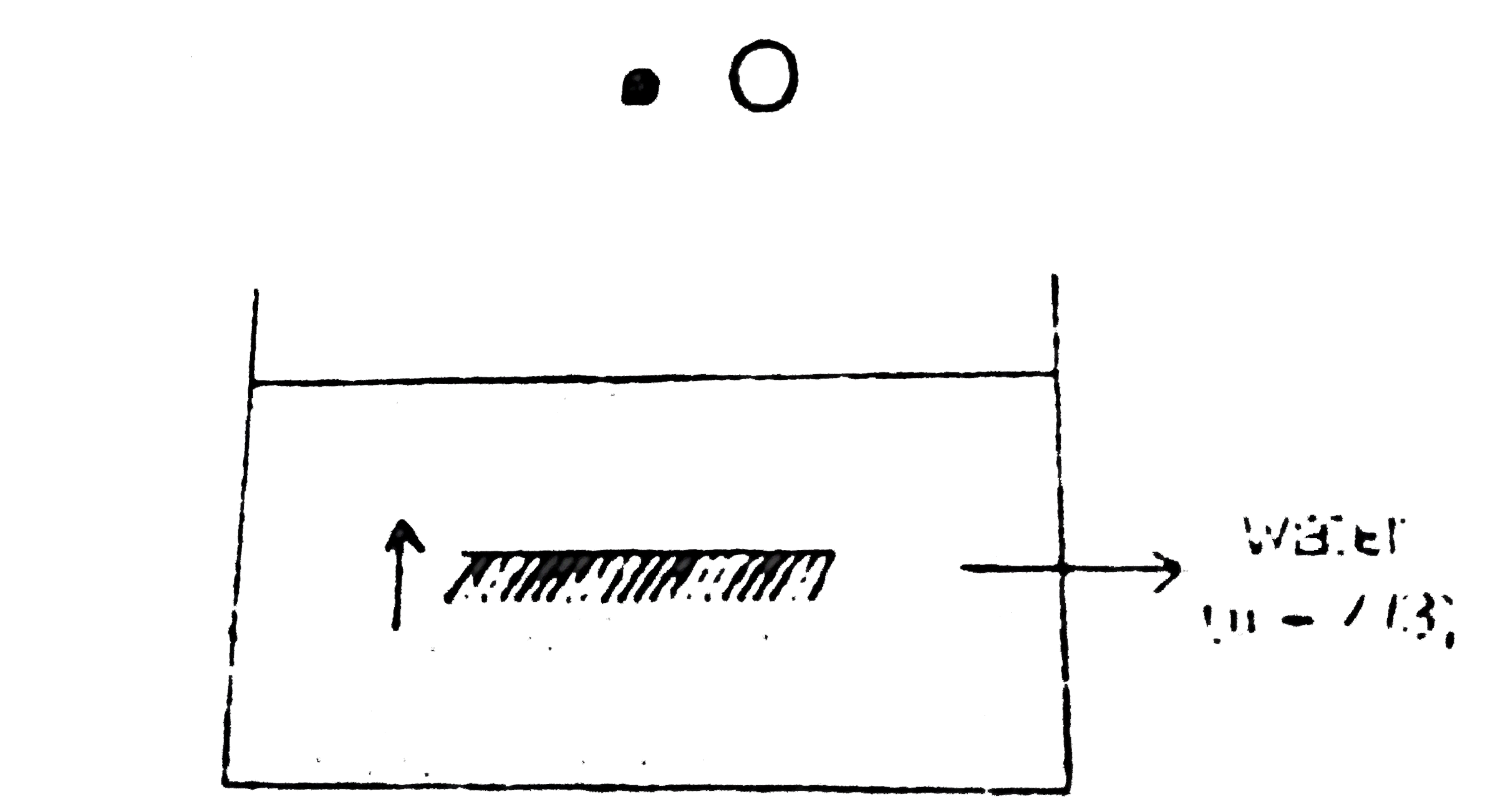
Mirror in the arrangement shown in figure is moving up with speed `8 cm//sec`. There is an object `O` outside water. Speed of final image formed after two refraction and one refraction and the reflection is :
.

Text Solution

Verified by Experts

The correct Answer is:

6

N//a
Promotional Banner

Topper's Solved these Questions

  • GEOMATRICAL OPTICS

    RESONANCE ENGLISH|Exercise Exercise-3|80 Videos
  • GEOMATRICAL OPTICS

    RESONANCE ENGLISH|Exercise Advance level Problems|35 Videos
  • GEOMATRICAL OPTICS

    RESONANCE ENGLISH|Exercise Exercise-1|141 Videos
  • EXPERIMENTAL PHYSICS

    RESONANCE ENGLISH|Exercise PART -II|10 Videos
  • GRAVITATION

    RESONANCE ENGLISH|Exercise HIGH LEVEL PROBLEMS|16 Videos

Similar Questions

Explore conceptually related problems

An insect at point 'P' sees its two images in the water mirror system as shown in the figure. One image is formed due to direct partical reflection from water surface and the other image is formed due to refraction, reflection & again refraction by water mirror system in order. Find the separation (in cm) between the two images. Mirror M has focal length 60 cm [Take mu_(w)=4//3]

All objects referred to the subsequent problems lie on the principal axis. In above question if the object is real, then the final image formed after two refractions :

In the figure shown , a point object O is placed in air on the principal axis. The radius of curvature of the spherical surfaces is 60 cm. I is the final image formed after all reflections and refractions.

A plane mirror and a concave mirror are arranged as shown in figure and O is a point object, Find the position of image formed by two reflection, first one talking place at concave mirror.

Figure shows a transparent hemisphere of radius 3.0 cm made of a material of refractive index 2.0. (a) A narrow beam of parallel rays is incident on the hemisphere as shown in the figure. Are the rays totally reflected at the plane surface ? (b) Find the image formed by the refraction at the first surface. (c) Find the image formed by the reflection or by the refraction at the plane surface. (d) Trace qualitatively the final rays as they come out of the hemisphere.

Two plane mirrors intersect at origin. An object 'O' is kept at a distance R on negative y-axis as shown in the figure. The co-ordinates of images formed after three reflections will be (first reflection is is considered at m_(1) )

An object is placed at a distance of 40 cm from a convex lens of focal length 20cm. On the far side of the lens, a concave mirror of focal length 10cm is placed such that the distance of the object from the concave mirror is 100 cm. Then the final image which is formed after refraction from the lens, reflection from the mirror and again refraction from the lens, will be

Two concave mirrors are places 40cm apart and are facing each other. A point object lies between them at a distance of 12cm from the mirror of focal length 10cm. The other mirror has a focal length of 15cm. Find the location of final image formed after two reflections - first at the mirror nearer to the object and second at the other mirror.

For the situations shown in figure, determine the angle by which the mirror should be rotated, so that the light ray will retrace its path after refraction through the prism and reflection from the mirror?

An object is placed 10cm away form a glass piece (n = 1.5) of length 20cm bounded by spherical surfaces of radii of curvaure 10cm . Find the position of final image formed after two refractions at the spherical surfaces.

RESONANCE ENGLISH-GEOMATRICAL OPTICS -Exercise-2
  1. The x-y plane is the boundary between two transparent media. Medium-1 ...

    Text Solution

    |

  2. (a) In the figure shown a slab of refractive index (3)/(2) is moved to...

    Text Solution

    |

  3. Mirror in the arrangement shown in figure is moving up with speed 8 cm...

    Text Solution

    |

  4. A point object is placed on principal axis of a concave mirror of radi...

    Text Solution

    |

  5. Light is incident from glass to are. The variation of the angle of dev...

    Text Solution

    |

  6. A hemispherical portion of the surface of a solid glass sphere (mu = 1...

    Text Solution

    |

  7. In the figure, a point object O is placed in air. A spherical boundry ...

    Text Solution

    |

  8. A glass hemispher of refractive index 4//3 and of radius 4 cm is place...

    Text Solution

    |

  9. A converging lens of focal length 15 cm and a converging mirror of foc...

    Text Solution

    |

  10. An object of height h(0)=1 cm is moved along principal axis of a conve...

    Text Solution

    |

  11. Object O is kept in air in fron of a thin plano convex lens of radius ...

    Text Solution

    |

  12. A symmetrical converging convex lens of focal length 10 cm & diverging...

    Text Solution

    |

  13. An object O is kept in air and a lens of focal length 10 cm (in air) i...

    Text Solution

    |

  14. A stationary observer O looking at a fish (in water of mu=4//3 ) throu...

    Text Solution

    |

  15. The dispersive power of the material of a lens is 0.04 and the focal l...

    Text Solution

    |

  16. The image formed by a concave mirror is twice the size of the object. ...

    Text Solution

    |

  17. Which of the following statements are incorrect for spherical mirror.

    Text Solution

    |

  18. A ray of monochromatic light is incident on the plane surface of separ...

    Text Solution

    |

  19. For refractin of light through a prism

    Text Solution

    |

  20. An equilateral prism deviates a ray through 45^(@) for the two angles ...

    Text Solution

    |
