Home
Class 12
PHYSICS
In the figure, a point object O is place...

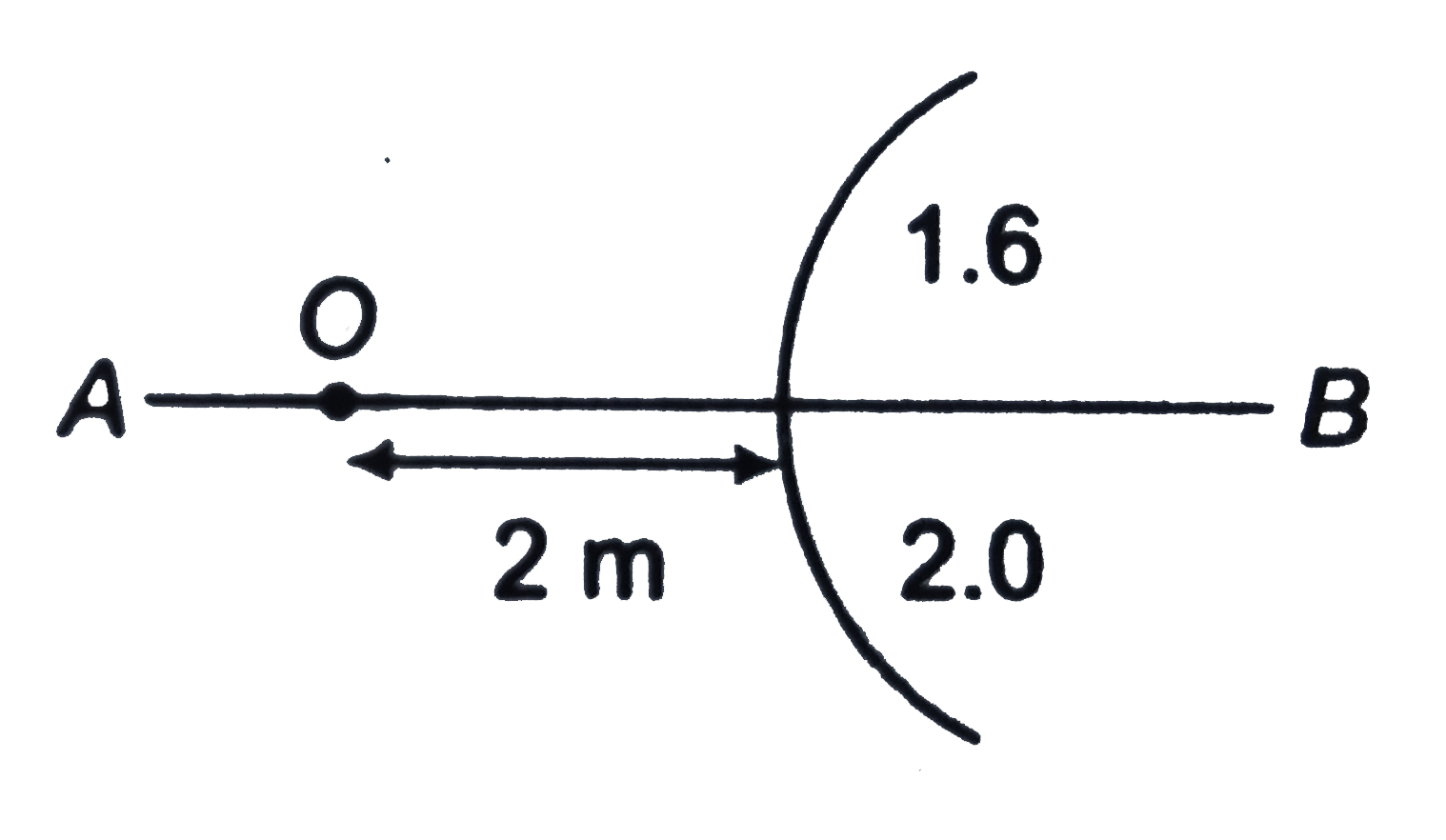
In the figure, a point object O is placed in air. A spherical boundry separates two media of radius of curvature `1.0 m.` AB is principal axis. The separation between the images formed due to refraction at spherical surface is

Text Solution

Verified by Experts

The correct Answer is:

12

N//a
Promotional Banner

Topper's Solved these Questions

  • GEOMATRICAL OPTICS

    RESONANCE ENGLISH|Exercise Exercise-3|80 Videos
  • GEOMATRICAL OPTICS

    RESONANCE ENGLISH|Exercise Advance level Problems|35 Videos
  • GEOMATRICAL OPTICS

    RESONANCE ENGLISH|Exercise Exercise-1|141 Videos
  • EXPERIMENTAL PHYSICS

    RESONANCE ENGLISH|Exercise PART -II|10 Videos
  • GRAVITATION

    RESONANCE ENGLISH|Exercise HIGH LEVEL PROBLEMS|16 Videos

Similar Questions

Explore conceptually related problems

In Figure, a point object O is placed in air. A spherical boundary separates two media. Ab is the principall axis. The refractive index above AB is 1.6 and below AB is 2.0. The separation between the images formed due to refraction at a the spherical surface is (assume the radius of curvature (R) to be 1 unit)

In the figure shown , a point object O is placed in air on the principal axis. The radius of curvature of the spherical surfaces is 60 cm. I is the final image formed after all reflections and refractions.

An object is placed 10cm away form a glass piece (n = 1.5) of length 20cm bounded by spherical surfaces of radii of curvaure 10cm . Find the position of final image formed after two refractions at the spherical surfaces.

A poinit object O is placed in front of a glass rod having spherical end of radius of curvature 30cm . The image would be formed at

A poinit object O is placed in front of a glass rod having spherical end of radius of curvature 30cm . The image would be formed at

Trace the rays of light showing the formation of an image due to a point object placed on the axis of a spherical surface separating the two media of refractive indices n_(1) and n_(2) . Establish the relation between the distance of the object, the image and the radius of curvature from the central point of the spherical surface. Hence derive the expression of the lens maker's formula

An object 5 cm tall is placed 1 m from a concave spherical mirror which has a radius of curvature of 20 cm. The size of the image is

An object 5 cm tall is placed 1 m from a concave spherical mirror which has a radius of curvature of 20 cm. The size of the image is

(a) A point object, O is on the principle axis of a spherical surface having a radius of curvature, R. Draw a diagram to obtain the relation between the object and image distances, the refractive indicess of the media and the radius of curvature of the spherical surface.

Figure below shows a parallel beam of monochromatic light incident on a convex spherical surface, radius of curvature R = 30 cm, which separates glass (refractive index - 1 6) from air. Find the position of the image formed due to refraction of light at this single spherical surface.

RESONANCE ENGLISH-GEOMATRICAL OPTICS -Exercise-2
  1. Light is incident from glass to are. The variation of the angle of dev...

    Text Solution

    |

  2. A hemispherical portion of the surface of a solid glass sphere (mu = 1...

    Text Solution

    |

  3. In the figure, a point object O is placed in air. A spherical boundry ...

    Text Solution

    |

  4. A glass hemispher of refractive index 4//3 and of radius 4 cm is place...

    Text Solution

    |

  5. A converging lens of focal length 15 cm and a converging mirror of foc...

    Text Solution

    |

  6. An object of height h(0)=1 cm is moved along principal axis of a conve...

    Text Solution

    |

  7. Object O is kept in air in fron of a thin plano convex lens of radius ...

    Text Solution

    |

  8. A symmetrical converging convex lens of focal length 10 cm & diverging...

    Text Solution

    |

  9. An object O is kept in air and a lens of focal length 10 cm (in air) i...

    Text Solution

    |

  10. A stationary observer O looking at a fish (in water of mu=4//3 ) throu...

    Text Solution

    |

  11. The dispersive power of the material of a lens is 0.04 and the focal l...

    Text Solution

    |

  12. The image formed by a concave mirror is twice the size of the object. ...

    Text Solution

    |

  13. Which of the following statements are incorrect for spherical mirror.

    Text Solution

    |

  14. A ray of monochromatic light is incident on the plane surface of separ...

    Text Solution

    |

  15. For refractin of light through a prism

    Text Solution

    |

  16. An equilateral prism deviates a ray through 45^(@) for the two angles ...

    Text Solution

    |

  17. Two refracting media are separated by a spherical interfaces as shown ...

    Text Solution

    |

  18. The values of d(1) & d(2) for final rays to be parallel to the princip...

    Text Solution

    |

  19. An object O is kept infront of a converging lens of focal length 30 cm...

    Text Solution

    |

  20. If a symmetrical bi-concave thin lens is cut into two identical halves...

    Text Solution

    |
