Home
Class 12
PHYSICS
A stationary observer O looking at a fis...

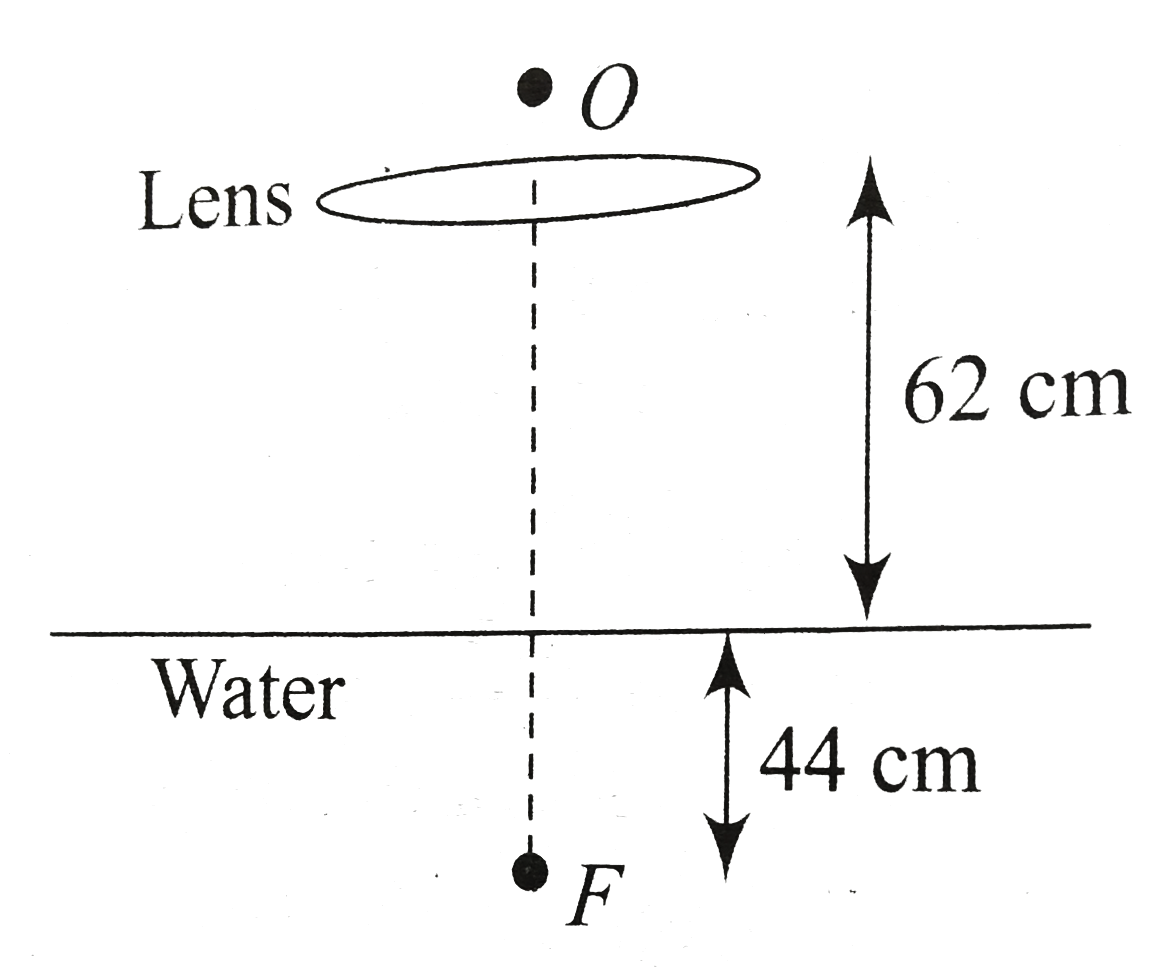
A stationary observer O looking at a fish (in water of `mu=4//3` ) through a converging lens of focal length `90.0cm. ` the lens is allowed to falll freely from a height of `62.0cm` with its axis vertical. The fish and the observer are on the principal axis of the lens. The fish moves up with constant velocity `100cm s^(-1)` . Initially, it was at a depth of `44.00cm. ` Finally the velocity with which the fish appears to move to the observer at `t=0.2sec. `

Text Solution

Verified by Experts

The correct Answer is:
22

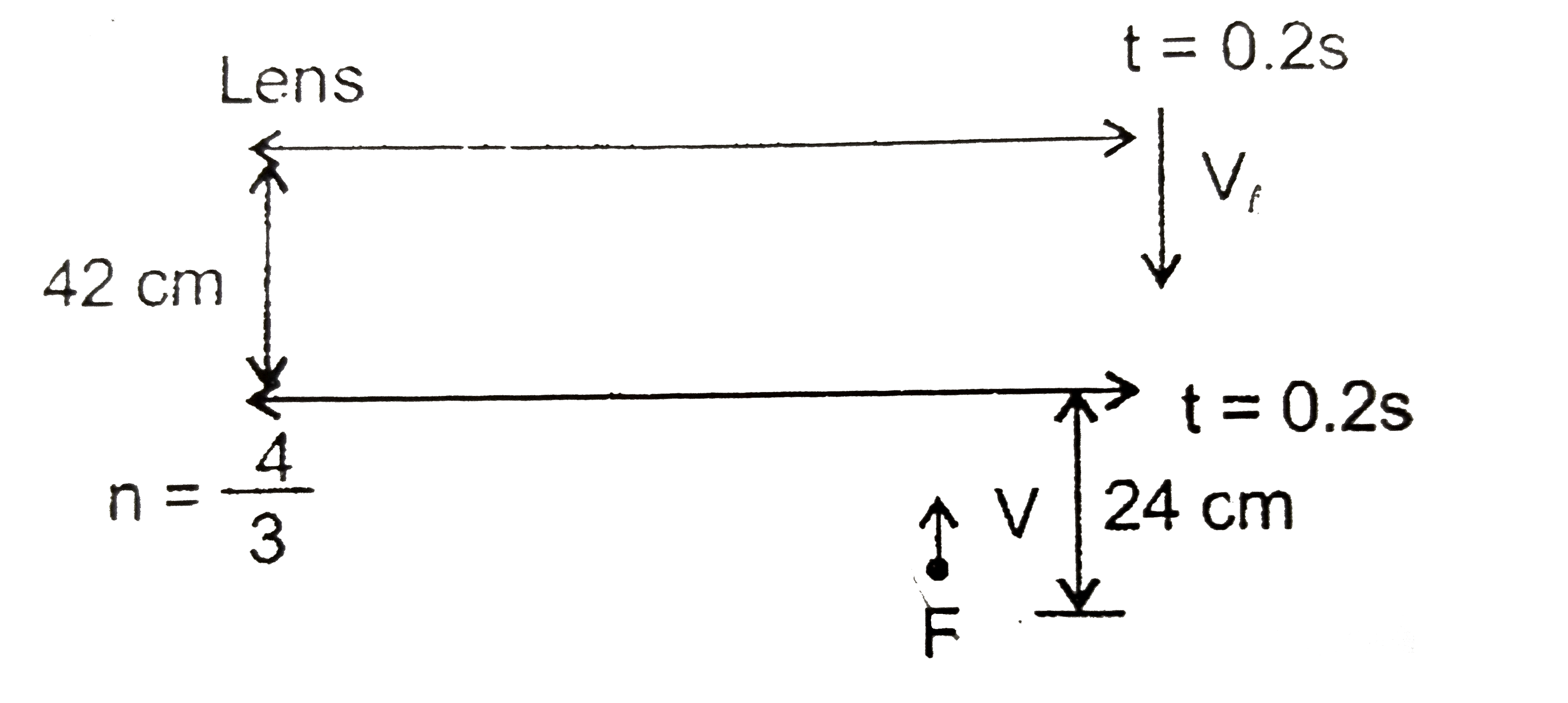
At `t=0.2 sec` , velocity of lens
`V_(l)=gt=2m//s` (downwards)
`therefore` For lens the fish appears to approach with a speed of `2+(1xx(3)/(4))=(11)/(4)m//s`
at a distance of `(42+(24)/((4/3)))=60 cm `

`therefore` distance of image from lens, `V=(-60xx90)/(-60+90)=-180 cm` .
`therefore` Velocity of image `w.r.t` . lens `V_(i)=(v^(2)/(u^(2)))(du)/(dt)=((-180)/(-60))^(2)xx(11)/(4)=(99)/(4)m//s`
velocity of image `w.r.t`. observer `=V_(i)-2=(99)/(4)-2(91)/(4)m//s=22.75 m//s` (upwards)
Promotional Banner

Topper's Solved these Questions

  • GEOMATRICAL OPTICS

    RESONANCE ENGLISH|Exercise Exercise-3|80 Videos
  • GEOMATRICAL OPTICS

    RESONANCE ENGLISH|Exercise Advance level Problems|35 Videos
  • GEOMATRICAL OPTICS

    RESONANCE ENGLISH|Exercise Exercise-1|141 Videos
  • EXPERIMENTAL PHYSICS

    RESONANCE ENGLISH|Exercise PART -II|10 Videos
  • GRAVITATION

    RESONANCE ENGLISH|Exercise HIGH LEVEL PROBLEMS|16 Videos

Similar Questions

Explore conceptually related problems

A stationary observer O looking at a fish F in water (mu_(w)=4//3) through a converging lens of focal length 90.0cm . The lens is allowed to fall frelly from a height 62.0cm with its axis vertical. The fish and the observer are on the principal axis of the lens. The fish moves up with constant velocity 100cm//s . Initially it was at depth of 44.0cm . Find the velocity (in cm//s) with which the fish appears to move with respect to lens to the observer at t=0.2 s . (take g=10m//s^(2))

A diverging lens of focal length 20 cm and a converging lens of focal length 30 cm are placed 15 cm apart with their principal axes coinciding. Where should an object be placed on the principal axis so that its image formed at infinity ?

A small fish 0.4 m below the surface of a lake is viewed through a simple converging lens of focal length 3 m.the lens is kep at 0.2 m above the water surface such that the fish lies on the optical axis of the lens. Find the image of the fish seen by the observed. (mu_(water)=(4)/(3))

A converging lens of focal length 5.0cm is placed in contact with a diverging lens of focal length 10.0cm. Find the combined focal length of the system.

An object O is kept infront of a converging lens of focal length 30 cm behind which there is a plane mirror at 15 cm from the lens.

A convex lens of focal length 40 cm is in contact with a concave lens of focal length 25 cm. The power of the combination is

An object is placed 12 cm to the left of a converging lens of focal length 8cm . Another converging lens of 6 cm focal lengh is placed at a distance of 30 cm to the right of the first lens. The second lens will produce

A converging lens of focal length 40 cm is kept in contact with a diverging lens of focal length 30 cm. Find the focal length of the combination.

A convex lens of focal length 15 cm is placed on a plane mirror. An object is placed at 30 cm from the lens. The image is

Point object O is placed on the principal axis of a convex lens of focal length 20cm at a distance of 40 cm to the left of it. The diameter of the lens is 10cm to the right of the lens at a distance h below the principal axis, then the maximum value of h to see the image will be

RESONANCE ENGLISH-GEOMATRICAL OPTICS -Exercise-2
  1. A symmetrical converging convex lens of focal length 10 cm & diverging...

    Text Solution

    |

  2. An object O is kept in air and a lens of focal length 10 cm (in air) i...

    Text Solution

    |

  3. A stationary observer O looking at a fish (in water of mu=4//3 ) throu...

    Text Solution

    |

  4. The dispersive power of the material of a lens is 0.04 and the focal l...

    Text Solution

    |

  5. The image formed by a concave mirror is twice the size of the object. ...

    Text Solution

    |

  6. Which of the following statements are incorrect for spherical mirror.

    Text Solution

    |

  7. A ray of monochromatic light is incident on the plane surface of separ...

    Text Solution

    |

  8. For refractin of light through a prism

    Text Solution

    |

  9. An equilateral prism deviates a ray through 45^(@) for the two angles ...

    Text Solution

    |

  10. Two refracting media are separated by a spherical interfaces as shown ...

    Text Solution

    |

  11. The values of d(1) & d(2) for final rays to be parallel to the princip...

    Text Solution

    |

  12. An object O is kept infront of a converging lens of focal length 30 cm...

    Text Solution

    |

  13. If a symmetrical bi-concave thin lens is cut into two identical halves...

    Text Solution

    |

  14. A narrow beam of white light goes through a slab having parallel faces...

    Text Solution

    |

  15. By properly combining two prisms made of different materials, it is po...

    Text Solution

    |

  16. A plane mirror M is arranged parallel to a wall W at a distance l from...

    Text Solution

    |

  17. A man washign to get a picture of a Zebra photographed a white donkey ...

    Text Solution

    |

  18. An equiconvex lens of refractive index n(2) is placed such that the re...

    Text Solution

    |

  19. In the figure shown , a point object O is placed in air on the princip...

    Text Solution

    |

  20. An object is kept on the principal axis of a convex mirror of focal le...

    Text Solution

    |

